Showing posts with label theology. Show all posts

Friday, July 11, 2014

A Better Conversation about Homosexuality (Part 9): Not About Sex

This may come as a shock, but our conversation about homosexuality is not actually about sex. 
     I know sex is part of homosexuality.  It's right there in the middle of the word and in the middle of our thoughts.  But it doesn't belong in the middle of our conversation.

Photo Credit: Nick Sherman

    Our global culture tends to make desire our highest good - specifically fulfilling our desires.  17th century Dutch philosopher Baruch Spinoza would be right at home in postmodernism: "Desire is the very essence of man."
     David Fitch (a leading missional theologian) recently argued that world has a universal underlying paradigm that "desire is innate, not shaped, cannot be changed, and is who I am."  He continues: "This ... is so much part of the water we swim in, it is rarely if ever challenged. It plays deep into the psyches of the sexually charged cultures of the young. It drives the sexual controversies in society at large and in the church."  He proceeds to challenge and to break apart that paradigm.  I'd like to echo and reframe his arguments here. 

First of all, despite our cultural expectations, desire ≠ right.  
 We believe desire = right (as in good).
    Elvis started it out: "It feels so right, so right.  How can it be wrong?  ...  I know that nothing can't be wrong that feels so right."  But recent singers have carried forward this philosophy: Ne-Yo ("How can something that feels so right be so wrong?") and Carly Rae Jepsen ("Wrong feels so right").
     We have a basic cultural belief that whatever we desire is right.  If we want it bad enough, it must be inherently good - or at least good for us.  Even if it's normally bad for others, it must be good for us.
    However, we know that desire is a fickle thing and not a faithful barometer for ethics.  My desire for five bratwursts in two days during was not a good thing.  One of the essential elements of criminal prosecution is proving that the accused had sufficient motive (desire) for the crime.  We know that desire can easily lead us astray.

We also believe that desire = right (as in having a right to something).  
If I really desire it, then I have a right to it.   The US Declaration of Independence has enshrined our right to "life, liberty, and the pursuit of happiness" in our national documents, but the entire world has this motto etched on our minds.  Do not stand in the way between humans and our desires.  That is a good way to get yourself killed.

Friday, June 20, 2014

A Better Conversation about Homosexuality (Part 8): Not About Equality

Photo Credit: See-Ming Lee
     The conversation about homosexuality is not about equality.  Not just about equality.  Not simply that.  Equality is not the primary issue at hand.  Not for Christians.

     For Christians, the primary issue at hand is understanding how the Bible guides our lives.  Nothing supersedes that.  We use tradition, reason, and experience to help us understand the Bible, but still the Bible is the primary material for ethics and theology.  As we look at the whole spectrum of the Bible, the parts that speak directly to homosexuality, sexuality, and relationships and the parts that speak to the broader issues of God's movement in the world, what is the confluence of all of those texts? How does the overall story of the Bible speak to the specific issue of homosexuality?  That is the primary question at hand for Christians.
     The larger culture is in a broad push to affirm "gay equality" across all sectors of society.  A notable example is Obama's push for gay partners to have the same rights as straight partners in all areas of federal law.  His twitter feed called his latest effort "another victory for equality."  A great many business and organizations are making similar choices in their own employment policies.
     With this kind of wide-scale change, the questions relating to gay marriage can feel like a no-brainer issue of equal rights for all people.  The no-brainer rating of this issue increases as the age of the opinion-holder decreases, by the way.  But cultural change is not always good.
"Everyone's doing it" doesn't hold much weight logically or theologically.

Tuesday, June 17, 2014

Renovating Holiness: Empowerment in Holiness and Feminism (Deanna Hayden)

    I set down the phone, dropped my face in my hands and slowly let the tears fall.  As my husband sat nearby, holding our baby boy, he waited for me to settle down enough to explain.   A year before, I had felt the Lord’s call on my heart to become a senior pastor.  Following months of communicating with districts around the country, I had finally interviewed.  The leadership of the church had been enthusiastic toward me, and - even as the voices of some were raised questioning the validity of having a female pastor - my responses seemed well received.  Several people told me they expected favorable congregational vote.  After the vote, however, those questioning voices had carried enough weight to turn down my opportunity to come as their pastor.  The apologetic phone call informing me of the decision left me heartbroken and confused.
    In a holiness denomination that has ordained women since its inception, how could women be refused the opportunity to fulfill their call simply because of their gender?  And from a broader perspective, what is it in the soul of the Church that seems inclined to deny the full equality of men and women?
Can the call to a life of holiness speak to the work of feminism? 
Are they two contrasting theories, or might they relate to each other?

Photo Credit: World Bank Photo Collection


Feminism Defined
    Simply defined, feminism is “the theory of the political, economic and social equality of the sexes.”  Looking through theological and biblical lenses, we could add “religious” to the categories of equality advocated by feminism.  In a variety of cultures, this term has taken on negative connotations.  Within religious circles including some areas of Christianity, feminism is often assumed to have specific political agendas, and is quickly written off as being irrelevant and even oppositional to a life of Christian faith.  The work of feminism is then something to be ignored, if not opposed.

Friday, June 13, 2014

A Better Conversation about Homosexuality (Part 8): Not About Whether We Believe in the Bible

Photo Credit: David Campbell
     "The Bible says homosexuality is wrong" - that's the starting point for many conservatives.  The greatest fear among both conservatives and moderates is that, if the Church accepts homosexuality in any form, then we are rejecting the authority of the Bible.  
     The whole debate about homosexuality is fraught with such heavy emotional baggage in part because it is attached to this larger issue of Biblical authority.  
For many, the question of gay marriage is simple: “Either you believe the Bible, or your don’t.”  
The great fear is that we Christians will lose our ethical bearings in the world and become lost in a moral swamp of squishy ground in which everything is personally debatable.  

     On one hand, this makes a lot of sense.  For Christians, the Bible is our moral compass.  The Bible is our guide for life.  Christians believe the Bible is inspired by God and actually alive with the Spirit of God.  The Bible is our supreme authority for understanding God and how God wants us to live in this world.  Of course, we also use reason, tradition, and experience to help us understand the Bible, but the Bible’s voice is always in the trump suit.  The Bible always has the authority to correct us.  The Bible is always the voice that moves the Church to reform when we have gone astray.  It is good and right for Christians to highly value the authority of the Bible.
     And when the Bible talks directly about homosexuality, it is always negative.  Accepting something the Bible seems to reject outright sounds like heresy to many.  It sounds like gay-affirming people are saying we get to pick and choose which parts of the Bible we believe in.  And of course, if we can pick and choose which texts have authority over us, then none have actual authority.   
If we are the filter of authoritative texts, then we are the real authority not the Bible. 

    Some advocates of gay marriage and other gay rights are perfectly fine with this conclusion.  
Whether Christian or not, they view the Bible as an archaic, mostly obsolete book.  
These Christians view it primarily as the story of God’s work in the world, but they see it as so heavily weighted with ancient cultural baggage that it has nothing meaningful to say about ethics in today’s world. 
     Another group of Christians prioritize Jesus’ teachings over all else, to the point of radically discounting both Paul and the Old Testament.  With all of their good intentions and honest love for Jesus, these genuine Christians are also practicing Marcionites.  Marcion was a 2nd century Christian leader who rejected the Old Testament and parts of the New Testament in favor of the portions that incline theology toward an all-forgiving God.  Marcion was ruled a heretic, and the global Church affirmed our commitment as Christians to the authority of the whole Bible.

     However, a whole other set of gay-affirming Christians remain Bible stalwarts.  They believe in the Bible with their whole hearts, and they are trying to shape their lives by the Bible’s teachings.  They remain deeply committed to the authority of the whole Bible - both Old and New Testaments.  And yet, as they understand the Bible, gay marriage is an acceptable option for Christians.  Even more, some of them feel that the Bible itself compels them to work for gay equality in the Church.

Tuesday, June 10, 2014

Renovating Holiness: A View from the Dutch Pews (Ank Verhoeven)

Editor's Note: This essay is part of the Renovating Holiness project.  Ank Verhoeven is a pastor in the Netherlands, and this essay reflects a series of dialogs with the people and pastors of Vlaardingen Church of the Nazarene, a church of some 1,700 people. 
Vlaardingen Church of the Nazarene
    Personally, I feel torn.  I love theology; I really do.  I love to talk about it; I love to think about it; I love to study it.  But I so hate how it can divide people.
 
    I just read a discussion on Facebook, of all places, about creation versus evolution. There are arguments to and fro, but all seem to be missing the point of the relationship between God and man.  In a loving relationship people are never testing the words of their significant other to be scientifically true, are they?  It just matters if everything that is significant for the relationship is true, and more importantly, trustworthy.  Why should God’s Word be treated so differently?
    In the present discussion concerning entire sanctification, it is no different.  
There are arguments against arguments, dividing people more than unifying them.  In my opinion, that should never be the purpose of the discussion.  Is the Church of the Nazarene not the place where tolerance for differences in interpretation should be most expected and even valued?  I cannot accept the fact that a theological difference could lead to division in our denomination.  That is why I wanted to participate in the project of the formation of this book.
    I put myself to the task of discovering how the people of my own congregation perceive the concept of sanctification, hoping to find points that would bind us, instead of divide us.
    The Dutch are Calvinistic from origin.  A couple of years ago, there was an internet test issued on how much people score on a Calvinistic attitude towards life, and even atheists (and Nazarenes) scored well above 60%.  Calvinism among the Dutch is often characterized by remarks as: ‘If you’re born for a dime, you will never become a quarter,” or “If your head sticks out above the wheat on the field, don’t be surprised if you lose it in the mowing.”  All of these sayings are trying to make sure that you remain a very humble person.  Success is in no way applauded as it is in the United States.  The possibility of being holy or perfect, even in the meaning of John Wesley’s “Christian Perfection” is, therefore, hard for us Dutch to wrap our brains around.

Friday, May 30, 2014

A Better Conversation about Homosexuality (Part 7): Not About Sodom and Gomorrah

“Where are the men who came to spend the night with you? Bring them out to us so we can have sex with them!” (Genesis 19:5).


www.freebibleimages.org

     The Biblical cities Sodom and Gomorrah have become idiomatic of wanton sinfulness.  In Genesis 18, God tells Abraham that God will destroy the twin cities of Sodom and Gomorrah "because their sin is so flagrant" (18:20).  
     Two angels then go into Sodom to investigate, and they eventually agree to stay in the home of Lot, Abraham's nephew.  That night, the men of Sodom surrounded Lot's house and demanded to have sex with the visiting men.  
     This story is often cited as a proof of the evils of homosexuality.  A traditional interpretation of the story is that the people of Sodom and Gomorrah were so sexually corrupt that God could not stand their presence on the earth any longer.  The text's depiction of men demanding sex with men is often seen as evidence of God's prohibition of homosexuality as a whole.  In fact, the word "sodomy" (having various meanings relating to "unnatural" sex) gets its meaning from the city of Sodom. 

      However, this is a gross misreading of the text.  Nothing in the Sodom and Gomorrah story says anything about modern homosexuality or gay marriage. 

Consider the following basic points. 

1. Sodom and Gomorrah is about rape.  The straight narrative of the story is that the men of Sodom try to gang rape Lot's guests and threaten to do even worse to Lot.  The issue at hand is primarily power and domination, not sexual desire.  Men raping men was a common form of humiliation against prisoners of war.  For some reason, the men of Sodom were trying to show their utter dominance over Lot and his guests.  This has nothing to do with consenting sexual relationships and even less for gay marriage.  

Wednesday, May 28, 2014

Renovating Holiness: Last Round of Contributors

The Renovating Holiness project is well underway.  Gen-X and Millennial Nazarenes from around the world are revisioning sanctification for the 21st century.  We have inherited a beautiful theological house that is in serious need of renovation. 
Photo Credit: "Nathan"
These are the topic summaries for our last round of contributors.

Christa Klosterman (Pastor, Idaho & Oregon)
For the last many decades, each denomination has had its own distinctive element of theology or practice, a way to be set apart from the others.  For Nazarenes it has been holiness and our distinctive doctrine on sanctification.  In these current days, the lines we once drew to separate us from each other have disappeared or have become blurry.  What might it look like for the people called Nazarenes to share holiness with the broader Christian community?  And what might Nazarenes learn about holiness from the broader Christian community?

Montague R. Williams (Eastern Nazarene College)
Holiness and Racial Reconciliation: Considering Possibilities and Limitations
Christians in the U.S. have been expected to participate in congregations that match them racially.  Because racial division is heightened among evangelical congregations, it is not surprising from a sociological perspective that one rarely hears about racial reconciliation in Nazarene churches and statements.  However, from a theological perspective, there is a great deal of space to consider the connections between holiness and the hope and practice of racial reconciliation.  Making use of insights from interdisciplinary sources, I would like to identify possibilities and limitations of leaning on the doctrine of holiness for racial reconciliation.

Chad Maxson (Trevecca Nazarene University)
God’s Church and The Lens of Christ
Martin Luther spoke of God seeing us through Christ.  Wesleyans have often discounted that notion of imputed righteousness.  In this essay, I will touch on Dunning’s four relationships (self, others, God, and world) to make the case that, rather than aligning the human will with God’s will, sanctification is about aligning our vision with God’s.  When we see ourselves, others, God, and the world through the lens of Christ, we see true. Thus we are restored to the image of God.  This process requires guidance, which means that God’s Church is vital to entire sanctification.

Tuesday, May 27, 2014

Renovating Holiness: Reclaiming Entire Sanctification (Tim Crutcher)

     Tim Crutcher is a theology professor at Southern Nazarene University.  This is his contribution to the Renovating Holiness Project.

Photo Credit: Jaroslaw Filiochowski
     Just how “entire” is “entire sanctification”?  That’s always been a difficult question for me. On the one hand, I read in Scripture the call to “Be perfect, therefore, as your heavenly Father is perfect” (Matt 5:48, NIV).  I have also inherited a tradition that tells me that God can completely and decisively “fix” the problem of sin, either by eradicating the root from which it springs (an American Holiness emphasis) or by filling the heart so full with love that there is simply no room for sin anymore (John Wesley’s emphasis).
     On the other hand, my own experience—indeed, the experience of all the people I know—tells me that the battle against sin isn’t something that just “goes away.”  Furthermore, it just doesn’t make sense to think that, in this world filled with distractions and pleasures, we could ever rise above the level of temptation and reach some state where sin is no longer an option.  After all, look at Jesus.  Surely he had no “root of sin” in him, and surely his heart was completely filled with love, and yet he was tempted. 
     And so I’m still left with my question: Just how “entire” is “entire sanctification” anyway?

Friday, May 23, 2014

A Better Conversation about Homosexuality (Part 6): Not about Individual Worth

When Christians start talking about homosexuality, most LBGT people feel that their personal identity is under attack.
Photo Credit: Axel.Foley
This is unfortunately understandable, but fortunately not true.

     It's understandable for several reasons.
     First of all, some Christians mistakenly paint homosexual practice as a super-sin.  They give the impression in more ways than one that homosexual sex is worse than heterosexual adultery, or almost any other kind of sin under the sun.
     Second, many Christians and other conservatives have developed somewhat of a conspiracy theory called "the gay agenda."  The idea is that there is an organized plot to liberalize America, to destroy "family values", to disenfranchise Christians, and otherwise to bring general moral corruption.  Somehow a great majority of the focus in this perceived cultural battle has focused in on homosexuality in general and gay marriage in particular.
     Third, as I said in a previous post, many LBGT people feel that their sexual orientation is part of their core identity as a person.  Therefore, when anyone says anything negative about that sexual orientation, the LBGT person naturally feels deeply threatened.  The message they hear - based on conversations with my gay friends - is something most Christians never meant to say: "Who you are as a person is fundamentally bad or sinful or evil." 
     Lastly, it seems that many Christians have drawn a line in the theological and ethical sand on the issues relating to gay marriage. 

Tuesday, May 13, 2014

Renovating Holiness: Sarmiento on THE POWER OF ONE

Christian Sarmiento, South America Regional Director for the Church of the Nazarene, is a few years too old for the Renovating Holiness project.  (To qualify as a full contributor, you must be born on or after 1960.)  However, he believes in the project and contributed this essay for the discussion.

     “Therefore I, the prisoner of the Lord, implore you to walk in a manner worthy of the calling with which you have been called, with all humility and gentleness, with patience, showing tolerance for one another in love, being diligent to preserve the unity of the Spirit in the bond of peace. There is one body and one Spirit, just as also you were called in one hope of your calling; 5 one Lord, one faith, one baptism, one God and Father of all who is over all and through all and in all” (Ephesians 4:1-6, NASV).


     What does the “Power of One” mean? Is this a new “fad?” Is it another church program?
The expression, “Power of One,” points to God, Jehovah.
     He reveals Himself to Moses saying: “I am the Lord [Jehovah]; and I appeared to Abraham, Isaac, and Jacob, as God Almighty [El-shaddai], but by My name, Lord, I did not make Myself known to them” (Exodus 6:2-3).
     Jehovah means, “to be,” and it encompasses all the tenses: The God that was, that is and that will be; the eternal and only God. He is the “God Almighty” [El-shaddai], meaning the “most powerful” Being. He is the most sufficient, the most sustaining, the One that supplies more than what is necessary to have the highest realization of all. He is the “God of Power,” the God of creation, history, and salvation. His supreme call to Abram was: “I [am] God Almighty, walk habitually before Me, and be thou perfect” (Genesis 17:1, Young’s Literal Translation).
     Since God is who He is, he expects that His people “shall love the Lord your God with all your heart and with all your soul and with all your might” (Deuteronomy 6:5).

Wednesday, March 5, 2014

Renovating Holiness: Contributions Round 5

Photo by morganlevy

We now have more than 130 confirmed contributors to the Renovating Holiness Project.  Having inherited our grandparents' theological house which desperately needs updating, we are faced with three options: resentment, rejection, and renovation.  Nazarenes from around the world (from at least 24 countries) are joining together to revision sanctification for our world and our time.
Here are the next round of introductory submissions.  Enjoy.

To read the previous submissions, click here: Round 1, Round 2, Round 3, Round 4.)

Ryan Quanstrom (Pastor, North Carolina)
Entrepreneurialism as Holy Living
I would be working off of Wendell Berry's The purpose of a Coherent Community and some work done by Peter Storey. Holy people don't let broken systems sin for them. We need people to be righteous with their purchases to do that, they need entrepreneurs. 

Janary Suyat de Godoy (Pastor & Asia-Pacific NYI Coordinator, Philippines)
Holiness and Small Groups
Is holiness an individual pursuit? I have been a part of a traditional church in my growing up years and was taught to go to church, attend all the services and programs, sit in Sunday school classes and have my personal devotional time. It is just in the last 5 years that I have been involved in small groups, and have experienced the richness it has brought to my understanding and pursuit of holiness.
My essay intends to present an understanding of holiness in a small group setting, that holiness is not just an individual affair, but something we share.

Arseny Ermakov (Booth College, Australia) 
Separation or Presence? Reimagining the Biblical Theology of Holiness
Holiness in the Bible is traditionally defined through the terminology of ‘separation’ or ‘withdrawal.’ This has a profound effect on the understanding of God (as unapproachable “Other”), the Church (as separate from the world) and the practices of sanctification (emphasizing withdrawal from the wider society and culture). 
I would like to suggest that separation is not a primary meaning of holiness in the Scripture. Depending on the context, holiness in the Bible may refer to power, glory, wholeness, perfection, goodness, morality, being set apart, and life. Moreover, holiness in the Scriptures has never been equated with God’s withdrawal or absence. On the contrary, holiness constantly indicates the presence of God in the human or heavenly realm. 
I strongly believe that in order to restore the balance in our theological universe, we ought to see holiness primarily as a concept of presence rather than one of withdrawal. This paper will demonstrate that holiness as powerful, contagious, transformative, and inclusive presence could be found in both Old and New Testaments. This notion of holiness forces us to reimagine the identity and the mission of the holy people of God in the modern world. We would have to move away from a static category of status of separation to a more dynamic and dialectical concept of holiness that embraces both notions of presence and being set apart.

Monday, February 17, 2014

Renovating Holiness: Contributions Part 4

Photo by Want2Know
We now have more than 100 confirmed contributors to the Renovating Holiness Project.  Having inherited our grandparents' theological house which desperately needs updating, we are faced with three options: resentment, rejection, and renovation.  Nazarenes from around the world (from at least 16 countries) are joining together to revision sanctification for our world and our time.
Here are the next round of introductory submissions.  Enjoy.

To read the previous submissions, click here: Round 1, Round 2, Round 3.)

Oswald Vidal Cole (Pastor, Sierra Leon)
In my essay I will be sharing about how Christians understood holiness or what holiness meant to them in the days when evangelical Christianity was still in its early stages in our country (Sierra Leone). I will proceed to share how the concept of holiness also seemed to have disappeared on the scene because of other emphasis on different theological concepts. I will then share the present perspective and interest of Christians on the holiness concept and where this concept stands today in the church in our nation. I will not just share the perspectives but I will also shed light on certain happenings that led Christians to come the said perspectives and conclusions on this concept.

Frank Mills (District Superintendent, Ghana)
I want to talk about the way our holy God expects His ‘holy’ children to handle the injuries caused by the decisions and actions of others…whether caused by people within the church or outside the church. We still have many people within the church who are struggling with the practicing of true forgiveness of sins trespassed against us. There are Christians who still nurse their wounds because the wounds are so deep that they find it very difficult to let go of it. I will talk more on the biblical way of handling injuries caused by others. 
The above topic is my favorite because it all flows out of my past personal struggles and experiences and I have always wanted an opportunity to put it into writing for the sake of others who currently struggle with similar challenges.

Deanna Hayden (Pastor, Missouri)
While the topic of feminism has been at the forefront of our culture for decades now, it can sometimes be a taboo topic within the Church.  To broaden the idea a little, the concept of being “politically correct” is approached by many Christians as tongue-in-cheek at best, and completely absurd at worst.  We are sometimes comfortable supporting areas of feminism like equal rights in voting or education, but when we approach feminist theological topics like egalitarianism, female ministers, or even the feminine characteristics of God, our fundamentalist tendencies might tempt us to close ourselves even to conversation about it.  Our Wesleyan-Holiness theology not only calls us to open ourselves to this conversation, but to name it as valuable and vital to our faith.

Wednesday, February 5, 2014

Renovating Holiness Project: Early Responders

Photo by GenBug.
This week Thomas Oord and I announced (here and here) that we are launching the Renovating Holiness Project.  We are inviting Gen-X and Millennial Nazarenes from around the world to revision sanctification with us.  We have inherited the doctrine of sanctification from our grandparents and great grandparents.  In order to make this theological structure work for our friends and children, the whole house needs major renovation.
We thought you might be interested in some of the introductory essays from the contributors who have responded already.  Not a bad turn out after just a few days.  Enjoy.

Erik Groeneveld (Netherlands/Australia):
The topic of my doctoral thesis is 'a practical application of a Wesleyan theology of love in decision making processes' (working title). I build my thesis on Tom Oord's approach of love and on the Government Network Theory (GNT) I came across during my Masters of Public Administration. What Essential Kenosis and GNT ties together is a relational way of decision making, instead of top-down decision making. In GNT-language, the pastor (as representative of the church board) should take on a position of 'network manager', embedded in the congregation, intentionally engaging with different voices and opinions to take these into account when a decision needs to be made. 
My field research among the Australia and New Zealand clergy shows that too often church boards or pastors consider themselves capable enough to take decisions, leaving out opinions and feelings of the congregation. Obviously, in the end the church board needs to take a decision. But my hypothesis is that when the congregation had the opportunity to engage in the process leading up to the decision, they feel acknowledged and valued. It is an expression of love when this opportunity has been given intentionally and not randomly. 
My idea is to leave out the technical language in the essay and spice it with some interesting quotes (anonymously of course) from pastors I interviewed.

Ryan Giffin (Pastor & PhD candidate, Kentucky)
I would like to explore Paul’s theology of holiness as simultaneously individual and communal, and the potential his theology has to renovate our understanding of holiness in a way that is more faithful to the teaching of the NT and more sensitive to the world of Millenials and Gen Xers. Historically the Church of the Nazarene has emphasized individual aspects of holiness. While crucial, Millenials and Generation Xers are more interested than previous generations in relational and communal aspects of holiness. Paul’s theology holds both together in ways that honor our past and embrace our present.

Rick Lee James (songwriter, Ohio)
I would love to write about how the monastic tradition informs our discussion of sanctification? Thomas Merton has been a real influence on my understanding of holiness through books like 'No Man Is An Island', 'Contemplative Prayer', and 'Life and Holiness.' There is a real communal understanding of holiness in Merton's writings which is directly passed down from his monastic roots that I find helpful to the discussion of holiness for the Nazarene Church today. 

Sunday, October 27, 2013

Crowd Sourced Questions: Life and Church

We wanted to know what questions people are really asking.  For about two months, we asked our people to turn in their own questions and to poll their friends.  I even put my writing class students to work on this through homework assignments.  Today, we'll try to answer as many questions as possible in a rapid-fire two minute answer format.  
Previously, I posted the first two sets of questions: Questions about Theology and Questions about the Bible.   Here is the final set: Questions about Life and Church.

Feel free to offer up your own answers or questions in the comment section.  I'll try to post the audio of our Q and A time after we do it.  But for now, it may be helpful just to take a little refresher course on what questions people are actually asking - not just what questions do we think others should ask.


 Why are there so many denominations? Is this bad? Just preferences?

Should Christians drink alcohol?

Does God really expect people to wait until marriage to have sex?

What do we believe about women in ministry?

What about marriage roles? Should women submit to their husbands?

Why are Christians so judgmental or hypocritical?

Saturday, October 26, 2013

Crowd Sourced Questions: Bible

We wanted to know what questions people are really asking.  For about two months, we asked our people to turn in their own questions and to poll their friends.  I even put my writing class students to work on this through homework assignments.  This Sunday, we'll try to answer as many questions as possible in a rapid-fire two minute answer format.  
Yesterday, I posted the first category of questions: Questions about Theology.
Here is the second category: Questions about the Bible. 
Feel free to offer up your own answers or questions in the comment section.  I'll try to post the audio of our Q and A time after we do it.  But for now, it may be helpful just to take a little refresher course on what questions people are actually asking - not just what questions do we think others should ask.


What is the mark of the beast?

What did they do with all that meat sacrificed at the temple?

What is a Nazirite, and how is it related to a Nazarene?

How was the Bible formed?  What about the Gnostic gospels?

Why is the God of the OT so different from the God of the NT?

Friday, October 25, 2013

Crowd Sourced Questions: Theology

We wanted to know what questions people are really asking.  For about two months, we asked our people to turn in their own questions and to poll their friends.  I even put my writing class students to work on this through homework assignments.  This Sunday, we'll try to answer as many questions as possible in a rapid-fire two minute answer format.  
Here is the first category: Questions about Theology.  Feel free to offer up your own answers or questions in the comment section.  (I'll try to post the audio of our Q and A time after we do it.)


 What is predestination, and what do we believe about it?

Can we lose our salvation?  Can we be separated from God?

What is hell like?

How could a loving God allow eternal punishment in hell?

Are there aliens? How would we make sense of aliens with our beliefs about God and Jesus?

Thursday, October 10, 2013

Progress and Stuckness


OK, so maybe I just coined a new word there - stuckness - the state of being stuck.  In our Crowdsourcing series, as we address the big questions that we and our neighbors have about faith, what really stands out is that they are the same questions we’ve had for many decades (even centuries): science and faith, the problem of suffering, Christianity and world religions, judgmentalism and hypocrisy in the church.  We seem to be stuck with these.
But let’s talk about the progress, too.  Last week, as I looked at the rough and broken sheetrock that is still visible around our new and newly stained doors, two beautiful truths about our church hit me.
  1. We are obviously a work in progress.  Our interior paint job is better but not finished.  We still have temporary walls and curtains.  We have a thousand different improvements on our wish list, and it seems like at least a hundred are halfway done.  But we’re still welcoming in new people.  We’re a work in progress, and we know it.  We aren’t trying to hide it.  Come on in, and don’t mind the dust.  That describes not only our building but our people as well.
  2. Our progress is obvious.  The old joke asks, “How do you eat an elephant?”  -- One bite at a time.  We bought a $500,000 elephant with this old building, but we are steadily chipping away.  Paint, chairs, door stoppers, curtains, couches, carpets.  If you pay attention, you can probably see something new each week.  And that describes our people too.  We are growing in faith and mission.  Tribe, Free the Girls, Kairos Outside, World Vision at the Chicago Marathon, and local hospitality and love.  As individuals, people are taking steps of faith and courage and hope to actually live more like Jesus.  It’s beautiful. 
Maybe that progress is the answer to our stuckness.  As we live open and honest lives following Jesus with love for our neighbors, people will find the answers to their biggest questions in our lives and in our community.  May people find answers to their questions in the love and truth they find in us.


Monday, September 9, 2013

Beyond NOT-Living

Yesterday, while Greg (my senior pastor, boss, supervisor, head honcho dude) was preaching about Deuteronomy 6 and how God was retraining the Hebrew people to be something more than freed slaves, God started working in me and a blog was being born.
The people of Israel were primarily concerned with being NOT-slaves.  They were done with Egypt (mostly, usually, except when things got really bad).  Their primary concern with leaving Egypt was not being slaves anymore.  However, they didn't really have a positive understanding of who or what they were supposed to become.  They certainly didn't believe that they could march into an occupied land, do battle, take over, and establish a new nation.  (The ethical debate of social conquest is duly noted, but let's set it aside for now.)
God was asking Israel to be something far beyond NOT-slaves.  God was calling them into being God's representatives in the world, God's agents for blessing all peoples.  God was forging them into a new nation that should function as the embodiment of God's purposes and desires for humanity.  They were God's children, God's family, God's special possession, a holy nation, a royal priesthood.  That is infinitely more than NOT-slaves.

Today, we Christians (and a whole lot of other folks as well) often define ourselves by what we are not.  We live NOT-lives.  We are NOT-heathens, NOT-immoral, NOT-liberal, NOT-gay, NOT-pro-choice, NOT-whatever, NOT-too-many-things.
But God is calling us far beyond NOT-living and NOT-theology.  God is calling us to be holistically good representatives of his love and grace in our world.  God is calling us far beyond resisting the bad into creatively and persistently celebrating and causing the good.  Live primarily FOR the good, not against the bad.  That is the live into which God calls us.

Tuesday, July 23, 2013

Revolution: The Story of the Early Church 30-47 AD - by Gene Edwards

I'm still not sure what I think about this book.
It came recommended by some of the 3DM leaders.  It's a narrative account of the beginning of Christianity - up to the sending of Barnabas and Paul - which Gene Edwards reckons to be 17 years in time.
And that is one of my biggest questions with the book.  How does he get his figures?  He estimates huge time lapses in the book of Acts, much longer than any estimates I've read anywhere else.  Yet, he gives no supporting evidence - arrgg.
On the positive side, Edwards hammers home several points worth emphasizing.
Leadership and spiritual depth take time to develop.  In the modern western world, we tend to hurry our leaders along and expect instant results.  It seems that the ancient Hebrew-Christians were much more content to allow a significant incubation period.  This has the ring of authentic health and wholeness.
"Church-life" is critical to healthy Christianity, but please, please do not confuse this with 21st century churches.  The "church-life" of the early Church was a deep, raw, generous, honest, Spirit-filled community of believers who spoke the truth in love and shared freely with all who had need.  It is the absolute best of all the various forms of community we have experienced.  According to Edwards, without this authentic "church-life" almost nothing of value can happen in Christianity - especially not the formation of genuinely called and equipped leaders.
The leadership of the Spirit is far more important than the best leadership of humans.  The Church started and grew in unexpected ways and at unexpected times.  If humans planned it, the process would have been far more logical and far less successful.
Another, radically challenging bit was an insight right in the first chapter that Jesus was probably resurrected at the same time as the priest celebrated the "first fruits" ceremony in the Jerusalem temple.  If this is true, that is a profound insight, especially since Jesus is called "the first fruits from the dead" ( 1 Corinthians 15:20).

On the downside, Edwards tends to overstate his case (true to form for all radical reformers).  In the midst of his semi-fictional narrative of the early church, he makes radical statements about the 21st century church.  We have NO true apostles.  We have NO true "church-life" happening anywhere.  Etc, etc.
Edwards piques my interest.  I'm not sure I buy everything he's saying, but he's challenging my ideas of the timeframes and procedures of the early church.  I'd like to know his sources, and I need to spend more time thinking on his ideas.  But I'm interested, and I guess that counts as a success for him at this point.


Tuesday, November 1, 2011

Nazarene Heritage Week 2: Wesley and Bresee (All Saints Day)


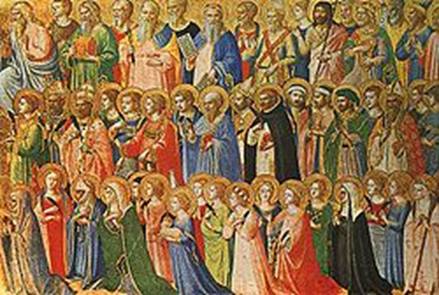
Today is All Saints Day - a day to remember people who have followed Jesus especially well. Nazarenes donʼt usually celebrate All Saints Day, but weʼre missing out.
All Saints Day is an important part of Christian tradition, and it was actually John Wesleyʼs favorite day of the church year. All Saints Day is a great opportunity for us to remember the “great cloud of witnesses” who have gone before us (Hebrews 12:1).

Listen to how John the Revelator describes this great crowd in his vision of
heaven in Revelation 7:9-17.
 9 After this I saw a vast crowd, too great to count, from every nation and tribe and people and language, standing in front of the throne and before the Lamb. They were clothed in white robes and held palm branches in their hands. 10 And they were shouting with a mighty shout,“Salvation comes from our God who sits on the throne and from the Lamb!”
 11 And all the angels were standing around the throne and around the elders and the four living beings. And they fell before the throne with their faces to the ground and worshiped God. 12 They sang,
   “Amen! Blessing and glory and wisdom and thanksgiving and honor
   and power and strength belong to our God forever and ever! Amen.”
[3] 13 Then one of the twenty-four elders asked me, “Who are these who are clothed in white? Where did they come from?”
 14 And I said to him, “Sir, you are the one who knows.”
   Then he said to me, “These are the ones who died in the great tribulation. They have washed their robes in the blood of the Lamb and made them white.
 15 “That is why they stand in front of God’s throne and serve him day and night in his Temple.   And he who sits on the throne will give them shelter.
 16 They will never again be hungry or thirsty; they will never be scorched by the heat of the sun.
 17 For the Lamb on the throne will be their Shepherd.  He will lead them to springs of life-giving water. And God will wipe every tear from their eyes.”


There will come a time, when we will stand with the saints from every tribe and language and culture and time - all those who have ever trusted in the Jesus as the Lamb of God. Together we will sing praises to God. We will be one people, healed together by his love.

All Saints Day is a day to practice this corporate worship and unity now - here on earth. We stand today with the saints of Africa, Asia, Europe, Oceania, and the Americas. We stand today with the saints of the first humans, the first Israelites, the first Christians, the Middle Ages, the Reformation, the Industrial Age, our own time, and all times yet to come. Together, we are Godʼs people. Together, we worship him. Together, we learn what it means to follow him.

Today, as part of our study of our Nazarene Heritage, we are focusing on the two most important saints in our history: John Wesley and Phineas Bresee. As we talk about these two leaders and how God used them, my prayer is that we will catch some of their passion and let God use us in similar ways.