Showing posts with label isaiah. Show all posts

Saturday, September 29, 2012

Sabbath Revolution (Isaiah 56 & 58)


Let’s step back in time 500 years to the year 1512.  Look up with me into the sky?  What do you see?  You see the sun moving across the sky, from east to west.  Move 12 hours forward to night time.  What do you see now?  You see the stars and planets moving across the sky, again from east to west.  What is the most stable, most durable, least movable, physical thing you know?  The earth.  It was patently obvious to everyone 500 years ago that the earth is the stable center of the universe, and the sun, the moon, and all the stars and planets revolve around the earth.  This was so obvious that there was no argument.  Just look up.  How could it be any other way?
Then, there was this pesky astronomer named Nicolaus Copernicus.  He looked up and looked up and looked up, and he just couldn’t make sense of what he was seeing.  The patterns of movement for the sun, the planets, and the stars just didn’t make sense.  Finally, just before he died in 1543, he published an “earth shattering” book called: On the Revolutions of the Heavenly Spheres.  He argued that the whole world had been wrong.  
Even though we can look “up” and see what seems like the sun moving, it isn’t.  We’re the ones moving.  The earth and all the planets actually revolve around the sun.  It’s like when you’re sailing down a river and the trees on the bank look like they’re moving.  This started the Copernican Revolution which completely changed not only our understanding of astronomy but also our understanding of the world and our place in it.  Copernicus was one of the chief sparks of the scientific revolution that is still happening today.
But what most people don’t know is that Copernicus was not the first person to propose this theory.  Someone else beat him to it - by almost 2,000 years.  In the 3rd century BC, Aristarchus, an ancient Greek astronomer, suggested that the sun is fixed and earth is one of many planets revolving around the sun.  Almost without exception, he was shamed and condemned for promoting scientific foolishness and theological heresy.  What would have happened if people had doubted what seemed “obvious” to “everyone” to consider the possibility that the universe might work in more mysterious ways?  How would our world be different?
Let me describe another prevailing world-view.  More work = more productivity.  More activity = more happiness.  More study time = better grades.  Better grades = a better life.  More status = more satisfaction.  More success = a better life.  More stuff = a better life.  More pleasurable experiences = a better life.  Basically, quantity = quality.   Success, status, stuff, and pleasure are the keys to a good life.  And the more the better.  This is the prevailing view of our world.  It is “obvious.”  Just look up.  Just look at the stars and the rich people and the geniuses.  They’ve got it made.  It’s obvious.  

Thursday, December 8, 2011

The Gospel of Restoration - Isaiah 61


             Hello.  My name is Josh, and I’m an alcoholic.
             I’m a porn addict, a compulsive gambler, a smoker, and a semi-regular crack user.
             I’m a shopaholic, workaholic, me-aholic.
             I’m the child of abusive parents, and now I’m a codependant adult.
             I beat my wife, and I’m more than $100,000 in debt.
             I am a rape victim, and I’m a sexual abuser.
             I’m grieving the loss of a loved one.
             I’m a racist, a legalist, a moralist, and a recovering hypocrite.
             I am depressed and lonely. 
Sometimes I have thoughts of suicide.  I may even have a plan.
I look like I have a lot of friends, but really I have a very hard time developing meaningful relationships.
I’m struggling with problems with my parents, and my marriage is falling apart.
I’m obsessed with my looks, and I have an eating disorder.
I’m addicted to the internet, and I am a flagrant procrastinator.  Not a good combination!
I have deep resentment and hidden anger.
I am addicted to romance.
My life is dominated by anxiety.
I use profanity often – especially when I’m not at church.
I can’t stop gossiping, no matter how many times I tell myself I’m going to stop.
I’m beginning to lose hope in God.
I am actually an athiest.
I doubt everything all the time.
I value achievement more than love.
I’m struggling to become the person God wants me to be, and I’m beginning to give up.
I’m sick and tired of being sick and tired.
I am lost, captive, blind, despairing, mourning, helpless, and hopeless.
I am broken.  I am a sinner.

Some of these are true of me.  All of these are true for someone in this room.

Thursday, November 24, 2011

Feeling our Prayers - Isaiah 63-64

   Every single person I know has struggled with prayer at some time.  Most people I know struggle with prayer most of the time.  Praying can be hard.  Someone told me last week that he has just about given up on prayer.  Most people say they wish they had more time to pray, but most people don’t seem particularly interested in actually spending more time in prayer.  When it comes right down to it, most of us would rather do most other things.  If you have ever struggled with prayer or with not praying, you are not alone.  Most people are like you.

   We are entering the Season of Advent.  This is a season of waiting.  We are waiting in three ways. 
  • We’re waiting symbolically with the people of the Old Testament for Jesus, the Messiah to come.  We’ll celebrate Jesus’ coming at Christmas time.
  • We’re waiting for Jesus to come again and make our world right.
  • We’re waiting for God’s coming and action to be more fully present in our world and in our lives.
    In the midst of all this waiting, prayer can be hard.  When I graduated from university, my Aunt Sue gave me a book by one of America’s greatest philosophers: Dr. Seuss.  It’s called O, the Places You’ll Go.  Dr. Seuss describes life as this long journey of ups and downs, celebrations and failures.  But one stage of life is often “The Waiting Place”:
        a most useless place … 
        … for people just waiting.
        Waiting for a train to go
        Or a bus to come, or a plane to go
        Or the phone to ring, or the snow to snow
        Or waiting around for a Yes or a No
        Or waiting for their hair to grow.
        Everyone is just waiting. 

Tuesday, November 1, 2011

Nazarene Heritage Week 2: Wesley and Bresee (All Saints Day)


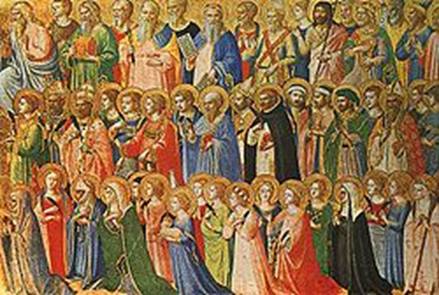
Today is All Saints Day - a day to remember people who have followed Jesus especially well. Nazarenes donʼt usually celebrate All Saints Day, but weʼre missing out.
All Saints Day is an important part of Christian tradition, and it was actually John Wesleyʼs favorite day of the church year. All Saints Day is a great opportunity for us to remember the “great cloud of witnesses” who have gone before us (Hebrews 12:1).

Listen to how John the Revelator describes this great crowd in his vision of
heaven in Revelation 7:9-17.
 9 After this I saw a vast crowd, too great to count, from every nation and tribe and people and language, standing in front of the throne and before the Lamb. They were clothed in white robes and held palm branches in their hands. 10 And they were shouting with a mighty shout,“Salvation comes from our God who sits on the throne and from the Lamb!”
 11 And all the angels were standing around the throne and around the elders and the four living beings. And they fell before the throne with their faces to the ground and worshiped God. 12 They sang,
   “Amen! Blessing and glory and wisdom and thanksgiving and honor
   and power and strength belong to our God forever and ever! Amen.”
[3] 13 Then one of the twenty-four elders asked me, “Who are these who are clothed in white? Where did they come from?”
 14 And I said to him, “Sir, you are the one who knows.”
   Then he said to me, “These are the ones who died in the great tribulation. They have washed their robes in the blood of the Lamb and made them white.
 15 “That is why they stand in front of God’s throne and serve him day and night in his Temple.   And he who sits on the throne will give them shelter.
 16 They will never again be hungry or thirsty; they will never be scorched by the heat of the sun.
 17 For the Lamb on the throne will be their Shepherd.  He will lead them to springs of life-giving water. And God will wipe every tear from their eyes.”


There will come a time, when we will stand with the saints from every tribe and language and culture and time - all those who have ever trusted in the Jesus as the Lamb of God. Together we will sing praises to God. We will be one people, healed together by his love.

All Saints Day is a day to practice this corporate worship and unity now - here on earth. We stand today with the saints of Africa, Asia, Europe, Oceania, and the Americas. We stand today with the saints of the first humans, the first Israelites, the first Christians, the Middle Ages, the Reformation, the Industrial Age, our own time, and all times yet to come. Together, we are Godʼs people. Together, we worship him. Together, we learn what it means to follow him.

Today, as part of our study of our Nazarene Heritage, we are focusing on the two most important saints in our history: John Wesley and Phineas Bresee. As we talk about these two leaders and how God used them, my prayer is that we will catch some of their passion and let God use us in similar ways.

Friday, July 8, 2011

Eschatology: Rapture or Restoration?

    We humans have a love-hate relationship with eschatology.  Eschatology is the study of the end.  What will happen at the end of the world?  What comes next? 
    On one hand, we seem to be irrevocably drawn to the apocalyptic, end-of-the-world stuff, especially in movies.  apocalypticmovies.com lists 61 apocalyptic movies since the year 2000.  In his article, “It’s the End of the World, and We Love It,” Mark Moring says, “We are divinely wired to wonder what comes next.”1
    Every now and then, this deep hunger for knowing the future leads people to make some outrageous claims.  Just a few months ago, an 89 year old American radio guy named Harold Camping hosted a huge campaign - with public billboards, radio slots, news footage, and mobile bus advertisements - saying Jesus was coming back at exactly 6 p.m. on May 21, 2011.  Obviously, that didn’t happen.
    That kind of error-based fear-building has given many people a distaste for eschatology.  Many of us would rather just put our heads down and live today, one day at a time.  Some folks just want to forget the future.
    But eschatology is still really important.  It’s the closing chapter of our human story.  In fact, nearly all of the New Testament - and really the whole Bible - is forward looking.  From the Biblical perspective, the future is holding our hand and pulling us into its reality.  
    The problem with understanding the future is that it isn’t here yet.  As much as the Bible is forward-leaning, as much as Christianity views us as being pulled into the future, there aren’t many details. 
   
    Christians are deeply committed to the future, though.  We have a few absolute beliefs about the future.  ...

To continue reading this post, click here.

.