Showing posts with label Nazarene. Show all posts

Wednesday, July 9, 2014

Renovating Holiness: Helena the Hedgehog and Holiness (Janel Apps Ramsey)

This essay is part of the Renovating Holiness Project.  Janel Apps Ramsey is a staff member at Bloom Church Denver.  She graduated from NTS with an MA in Theological Studies.  She loves exploring topics of women and church, wholeness and healing, and techno music.  She lives with her husband Baird, cats Yao and Ty, and Helena the Hedgehog.  She loves waking up and seeing mountains every single day.

Photo Credit:

    The community where I serve expresses its vision as “cultivating gardens of resurrection.”  To explore this idea more fully, I’d like you to meet Helena the Hedgehog. A hedgehog is a softball sized insectivore with short sharp spines on her back and sides.  They have a soft furry underbelly and an expressive face with a cute button nose that wiggles from side to side.  Hedgehogs, in their native habitat, live in gardens and hedgerows in several parts of the world.
    Helena lives in a cage in the corner of my living room.  In a perfect world, I could train Helena to live in my garden during the summer and then bring her inside to protect her during the winter and spring.  (They hibernate and often die in the cold.)  But unfortunately, when she does what she was created to do, she isn't really thinking about the fact that I want her to stay only in my patch of garden.  Helena was created to tend the garden at large to help make all things new.
    Stewardship is in her DNA.  Eating bugs, stirring up the soil, and protecting the garden are all things she does naturally.  She is a kingdom creature, cultivating what is given to her.  However, when my cats want to play with her, or when she sees an arm come over her like the shadow of a bird, she takes a defensive posture.  She immediately curls up into a ball and puffs out her quills.  In this defensive posture, safety means keeping everything else out.
    For Helena, vulnerability comes when she is doing what she was made to do.  Moving around in the garden means that her belly is exposed and her defenses are down.  A few weeks ago, I let her out to roam the yard.  She was SO excited.  She walked the entire fence line, rambled through the raspberry bush, and foraged through the grass.  In her excitement, she got a little cut on one of her legs,which she barely even noticed.  I had to keep an eye on it the next few days and make sure she was okay.
    If I just put her in a cage with food, water, clean bedding, and a wheel to run on, she would be well taken care of.  But if I never picked her up and played with her, or let her run around outside, she would get bored, which would lead to several negative behaviors.  When bored with the world, hedgehogs will self-harm.  To release their energy and frustration, they will gnaw on their feet, sometimes until they can’t walk.  Second, if they get suspicious and paranoid, they will stop allowing you to tend to their needs.  From rolling into an indistinguishable ball of prickles to head-butting you when you are trying to care for them, they can become extremely difficult to interact with.  Even though I am trying to help her, to trim her nails so she can move around better, she butts me out.

Tuesday, June 17, 2014

Renovating Holiness: Empowerment in Holiness and Feminism (Deanna Hayden)

    I set down the phone, dropped my face in my hands and slowly let the tears fall.  As my husband sat nearby, holding our baby boy, he waited for me to settle down enough to explain.   A year before, I had felt the Lord’s call on my heart to become a senior pastor.  Following months of communicating with districts around the country, I had finally interviewed.  The leadership of the church had been enthusiastic toward me, and - even as the voices of some were raised questioning the validity of having a female pastor - my responses seemed well received.  Several people told me they expected favorable congregational vote.  After the vote, however, those questioning voices had carried enough weight to turn down my opportunity to come as their pastor.  The apologetic phone call informing me of the decision left me heartbroken and confused.
    In a holiness denomination that has ordained women since its inception, how could women be refused the opportunity to fulfill their call simply because of their gender?  And from a broader perspective, what is it in the soul of the Church that seems inclined to deny the full equality of men and women?
Can the call to a life of holiness speak to the work of feminism? 
Are they two contrasting theories, or might they relate to each other?

Photo Credit: World Bank Photo Collection


Feminism Defined
    Simply defined, feminism is “the theory of the political, economic and social equality of the sexes.”  Looking through theological and biblical lenses, we could add “religious” to the categories of equality advocated by feminism.  In a variety of cultures, this term has taken on negative connotations.  Within religious circles including some areas of Christianity, feminism is often assumed to have specific political agendas, and is quickly written off as being irrelevant and even oppositional to a life of Christian faith.  The work of feminism is then something to be ignored, if not opposed.

Wednesday, March 5, 2014

Renovating Holiness: Contributions Round 5

Photo by morganlevy

We now have more than 130 confirmed contributors to the Renovating Holiness Project.  Having inherited our grandparents' theological house which desperately needs updating, we are faced with three options: resentment, rejection, and renovation.  Nazarenes from around the world (from at least 24 countries) are joining together to revision sanctification for our world and our time.
Here are the next round of introductory submissions.  Enjoy.

To read the previous submissions, click here: Round 1, Round 2, Round 3, Round 4.)

Ryan Quanstrom (Pastor, North Carolina)
Entrepreneurialism as Holy Living
I would be working off of Wendell Berry's The purpose of a Coherent Community and some work done by Peter Storey. Holy people don't let broken systems sin for them. We need people to be righteous with their purchases to do that, they need entrepreneurs. 

Janary Suyat de Godoy (Pastor & Asia-Pacific NYI Coordinator, Philippines)
Holiness and Small Groups
Is holiness an individual pursuit? I have been a part of a traditional church in my growing up years and was taught to go to church, attend all the services and programs, sit in Sunday school classes and have my personal devotional time. It is just in the last 5 years that I have been involved in small groups, and have experienced the richness it has brought to my understanding and pursuit of holiness.
My essay intends to present an understanding of holiness in a small group setting, that holiness is not just an individual affair, but something we share.

Arseny Ermakov (Booth College, Australia) 
Separation or Presence? Reimagining the Biblical Theology of Holiness
Holiness in the Bible is traditionally defined through the terminology of ‘separation’ or ‘withdrawal.’ This has a profound effect on the understanding of God (as unapproachable “Other”), the Church (as separate from the world) and the practices of sanctification (emphasizing withdrawal from the wider society and culture). 
I would like to suggest that separation is not a primary meaning of holiness in the Scripture. Depending on the context, holiness in the Bible may refer to power, glory, wholeness, perfection, goodness, morality, being set apart, and life. Moreover, holiness in the Scriptures has never been equated with God’s withdrawal or absence. On the contrary, holiness constantly indicates the presence of God in the human or heavenly realm. 
I strongly believe that in order to restore the balance in our theological universe, we ought to see holiness primarily as a concept of presence rather than one of withdrawal. This paper will demonstrate that holiness as powerful, contagious, transformative, and inclusive presence could be found in both Old and New Testaments. This notion of holiness forces us to reimagine the identity and the mission of the holy people of God in the modern world. We would have to move away from a static category of status of separation to a more dynamic and dialectical concept of holiness that embraces both notions of presence and being set apart.

Wednesday, February 19, 2014

Renovating Holiness: Discovering the Values of Holiness [Grant Zweigle]


This is the first full essay submitted to the Renovating Holiness Project.

Grant Zweigle pastored in Kansas City, MO; Seattle, WA; and currently in Vancouver, BC, Canada. Grant and his wife Aisling are relocating to Manila, Philippines with their two boys in 2015. Grant is completing a Doctor of Ministry at Nazarene Theological Seminary. 


  My grandmother lived in a German Mennonite Brethren community in Southern Russia as a young girl. When her parents immigrated to Canada they made their new home in a German Mennonite Brethren community in Yarrow, British Columbia. My grandmother learned some English in school, but spoke German at home and in church. Her family maintained their cultural distinctiveness in their new home, even as they adapted to a new way of life in Canada.

  My mother spoke some German in home and in church, but English was her first language. Her parents brought her up in the German Mennonite way, but as a young adult she forged her own way and more fully embraced the life and culture of Canada than her parents did.  

  My mother never spoke German to me. When I was 2, my Canadian mom and American dad moved to the United States. I am culturally an American and an English speaker. I tried studying German in high school and college, but it didn’t stick. I’ve always known my ancestry is German Mennonite with a Canadian flavour, but it didn’t seem to have much bearing in my everyday life.

  Eight and a half years ago, I moved back to Canada to pastor First Church of the Nazarene in Vancouver, British Columbia, Canada. Since coming back to Canada, I’ve been able to spend more time with my grandmother who is now 95. When I visit my grandmother, she shares stories with me about her childhood in Southern Russia; about why and how her family came to Canada; and about the joys and struggles of making a new life in a new land.

  Over the course of her lifetime, my grandmother has learned to adapt to the cultural changes taking place around her. Some of these changes were forced upon her, but some she willingly embraced. As I’ve listened to her stories, I’ve discovered that many of the values that are dear to my grandmother are dear to me as well. Some of these values transcend culture. These include hospitality, generosity, stewardship, courage, diligence, faith, hope and love. As a dad, I now want to instil these values into my two boys. I like to take my boys to visit their great-grandmother so they can hear her stories and be inspired by the values that have shaped our family.

  Our spiritual grandparents and great-grandparents in the Church of the Nazarene had to adapt to cultural changes taking place around them. Some of these changes were forced upon them, while others they willingly embraced. As the spiritual grandchildren of these holiness pioneers, we would do well to listen to their stories, and in doing so we might discover values that we can embrace and pass on as well. 

     Vancouver First Church of the Nazarene is a traditional Nazarene church in the midst of a rapidly changing urban context. Many of the core members of our church are of that generation of spiritual grandparents who lived a life of holiness in the midst of changing and challenging circumstances. 

Monday, February 17, 2014

Renovating Holiness: Contributions Part 4

Photo by Want2Know
We now have more than 100 confirmed contributors to the Renovating Holiness Project.  Having inherited our grandparents' theological house which desperately needs updating, we are faced with three options: resentment, rejection, and renovation.  Nazarenes from around the world (from at least 16 countries) are joining together to revision sanctification for our world and our time.
Here are the next round of introductory submissions.  Enjoy.

To read the previous submissions, click here: Round 1, Round 2, Round 3.)

Oswald Vidal Cole (Pastor, Sierra Leon)
In my essay I will be sharing about how Christians understood holiness or what holiness meant to them in the days when evangelical Christianity was still in its early stages in our country (Sierra Leone). I will proceed to share how the concept of holiness also seemed to have disappeared on the scene because of other emphasis on different theological concepts. I will then share the present perspective and interest of Christians on the holiness concept and where this concept stands today in the church in our nation. I will not just share the perspectives but I will also shed light on certain happenings that led Christians to come the said perspectives and conclusions on this concept.

Frank Mills (District Superintendent, Ghana)
I want to talk about the way our holy God expects His ‘holy’ children to handle the injuries caused by the decisions and actions of others…whether caused by people within the church or outside the church. We still have many people within the church who are struggling with the practicing of true forgiveness of sins trespassed against us. There are Christians who still nurse their wounds because the wounds are so deep that they find it very difficult to let go of it. I will talk more on the biblical way of handling injuries caused by others. 
The above topic is my favorite because it all flows out of my past personal struggles and experiences and I have always wanted an opportunity to put it into writing for the sake of others who currently struggle with similar challenges.

Deanna Hayden (Pastor, Missouri)
While the topic of feminism has been at the forefront of our culture for decades now, it can sometimes be a taboo topic within the Church.  To broaden the idea a little, the concept of being “politically correct” is approached by many Christians as tongue-in-cheek at best, and completely absurd at worst.  We are sometimes comfortable supporting areas of feminism like equal rights in voting or education, but when we approach feminist theological topics like egalitarianism, female ministers, or even the feminine characteristics of God, our fundamentalist tendencies might tempt us to close ourselves even to conversation about it.  Our Wesleyan-Holiness theology not only calls us to open ourselves to this conversation, but to name it as valuable and vital to our faith.

Monday, February 10, 2014

Renovating Holiness: Contributions Part 3

Photo by Houstonian
Introductory essays for the Renovating Holiness project keep rolling in.  For the third installment today, notice the increase in ladies and international contributors.  (See other contributions here and here.)

Lori Ward (Pastor/Teacher, South Korea)
I’d like to write about holiness expressed through hospitality.  We are invited by Christ to open ourselves in vulnerability, welcome, and service to others.  When we welcome the stranger, when we share a meal, when we open our homes, when we are present with others in celebration and suffering, we engage them with the love of Christ.  The work of Christ in us enables us to lower our guard and to invest our lives intimately with others, especially those who live in the margins.  Holiness expressed through hospitality does not set us up as proprietors, but as hosts—broken and consumed by those we love and serve, that we may embody the presence of Christ in our world.

Steve Walsh (Pastor, Australia)
Using the insights provided by Floyd T. Cunningham's Holiness Abroad: Nazarene Missions in Asia, as well as the research found in J Fred Parker's Mission to the World: A History of Missions in the Church of the Nazarene Through 1985, and Cunningham's Our Watchword & Song: The Centennial History of the Church of the Nazarene, my essay would seek to examine the relationship between our emerging contemporary understanding of the theology and experience of entire sanctification and the international and intercultural dissemination of our distinctive message by endeavoring to answer the question "What might Hiram F Reynolds say to the Church of the Nazarene today?"  Reynolds addressed the concerns of his contemporaries who worried about "doctrinal confusion, and a low standard of experience" in churches planted on foreign mission fields, which would lead the church to be ashamed to call its progeny  "Nazarene". I believe this parallels concerns especially of the American church as the denominational demographics change dramatically. The essay would consider the tensions between missional strategies aiming at both the indigenisation and internationalisation of the Church of the Nazarene as it wrestles with the forces of globalisation and localisation. From its inception, the Church of the Nazarene was both "missionary-oriented and American-centered"The pragmatic Reynolds, one of the founders of the Church of the Nazarene, and the architect of early Nazarene mission policies and strategies, who maintained  that "the work and manifestations of the Holy Spirit are practically the same in all countries" has much to say to the Church of the Nazarene today on such issues as contextualisation of theology, holistic ministry, and missional strategy.

Jason Robertson (Olivet Nazarene University)
Over the past year I’ve been contemplating our tradition’s emphasis on the “radical optimism of grace.” This notion made sense at the turn of the 20th century when optimism was woven through the fabric of American society. But does it work for a generation that is not given an optimistic outlook on most areas of life? “Optimism” is an anemic notion better suited for the social sciences. Millennials and Xers have to fight to be optimistic about the future, and older generations seem more optimistic about days gone by. From my experience those who are most passionately teaching radical optimism are hardly optimistic about the direction our world is going. The disconnect for their younger audience is obvious. I think our tradition needs to recover the robust, biblical notion of hope. Hope draws us into the future with expectation of something better for the world, as well as our own souls. I would make a distinction between hope and optimism and then suggest the holiness tradition should recapture the essence of hope as a lived reality in light of God’s kingdom, past, present, and future.

Tara Smith (Pastor, Indiana)
I would like to discuss holiness as participation in the life of God.  When Nazarenes recall that the word "holy" means "to be set apart," we still struggle to understand what this could possibly mean concerning a human life.  So we fall short in our practical application:  to be holy is to be particularly good at following rules; to be holy is to be counter-cultural; to be holy is to love slightly better (more often?) than the average person.
It's my suggestion that we apply the word holy quite literally to God, who is something other than we are; i.e., set apart.  To "be holy as [God] is holy" is to participate in God's life.  This may mimic the rule-following, counter-cultural-operating, optimal-loving lifestyle, but its source is never any of those things.  Rather, the source of holiness is only ever God, and thus our stake in it only ever our participation in the divine life.  

Friday, February 7, 2014

Renovating Holiness: More Early Contributors

"Old House in Bucharest" by Apollinaire Zdrobeala
Renovating Holiness is a joint project in which 100+ Nazarenes from around the world are revisioning our doctrine and practice of sanctification.  So far, we have 44 confirmed contributors from 12 different countries and about as many universities.


For today, feast your eyes on these introductory submissions.

Michael Scarlett (Pastor, Texas)
I propose an essay on revisioning sanctification through the lens of baptism. We are marked by our baptism with a new identity--a holy identity. From that moment, much like the people of Israel and Gilgal, we have a reference point that marks our entry onto a new map. The holy life is one that continually lives from, lives by, lives in, and lives out one's baptism. Baptism and our daily dying and rising to new life elevates both baptism and sanctification in the common life of the church. Baptism is also the point at which we are set apart for our co-mission (The church is co-missioned with God) of the ministry of reconciliation.

Greg Crofford (Missionary, U.S.A. / Africa)
Holiness as Liberation: A Perspective from Africa
The doctrine of holiness has always had a place for the concept of freedom from sin. God in Christ - and through the abiding presence of the Holy Spirit - has broken the chains that bind us. As Wesleyan-Holiness denominations have worked in Africa, the theme of liberation has been one way of preaching holiness. This makes sense, since the history of Africa entailed a centuries long chattel slave trade and the throwing off of colonial oppression in the last half of the twentieth century. 

Wednesday, February 5, 2014

Renovating Holiness Project: Early Responders

Photo by GenBug.
This week Thomas Oord and I announced (here and here) that we are launching the Renovating Holiness Project.  We are inviting Gen-X and Millennial Nazarenes from around the world to revision sanctification with us.  We have inherited the doctrine of sanctification from our grandparents and great grandparents.  In order to make this theological structure work for our friends and children, the whole house needs major renovation.
We thought you might be interested in some of the introductory essays from the contributors who have responded already.  Not a bad turn out after just a few days.  Enjoy.

Erik Groeneveld (Netherlands/Australia):
The topic of my doctoral thesis is 'a practical application of a Wesleyan theology of love in decision making processes' (working title). I build my thesis on Tom Oord's approach of love and on the Government Network Theory (GNT) I came across during my Masters of Public Administration. What Essential Kenosis and GNT ties together is a relational way of decision making, instead of top-down decision making. In GNT-language, the pastor (as representative of the church board) should take on a position of 'network manager', embedded in the congregation, intentionally engaging with different voices and opinions to take these into account when a decision needs to be made. 
My field research among the Australia and New Zealand clergy shows that too often church boards or pastors consider themselves capable enough to take decisions, leaving out opinions and feelings of the congregation. Obviously, in the end the church board needs to take a decision. But my hypothesis is that when the congregation had the opportunity to engage in the process leading up to the decision, they feel acknowledged and valued. It is an expression of love when this opportunity has been given intentionally and not randomly. 
My idea is to leave out the technical language in the essay and spice it with some interesting quotes (anonymously of course) from pastors I interviewed.

Ryan Giffin (Pastor & PhD candidate, Kentucky)
I would like to explore Paul’s theology of holiness as simultaneously individual and communal, and the potential his theology has to renovate our understanding of holiness in a way that is more faithful to the teaching of the NT and more sensitive to the world of Millenials and Gen Xers. Historically the Church of the Nazarene has emphasized individual aspects of holiness. While crucial, Millenials and Generation Xers are more interested than previous generations in relational and communal aspects of holiness. Paul’s theology holds both together in ways that honor our past and embrace our present.

Rick Lee James (songwriter, Ohio)
I would love to write about how the monastic tradition informs our discussion of sanctification? Thomas Merton has been a real influence on my understanding of holiness through books like 'No Man Is An Island', 'Contemplative Prayer', and 'Life and Holiness.' There is a real communal understanding of holiness in Merton's writings which is directly passed down from his monastic roots that I find helpful to the discussion of holiness for the Nazarene Church today. 

Tuesday, February 4, 2014

Renovating Holiness: Millennial and Gen-X Nazarenes Revision Sanctification

   Imagine that you inherited your grandparents' house.  The only condition is that you have to actually live in the house.   Your grandparents, whom you love, have lived in the same house for going on sixty years.  This simple abode holds an infinite amount of family memories.  
Tim Stanley Photography
   And yet, if you are going to live there, you'll have to make it your own.  The vinyl arm chair that is permanently imprinted with the shape of your Grandpa's posterior is not something to keep for posterity's sake.  Although the massive old faux-wood-boxed TV faithfully cranked out Wheel of Fortune at 6:30 for decades on end, it too will have to go.  
   But the furniture is just the beginning; the whole interior desperately needs to be updated.  12 inch pink flowers on the bathroom wallpaper may have been "snazzy" in the 70's, but now it just makes you feel like Pepto Bismol had a fight with the Easter Bunny.  New paint and new carpet are a must in every room.
   However, we haven't even started talking about the real improvements.  The whole house could use some basic environmental updating.  The windows leak air like a sieve.  (Maybe that's why Grandma always had that nappy afghan and two cats on her lap?)  The wood furnace is literally a fire trap.  And there's a spongy spot on the floor near the back porch where water has been seeping in every time they got a good rain.  
   The kitchen and dining room were designed for a time when meals were formal affairs with fine china.  Your family prefers an open kitchen/dining/living room, so a couple of walls will have to go.
   Furthermore, Grandpa sure saved a lot of money by doing the work himself when he added the extra bedroom in '69, and again when he built himself "Grandpa's workshop" in '83.  But the additions are showing their age, especially around the seems where the sheetrock is starting to turn brown because of some leaks.
   Don't get me wrong.  You're grateful for the house and all of the family heritage that goes with it.  It's just that Grandma and Grandpa didn't see that their house was deteriorating on pace with their bodies.  They didn't seem to notice that wonky faucet in the bathroom because they had lived with it for 30 years.  But if you are going to live there, you'll have to bring the house into the 21st century.  The challenge for you is to reshape the family history so that it can be a working home for your family.

   This is essentially the challenge facing younger Nazarenes.  We have inherited a doctrine of sanctification that our grandparents built.  

Tuesday, July 9, 2013

Nazarenes and Inerrancy (David Brush)

My friend David Brush was asked to reflect on the Church of the Nazarene's recent decision to maintain a middle-ground stance on Biblical inspiration as  a guest post on a big evangelical blog (Patheos, hosted by Scott McKnight).


Within the evangelical protestant movement there is a pull to increase the contrast within our articles of faith (statements of belief) so that there is little room left for nuance along the edges. In most protestant and evangelical denominations there is a clearly defined article regarding scripture, and specifically the inerrancy of scripture. The fervor over these kinds of clearly bounded definitions is continuing to rise as conservative and fundamentalist ideals react to the loss of influence in the western cultural arena. The struggle and contention within the protestant mind, and regarding the inerrancy of scripture specifically, is in how we qualify the word inerrant.
In 2009 a group put forward a resolution at the General Assembly of the Church of the Nazarene that would alter their article of faith by changing the statement on inerrancy from, “inerrantly revealing the will of God concerning us in all things necessary to our salvation,” to, “inerrant throughout, and the supreme authority on everything the Scriptures teach.” The assembly referred the motion for change to the scripture study committee in order to provide a response and recommendation at the 2013 assembly of the denomination. The committee released the report and recommendation ahead of the June 2013 assembly. In the report the committee recommended that the article of faith on Holy Scripture remain unchanged, and in it they also responded specifically to why it should remain so.

Friday, June 28, 2013

Nazarene General Assembly 2013 - Recap

Dramatic blessings.  Quiet blessings.  God gave both as Nazarenes gathered in Indianapolis for our once-in-4-years celebration and governing session we call General Assembly.
On the side of quiet blessings, three stand out to me.
  • We refused to step backward into fundamentalism.  Several resolutions were proposed that would have pulled us toward the radical right.  However, our leaders wisely chose to maintain the center ground.
  • We did lots and lots of healthy networking and meeting.  Getting loads of leaders together in the same place at the same time allows for all kinds of discussion and planning that isn't normally possible.  On my last day, for example, I talked with leaders from Bangladesh and Mozambique about the possibility of partnering with our church in our work with www.freethegirls.org.  Both groups were very positive.  They are going to do some research and get back to us.
  • We approved simultaneous multi-site general assemblies.  This will probably be the last general assembly with only one site.  In the future, we'll have once central site and extension sites all around the world.  This will save millions in travel costs and will enable the vast majority of our international delegates to participate (many of whom are denied visas to the USA).  Most likely, North American delegates will never be in the majority again (and rightly so).  This resolution passed without much discussion or fanfare, but it is the most significant change for the Church of the Nazarene in my memory.

Tuesday, June 25, 2013

Nazarene General Assembly - Day 6


The official business meetings for General Assembly opened Monday with almost an hour of prayer in small groups.  Delegates and visitors gathered in groups of 5-10 with GS’s giving prayer prompts about every five minutes or so.  


From a legislative perspective, some of the most significant decisions of the day were as follows.
  • We rejected a proposal to change General Assembly to once every five years, rather than once every four years.  It seemed that most people feel like (a) General Assembly is so important for our church as to justify the cost and time of doing it every four years, and (b) Changing the cycle to every five years would slow an already painfully slow global decision making process.
  • We approved a proposal to allow simultaneous sites for future General Assemblies.  As many as 50% of international delegates are unable to obtain visas to visit the USA, so this would greatly increase our international participation to more accurately represent every member of our church.  Also, it would significantly decrease travel costs.  The sites will all be linked via video and internet (and probably by technologies that don’t even exist yet).  
  • We rejected a decision to reduce the size of the General Board to about 30 instead of 50, based on increasing the ratio of General Board members to church members.  (Currently each region gets one General Board member for every 100,000 members.  The proposal was to change this to one delegate for every 150,000.)  This would have decreased the total number of delegates for every region except Africa.  However, because the proposal also combined USA/Canada into one region, it would have decreased the North American representation to 10 from 20.  This would have been proportionate, but I’m guessing this may be why the proposal failed.
  • Also, we decided that churches should give their pastors a sabbatical during their seventh year of ministry instead of after their seventh year.

Of course, there were other actions taken or rejected, but these were most important.

The other drama of the day centered naturally on the General Superintendent election process.  In the Church of the Nazarene, there are six General Superintendents, who serve until a mandatory retirement around age 67 or voluntary retirement previously.  Standing GS’s are re-elected by a yes/no vote.  As far as I know, no GS was ever voted out of office.  (If anyone knows differently, please speak up.)  This quadrennial (Yes, that’s the weird name for meetings that happen every four years.) we have two retiring GS’s, so we are electing two.  

Saturday, June 22, 2013

Nazarene General Assembly - Day 3


More workshops and more networking and of course more worship.
The day started for me with a workshop called, "Holiness in the 21st Century," with Dr. Carl Leth of Olivet Nazarene University.  A few highlights:
  • In recent years, unfortunately, the doctrine of holiness has more often been a place of controversy and struggle rather than proclamation and blessing.
  • The process and crisis debate has immobilized us unreasonably.  Process people believe in crisis, and crisis people believe in process.  A difference in emphasis shouldn't either freeze us or turn us against each other.  
  • We need to recapture the scope of holiness as involving the whole mission of God, redeeming and reordering our broken world.
  • Holiness is good news.  God can break in, ANYWHERE ANYTIME TO DO ANYTHING FOR ANYBODY.

Thursday, June 20, 2013

Nazarene General Assembly - Day 2

Everybody showed up today.  The workshops were out in full force and the delegates and representatives from around the world were finally settled in and active in the convention center.  I met friends from Bangladesh, Korea, Italy, Russia, European Nazarene College, MidAmerica Nazarene University, Nazarene Theological Seminary, and even an old girlfriend from Louisiana!


Most of the day consisted of morning to night workshops for me.   I learned a lot at each workshop, and I was able to make connections with some of the speakers for the possibility of working together in the future.  Here's a brief highlight from each workshop:

  • Missional Partnerships: The Church of the Nazarene finally carved out a specific position for a missional partnership coordinator.  This is a huge step forward in facilitating long-term transformational missional partnerships.   (To read more about partnerships, go to David Wesley's blog.)
  • Human Trafficking - Awareness: The average age a girl is first raped for profit is 12!  Trafficking is rampant around the globe, even in the US, even in rural communities.  (To read more, check out ONLY12.)

Wednesday, October 24, 2012

Retro Poem #17: Nothing Words


That was a nothing voice
That spoke in a nothing way
When it spoke to me about holiness.
They were nothing words 
Because I did not believe
I did not believe it was possible 
To live the kind of life
They proclaimed.
I had tried and failed.
I did not believe.
My experience taught me otherwise.
That was a nothing voice
That spoke in a nothing way
Because I did not believe.
I closed my ears
And embittered my heart
When they spoke in nothing words
A doctrine of holiness.
I did not believe.
My experience taught me otherwise.

But God will prove his person
To those who seek his face.
In his something way,
He found a path around 
My nothing walls
And slowly peeked His 
Holy light into my heart
And showed me His holy face.
In his something way,
He has removed my bitterness
And replaced it with passion,
Longing to be holy
Because of my holy God,
Who is Holy Love.
I stand longing yet resting,
Resting in what I have in Christ,
Who I have in Christ.
He in me, and I in him,
He is my life, my peace, my holiness.
God, in his something way,
Has moved me from bitterness, 
     to longing, to rest.
We serve a something God
Who dissolves our nothing walls
If we seek his face.

Written in 1998

Thursday, September 13, 2012

What does the Bible say about drinking? (Talk Back Series)


What does the Bible say about drinking? The Church of the Nazarene?  KNU International English Church?  Is there such a thing as drinking in moderation? Acceptable drinking?
[This is a response to a question shared on a "Talk Back" card at our church. Answered by Adam Jantz and Josh Broward.]

These are all very good questions, and we're glad you asked! 
First, let’s start with what the Bible says about drinking.  The Bible talks about alcohol over 70 different times, and many of them can seem confusing or contradictory. It is very common to hear one of two answers. “Yes, it is okay to drink as long as you don’t drink too much.”  Or “No, you should not drink at all because it is a sin!”
For example Leviticus 10:9 says “Drink no wine or strong drink, you or your sons with you, when you go into the tent of meeting, lest you die. It shall be a statute forever throughout your generations.”  Judges 13:4 says “Therefore be careful and drink no wine or strong drink, and eat nothing unclean, “ - So we should never drink – check!
But according to Ecclesiastes 9:7 “Go, eat your bread with joy, and drink your wine with a merry heart, for God has already approved what you do.”  And Psalm 104:14-15 “ You cause the grass to grow for the livestock and plants for man to cultivate, that he may bring forth food from the earth and wine to gladden the heart of man, oil to make his face shine and bread to strengthen man’s heart. “  - So we can drink?!?
Also, Paul told Timothy to stop drinking only water and to drink some wine because it was good for his stomach (1 Timothy 5:23).  Furthermore, Jesus turned water into wine at the wedding at Cana in John 2:1-11.  It had to be real, high quality wine because the people said that Jesus’ wine was the best wine at the party!
On the other hand, though, the Bible is clear that drunkenness is dangerous and sinful (Ephesians 5:18, Galatians 5:19-21, Proverbs 23:29-35).  We should not be mastered by anything on this earth (1 Corinthians 6:12; 2 Peter 2:19), and drinking alcohol can easily become addictive to many people.   Also, the Bible explains that we shouldn’t do anything that might offend other Christians or that might encourage them to sin (1 Corinthians 8:9-13).
So what do we get when we put all of this together? 

Friday, November 11, 2011

Nazarene Heritage: Unity (Snakes in a Church)

Numbers 21:4-9
 4 Then the people of Israel set out from Mount Hor, taking the road to the Red Sea to go around the land of Edom. But the people grew impatient with the long journey, 5 and they began to speak against God and Moses. “Why have you brought us out of Egypt to die here in the wilderness?” they complained. “There is nothing to eat here and nothing to drink. And we hate this horrible manna!”
 6 So the Lord sent poisonous snakes among the people, and many were bitten and died. 7 Then the people came to Moses and cried out, “We have sinned by speaking against the Lord and against you. Pray that the Lord will take away the snakes.” So Moses prayed for the people.
 8 Then the Lord told him, “Make a replica of a poisonous snake and attach it to a pole. All who are bitten will live if they simply look at it!” 9 So Moses made a snake out of bronze and attached it to a pole. Then anyone who was bitten by a snake could look at the bronze snake and be healed!


    Snakes on a Plane was possibly the worst movie made in the last ten years.  The basic concept is that someone releases hundreds of poisonous snakes on a plane flying over the Pacific Ocean.  They can’t land, and they can’t get the snakes out.  Just so you don’t have to watch it, let me give you the summary.  It’s a bad movie, and lots of people die.
    At the risk of extreme cheesiness and possible biblical irreverence, I want to use snakes as a theme for our talk today on unity.  You might call this sermon Snakes in a Church.   Let me give you the summary.  It’s a bad problem, and lots of people die - spiritually. 
    In Moses’ story, God sent the snakes as a punishment for Israel’s complaining and lack of faith.  In our story, the snakes are more the cause of the problems.  Our snakes are our sneaky, sneaking sins that hide in the darkness, tell us lies, and masquerade as truth.  They poison our lives, and they poison our churches.  Both stories point to Jesus as the cure. 

Tuesday, November 1, 2011

Nazarene Heritage Week 2: Wesley and Bresee (All Saints Day)


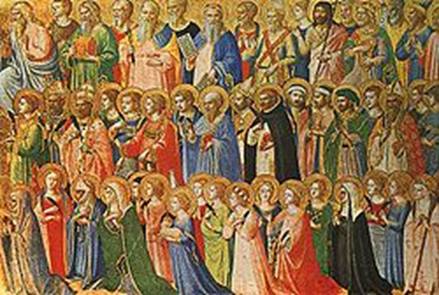
Today is All Saints Day - a day to remember people who have followed Jesus especially well. Nazarenes donʼt usually celebrate All Saints Day, but weʼre missing out.
All Saints Day is an important part of Christian tradition, and it was actually John Wesleyʼs favorite day of the church year. All Saints Day is a great opportunity for us to remember the “great cloud of witnesses” who have gone before us (Hebrews 12:1).

Listen to how John the Revelator describes this great crowd in his vision of
heaven in Revelation 7:9-17.
 9 After this I saw a vast crowd, too great to count, from every nation and tribe and people and language, standing in front of the throne and before the Lamb. They were clothed in white robes and held palm branches in their hands. 10 And they were shouting with a mighty shout,“Salvation comes from our God who sits on the throne and from the Lamb!”
 11 And all the angels were standing around the throne and around the elders and the four living beings. And they fell before the throne with their faces to the ground and worshiped God. 12 They sang,
   “Amen! Blessing and glory and wisdom and thanksgiving and honor
   and power and strength belong to our God forever and ever! Amen.”
[3] 13 Then one of the twenty-four elders asked me, “Who are these who are clothed in white? Where did they come from?”
 14 And I said to him, “Sir, you are the one who knows.”
   Then he said to me, “These are the ones who died in the great tribulation. They have washed their robes in the blood of the Lamb and made them white.
 15 “That is why they stand in front of God’s throne and serve him day and night in his Temple.   And he who sits on the throne will give them shelter.
 16 They will never again be hungry or thirsty; they will never be scorched by the heat of the sun.
 17 For the Lamb on the throne will be their Shepherd.  He will lead them to springs of life-giving water. And God will wipe every tear from their eyes.”


There will come a time, when we will stand with the saints from every tribe and language and culture and time - all those who have ever trusted in the Jesus as the Lamb of God. Together we will sing praises to God. We will be one people, healed together by his love.

All Saints Day is a day to practice this corporate worship and unity now - here on earth. We stand today with the saints of Africa, Asia, Europe, Oceania, and the Americas. We stand today with the saints of the first humans, the first Israelites, the first Christians, the Middle Ages, the Reformation, the Industrial Age, our own time, and all times yet to come. Together, we are Godʼs people. Together, we worship him. Together, we learn what it means to follow him.

Today, as part of our study of our Nazarene Heritage, we are focusing on the two most important saints in our history: John Wesley and Phineas Bresee. As we talk about these two leaders and how God used them, my prayer is that we will catch some of their passion and let God use us in similar ways.

Monday, October 31, 2011

All Saints Day Prayer

 
God of Abraham, Isaac, and Jacob,
             Who lived by your covenant,
             Imperfectly but without giving up,
Make us faithful as well.

God of Adam, Moses, and David,
             Who failed spectacularly,
             Yet repented faithfully,
Make us faithful as well.

God of Rahab, Esther, and Ruth,
             Who dared much and loved much,
Make us faithful as well.

God of the Psalmists,
             Who shouted their doubts
             And sang your praises,
Make us faithful as well.

God of Isaiah, Jeremiah, and Amos,
             Who spoke your truth
Despite great opposition,
Make us faithful as well.