Showing posts with label poor. Show all posts

Thursday, February 6, 2014

You Might Be Rich If ...

Despite what you think, you might be rich by global standards if ...
... you complain about wifi.
... food spoils in your fridge.
... you have a refrigerator.
... you are worried that you don't have enough money saved for retirement.
... you actually expect to stop working before you die.
... you have a savings account worth more than $100.
... you have health insurance (of any kind).
... you make more than minimum wage.
... you make minimum wage.  
... you have ever felt like your closet is getting too full.
... you have more than one of any of these: coat, pair of shoes, phone, computer, car, earbuds, twenty dollar bill, book, water faucet.
... you have enough food in your house to sustain you for more than a week without going shopping.
... you have ever said that your kids have too many toys.
... you or your wife owns a diamond.
... you are only concerned about WHAT your family will eat tonight, not IF your family will eat tonight.
... you are able to read this blog worrying about how you will pay for the internet access.

Instead of trying to prove all of these simple statements individually, I offer you a few simple yet shocking facts (from here and here).
  1. 80% of the world lives on less than $10 per day.
  2. Almost 50% of the world lives on less than $2.50 per day.
  3. Half of the 2 billion children in our world live in extreme poverty.
  4. One in eight people are chronically undernourished.
  5. One in six people don't have access to clean water.

Tuesday, March 26, 2013

Good News About Poverty

Finally some good news about global poverty.  Bono shares some shocking statistics about our progress in fighting extreme poverty around the world.  If you have ever had any doubts about whether we can do anything meaningful about poverty, you must watch this.

Thursday, December 8, 2011

The Gospel of Restoration - Isaiah 61


             Hello.  My name is Josh, and I’m an alcoholic.
             I’m a porn addict, a compulsive gambler, a smoker, and a semi-regular crack user.
             I’m a shopaholic, workaholic, me-aholic.
             I’m the child of abusive parents, and now I’m a codependant adult.
             I beat my wife, and I’m more than $100,000 in debt.
             I am a rape victim, and I’m a sexual abuser.
             I’m grieving the loss of a loved one.
             I’m a racist, a legalist, a moralist, and a recovering hypocrite.
             I am depressed and lonely. 
Sometimes I have thoughts of suicide.  I may even have a plan.
I look like I have a lot of friends, but really I have a very hard time developing meaningful relationships.
I’m struggling with problems with my parents, and my marriage is falling apart.
I’m obsessed with my looks, and I have an eating disorder.
I’m addicted to the internet, and I am a flagrant procrastinator.  Not a good combination!
I have deep resentment and hidden anger.
I am addicted to romance.
My life is dominated by anxiety.
I use profanity often – especially when I’m not at church.
I can’t stop gossiping, no matter how many times I tell myself I’m going to stop.
I’m beginning to lose hope in God.
I am actually an athiest.
I doubt everything all the time.
I value achievement more than love.
I’m struggling to become the person God wants me to be, and I’m beginning to give up.
I’m sick and tired of being sick and tired.
I am lost, captive, blind, despairing, mourning, helpless, and hopeless.
I am broken.  I am a sinner.

Some of these are true of me.  All of these are true for someone in this room.

Tuesday, November 1, 2011

Nazarene Heritage Week 2: Wesley and Bresee (All Saints Day)


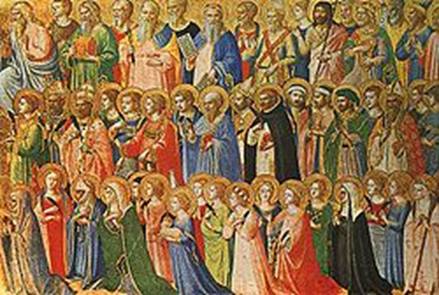
Today is All Saints Day - a day to remember people who have followed Jesus especially well. Nazarenes donʼt usually celebrate All Saints Day, but weʼre missing out.
All Saints Day is an important part of Christian tradition, and it was actually John Wesleyʼs favorite day of the church year. All Saints Day is a great opportunity for us to remember the “great cloud of witnesses” who have gone before us (Hebrews 12:1).

Listen to how John the Revelator describes this great crowd in his vision of
heaven in Revelation 7:9-17.
 9 After this I saw a vast crowd, too great to count, from every nation and tribe and people and language, standing in front of the throne and before the Lamb. They were clothed in white robes and held palm branches in their hands. 10 And they were shouting with a mighty shout,“Salvation comes from our God who sits on the throne and from the Lamb!”
 11 And all the angels were standing around the throne and around the elders and the four living beings. And they fell before the throne with their faces to the ground and worshiped God. 12 They sang,
   “Amen! Blessing and glory and wisdom and thanksgiving and honor
   and power and strength belong to our God forever and ever! Amen.”
[3] 13 Then one of the twenty-four elders asked me, “Who are these who are clothed in white? Where did they come from?”
 14 And I said to him, “Sir, you are the one who knows.”
   Then he said to me, “These are the ones who died in the great tribulation. They have washed their robes in the blood of the Lamb and made them white.
 15 “That is why they stand in front of God’s throne and serve him day and night in his Temple.   And he who sits on the throne will give them shelter.
 16 They will never again be hungry or thirsty; they will never be scorched by the heat of the sun.
 17 For the Lamb on the throne will be their Shepherd.  He will lead them to springs of life-giving water. And God will wipe every tear from their eyes.”


There will come a time, when we will stand with the saints from every tribe and language and culture and time - all those who have ever trusted in the Jesus as the Lamb of God. Together we will sing praises to God. We will be one people, healed together by his love.

All Saints Day is a day to practice this corporate worship and unity now - here on earth. We stand today with the saints of Africa, Asia, Europe, Oceania, and the Americas. We stand today with the saints of the first humans, the first Israelites, the first Christians, the Middle Ages, the Reformation, the Industrial Age, our own time, and all times yet to come. Together, we are Godʼs people. Together, we worship him. Together, we learn what it means to follow him.

Today, as part of our study of our Nazarene Heritage, we are focusing on the two most important saints in our history: John Wesley and Phineas Bresee. As we talk about these two leaders and how God used them, my prayer is that we will catch some of their passion and let God use us in similar ways.

Sunday, July 24, 2011

Gracias! - Review

Last week I took a spiritual retreat up to the mountains of northeastern South Korea (just below the border).  While there, I picked up a Nouwen book out of the monastery library.  Nouwen has been my most common spiritual director on retreats down through the years.
Gracias! did not disappoint.  It was full of profound cultural and spiritual insights which I needed to hear.
Gracias! tells the story of Nouwen's six month sojourn in Bolivia and Peru in the early 1980s while he was attempting to discern whether he was called to serve in Latin America.  If you think back about your world history, Latin America was a mess in the 70s and 80s.  For hundreds of years Latin America was ruled by European colonialists and their grandchildren.  Native Americans and people of mixed ethnicity were poor, uneducated, and deeply oppressed.  The fair skinned ruling class wanted to keep them that way, but around mid-century, the poor slowly decided that they didn't want to stay poor.
The Catholic Church - by far the largest religious group in Latin America - took a "preferential option for the poor" and assisted them in developing their lives through education, health care, better farming, better saving, social organization, healthier diets, etc.  Gustavo Guiterrez was developing and teaching his now famous - Liberation Theology - at this time.  As the poor gained knowledge of their human rights and hope that enabled them to shed fatalism, they began to push for reforms.  As the reformers were first ignored, then punished, then brutally persecuted, reform slowly merged into revolution.
And - given the power dynamics of wealthy nations, USA vs USSR, democracy vs communism - all of these issues in Latin America were set in the light of communism versus everything else.  80-90% of Latin America was poor at that time, and anyone who sided with them or helped them risked being labeled as communist, leftist, destabilizing, disruptive problem-makers.  The result was mass persecution of the Catholic Church whenever and wherever it openly assisted the poor.  People began to disappear.  The martyrs began to be counted by the dozens, then hundreds, then thousands and tens of thousands.
It is in this milieu, Nouwen was considering a life among the poor in Latin America.  A brave question and a brave sojourn.
I learned or relearned three important lessons through Nouwen's reflections.  Some of the most meaningful parts of the book came in his reflections of Gustavo Guitierrez's lectures which Nouwen attended several times.
1. Reform takes time.  I consider myself a reformer, a progressive, someone who is participating in the larger reform of the Church of our time.  I deeply want us to return to our Biblical and Christlike roots as a church, which will - yes - include much more service to the poor, but also much more love for all our neighbors and much more intense commitment to understanding and following Jesus in every possible way and reform in our structures and styles of doing church.  I have struggled with others' resistance, apathy, and lip-service to this reform.  However, observing the Latin American struggle from the distance of space and time encouraged me - oddly.  Their struggle - far more painful than ours - persevered as was largely successful, though it is still incomplete and ongoing.  If they can persevere in the face of persecution and death, I can persevere in the face of complaints or walk-outs.  Also, some of the people in the liberation theology group advised Nouwen that this all takes a great deal of time, that progress is slow, and that it must be done at the pace of the people not the pace of the reformers.  I felt a strong call to perseverance and patience.
2. True reform is deeply spiritual.  Gutierrez lectured on the spirituality of liberation and explained that without maintaining a deep connection with God, we lose the both the heart of love and the will to persevere.  Gutierrez advocated spending time in the "useless" work of prayer and meditation.   Nouwen observed that many of the reformers around him were hostile, angry, and militaristic (at least in words and mindset if not in action).  But the "old fighters" called these young bucks to peace, to patience, to connecting deeply with the Spirit of God, and to working patiently with the people even if that means suffering with the people as the people develop their own desire to further the reformation.  I felt a call to go deeper in my own spiritual life - even if that means less time for "tasks" and "productive" things.
3. Gratitude is central.  Nouwen was deeply struck by the inherent gratitude of the Latin American people.  They view everything as the gift that it is.  Life is a gift.  Food is a gift.  Work is a gift.  Home and family are gifts.  Every good thing we have is a gift from a gracious God.  As a reformer, as someone who deeply wants our world to be better, often I can focus on what is lacking the good that we need but is not yet.  Often I can look at our world as one large bundled collection of problems and deficiencies.  This is an extremely distorted view.  Yes, our world is broken and needs healing.  But even amid our brokenness, God is at work, and God has blessed us with innumerable good gifts.  Despite the dents and the dust, these gifts retain their glorious goodness, and I am - we are - called to celebrate these many gifts at all times and in all places.

The Josh rating: JJJJ.