Showing posts with label Korea Tip. Show all posts

Monday, May 14, 2012

Korea Tip 131: English Speaking Chiropractor

If you have back pain in Korea, it can be hard to know where to go for help.  Finding a doctor who speaks English or works in familiar ways is almost impossible.
Dr. SiHo Ahn, of Cheonan, may be exactly what you need.  He is a USA licensed chiropractic doctor (from Pennsylvania), and his office is near Dujeong Station on the north side of Cheonan (1469 Dujeong-Dong). 
Check out his English website at: www.ahnchiro.com.  For directions or to make an appointment call, 1661-1230. 

Tuesday, March 6, 2012

Korea Tip 128: Filing US Taxes

This is a guest post by David Reed.  (Thanks David!)


Taxes can be daunting, but luckily in this day and age there are several outlets for getting assistance.  Before we get started I have to tell you first and foremost, I am NOT a tax professional.  The information included in this post should not be taken as authoritative or all-inclusive.  If you have questions about your taxes or are unsure in any way contact a tax professional.  For this post I will be using the IRS information posted here: http://www.irs.gov/pub/irs-pdf/p54.pdf  All page numbers listed are from this document.

Now that the legal bit is out of the way lets get to work.  I am going to assume you have filed your taxes before in the States and understand the general process.  I will assume you know how to fill out a general 1040 or 1040EZ form using an online program (Like Turbotax) before and don’t need a step by step walk through.  The purpose of this post is to take you through the Expatriate process which is just a couple of extra steps.

First, the federal government states that there are only five different programs that they approve for doing your taxes online.  However, they don’t tell you which programs these are.  I have found two of these: Turbotax and Taxact.  I have used Turbotax in the past and found it very simple and intuitive but it costs $30 to file your state taxes.  This year I used Taxact and although it only costs about $15 to file your state taxes, it isn’t quite as intuitive as Turbotax. 

Saturday, February 25, 2012

Korea Tip 127: An Out for Privates

“Could you teach my child English?”
Any native English speaking teacher in Korea for more than a month has likely heard this multiple times, from multiple people, in multiple locations (buses and bathrooms, subways and stairwells).
Some are glad to comply for the extra cash.  However, others feel stuck in a prickly trap.  Private English tutoring - although very common - is still illegal for foreigners, and it’s grounds for deporting if you get busted.  Besides that many teachers simply don’t want the extra work commitment.
But there just seems to be no good way to respond.  Often those asking the question are bosses, coworkers, friends, or church members - people to whom we feel a measure of social obligation.  We seemed to be forced with a choice of making a social faux pas or else taking on a tutoring job that we really don’t want.
Let me suggest an alternative.  Connect with a native speaker who can do privates legally and willingly.  Usually, this is either a Korean-American or someone married to a Korean. 
For my part, Sarah and I will now be referring people to our friend and church member David Hill, who holds an F5-visa (영주권) which permits him to teach privates along with his Korean wife Hong Young-Ju under the banner of Oxford (영어전문과외).  Check out their website at: www.myfigtree.net.  To make an appointment call (010-4761-9202). 

Tuesday, February 7, 2012

Korea Tip 126: Expats and Life Abroad Series

Michael Palmer has put together a beautiful little series of posts about living abroad (mostly in Korea).  I highly recommend reading all five articles - plus the bonus.

1. Living Between the Times - Jason Veach - (a comparison of adapting to the varying time practices of the Swiss and the Spanish)
2. A Letter to Pre-Korea Me - Stacey Siebritz - (wise and witty bits of advice on living in Korea)
3. How Kimchi Changed My Life - Jolie Lee - (how living in Korea has increased her appreciation for the USA and for Korea)
4. The Beauty in Good-bye - Michael Palmer (a poignant piece about appreciating this painful but ever-present event)
5. Know Thyself - Yours Truly (how culture shock reveals our own junk)

And a bonus from Stacey's blog: What No One Tells You About Leaving South Korea.

Read, learn, and enjoy.

Wednesday, February 1, 2012

Korea Tip 125: AppleCare Stores

Korea is not very mac-friendly, but it's getting better.  Just a few years ago most Korean websites were basically inaccessible to Safari or even Firefox.  However, with the increasing popularity of Apple products - especially Ipads and Iphones - that is changing.
One of the big problems, though, is getting reliable service for Apple products.  Until recently, you had to journey to Seoul to use your Applecare warranty.  However, Apple Service Centers are slowly moving southward and popping up in some other big cities. 
If you live in Cheonan, where I'm based, the easiest store to reach is Neptune (also known as All-In-One-Tech), which is in the AK Plaza at Suwon Station.  That is just about an hour from Cheonan via the subway.  Follow the signs within the station complex to AK Plaza.  Then keep taking the escalators upward to the 3rd or 4th floor - look for all the appliances and home-ware.  Neptune is a very sleek glass-enclosed store.
I recently brought in my MacBook because the powercord port was damaged.  The Neptune service technician, who might actually be the owner, took my mac apart and fixed the problem in about 10 minutes - no waiting in line.  To top off the positive experience, he also speaks pretty fair English.
To see the latest list of all AppleCare Service Providers in Korea, click here.

Monday, January 16, 2012

Korea Tip 124: Know Thyself

Know Thyself.
Plato often advised his students: “Know thyself.” But the phrase probably precedes him by many centuries. By Plato’s time, KNOW THYSELF was already etched in temple walls.
This ancient wisdom takes on contemporary significance when we start jumping on planes and flying across oceans. Landing in a foreign land with a foreign language, foreign culture, and foreign foods can be exceedingly disorienting – even if we don’t always feel the disorientation. Culture shock hits everyone who lives abroad – whether we admit it or not.
Knowing ourselves can both ease the tension and cure some of the pain. We can find a measure of healing freedom through simply being aware of where we are in the normal stages of culture shock. However, knowing ourselves goes much deeper.
As one who has lived abroad for seven years, I can testify that culture shock will reveal our darkest parts. Our old wounds will be reactivated. Our old pains and fears will resurface as new incarnations. At this time, the most tempting option will be to  blame all our frustrations and pains on the new culture in which we find ourselves.
This place is so backward.
Why do they do such crazy things?
This stuff is just stupid.
The temptation is always to project our pain outward. It’s their fault. The problem is out there – with these people, this place, this system, this culture. The problem is never in here, with me, my own darkness. It is true that all cultures have weaknesses, and it’s true that some cultures are better at some things than others. However, our greatest frustrations often reveal more about ourselves than about whatever is driving us crazy. So go deep. Ask yourself some probing questions.
What is really going on here? 
Why does this frustrate me so much?
What am I really afraid of with this? 
How does this connect with my own history?
What does God want to do in me in the midst of this situation? 
If you’re like me,you may find that living in another culture teaches you more about yourself than anyone else.

(This blog was originally posted as part of a series on living abroad at: http://michaelrpalmer.wordpress.com/).  

Wednesday, December 7, 2011

Korea Tip 123: What the Book

If you want English books in Korea, you have scant options.
1) Scour the frustratingly small selections at local bookstore chains.  (However, these have improved from nothing in 2004 ... to a single shelf a few years ago ... to a genuine English book section with several book cases.)
2) Hit up some of the larger bookstores in Seoul with expanded selections.
3) Pay exorbitant international shipping rates through Amazon.com - something like $9 a book, with no discounts for multiple book orders.
4) Order from www.whatthebook.com.  What The Book has a physical location on the side streets of Itaewon (near the fire station), where you can also buy used books.  However, their real value is their online selection.
They can provide most English books in a wide variety of genres.  True, they mark up the price a bit higher than Amazon and other US based online distributors.  However, they don't charge for shipping in Korea if you spend more than 25,000 won.
Payment is relatively easy.  You can pay through credit card or bank transfer.  I do the transfers.  Just jot down the info on a post-it note, and head to your closest ATM.  In a few days or weeks, depending on whether they have your book currently in Korea, you'll be lounging on a couch with your new book.

Korea Tip 122: Fine Italian Dining in SsangYong Dong

There are some great Italian restaurants in Cheonan, and there are some Italian restaurants in SsangYong Dong (one of Cheonan's neighborhoods or districts, where KNU is located).  But there aren't many really good Italian restaurants in SsangYong Dong.  Most are semi-fast food, or they are a good try, but not quite. 
Until now.
Lieto opened several months ago, but I thought it was just a pricey coffee shop.  Sarah and I stumbled into this fine dining establishment looking for another place for our Friday night date last week.  We were pleasantly surprised!
First of all, the atmosphere is great - really classy and quiet.
Secondly, the service is very fast.  I noticed that she was already preparing the house salads as soon as she gave us the menus and confirmed that we would be ordering a meal.
Then, the house salad was hands-down the best house salad I've had in Korea.  It had a variety of fresh vegetables and a mouth-watering red wine and vinegarette dressing.
Next, out came a pumpkin soup.  Then, garlic bread.  Both of these were moderate, but I had to love the constant flow of appetizers.
The main courses were good.  Sarah's carbonara was a little bland, and my amitriciana was very spicy - even for me, but the quality was very good. 
Finally, the meal was topped off with high quality home roasted coffee. 
The only downside was the price.  For the two of us, it cost 29,000 won.  We won't be going back often, but maybe for a special occasion. 
It's located just a block east of the SsangYong Lotte Mart on the main street.

Wednesday, November 30, 2011

Korea Tip 120: Cheonan at Night

Want a sneak peak of Cheonan?  Or maybe just an interesting look at a place you've seen a thousand times? 
Here's a cool time-lapse photo video of downtown Cheonan by my friend Andy Phelps, who is an outstanding photographer.

Tuesday, November 29, 2011

Korea Tip 119: Gmarket

Gmarket is Korea's Amazon.  Actually, it's owned by Ebay, but it's not an auction-based site. 
It has a pretty good English translation of it's website.  There's even a button for product to use google to translate product descriptions.  This translation is spotty, but the parts that are absolutely necessary for transactions are easy to understand and easy to use.
We recently purchased diapers and printer ink cartridges at about a 40% discount over local store prices.  Also, for many items, especially things over 30,000 won, shipping is free.  Our products were delivered in 2-3 days. 
If you need help directing the delivery man to your address, just have it shipped to your work place and give the Korean secretary's phone number.  Or, if you live in an apartment complex, the delivery guy (Konglish: tech bay) can drop it off at the security office and you can pick it up later.
Another helpful tip for purchasing over the internet: you don't have to pay by credit card.  You can just click the button that says something like: "bank transfer."  Then follow the instructions on the site and make the transfer at an ATM.
Happy discount shopping!

Sunday, November 13, 2011

Korea Tip 118: Getting a Teaching Job in Korea

"I'm thinking of working in Korea.  What should I do to prepare?  What advice do you have for me?"
I've been getting these questions a lot lately.  Here are my answers.

1) Work for a reliable institution.  You are usually safer with universities or public schools (or programs working with public schools).  As a general rule of thumb, the larger the institution and the older the English teaching program, the safer it is as a workplace.  Here are some I recommend:

2) Start early.  Korea requires more and more documentation and authentication every year.  Some of those documents can take a great deal of time to obtain.

3) Maintain healthy skepticism.  Most employers and most recruiters are pretty good people who will treat you pretty well, but there are some real scumbags out there.  Check the wages compared to other jobs with similar working hours.  Ask to speak with a current or former employee (a foreigner if possible). 

4) Check out the area.  While public transportation here is good, its quality diminishes dramatically outside major cities.  Be aware that if you live in the sticks, you may have to buy a car or suffer the randomness of buses beyond your control.  If you're a Christian, you'll want to be looking for an English speaking church within reasonable commuting distance.

5) Know your rights.  We're currently working on an English Teacher's Rights guide.  Stay tuned here for that posting coming soon.  In the meantime, make sure your potential employer plans to provide you with health insurance and pension. 

Wednesday, November 2, 2011

Korea Tip 117: A Few Good Articles on North and South Korea

1. North Korea's Patchy Capitalism.  Due to the total failure of the government controlled system, North Korean citizens of all levels are resorting to gray-market capitalism.  Simply to purchase food and fuel, they must barter services and goods on the open market.  This hints at hopes and problems for unification.

2. Better Food-Aid to North Korea.  20 years of food assistance has failed to relieve chronic food-insecurity in North Korea, and hundreds of thousands have starved.  This is largely due to the governments incapacity and unwillingness to distribute the aid effectively and fairly.  Therefore, future aid programs need more stringent demands for outside involvement

3. Capitalism's Unstoppable Bubbling Up.  Once you start, you can't stop.  Capitalism is coming to North Korea, largely tainted with corruption and black markets, but still coming.  This is the crack in the communist system that will shatter it.  (This is why we should release all sanctions and invest and trade heavily with North Korea.)

4. Multiculturalism in South Korea. With increasing numbers of long-term foreign residents and multicultural marriages, South Korea is quickly losing its homogeneous make-up.  By 2020, 1/3 of all children born in South Korea may be multi-ethnic.  South Korea is still very much in the growing pains on adjusting to multiculturalism, but there are some signs of hope.

Thursday, October 13, 2011

Korea Tip 116: Mr. Pizza - The Original Pizza !?!

Wednesday, October 12, 2011

Korea Tip 115: HomePlus - Shopping in New Frontiers.


Click here for the text version of this story.  I especially like the idea of just scanning something at home when it runs out.  This could put an end to shopping lists.  Very innovative.

Wednesday, August 17, 2011

Korea Tip 114: Crazy May Have a Cause

Be careful what you call crazy.  When you enter a very different culture, some things will seem very strange - even senseless.  Korea is definitely not an exception in this category - at least not for Westerners.  I can't count the number of times I've said or heard someone else say, "That's just crazy."  Not to mention the thousand other variants.
However, one thing that dawned on me this week (once again) is that most of the unusual practices in Korea that seem crazy to me at first actually have a pretty good cause in reality.  Here are a few examples.
  • Brushing teeth after every meal.  I was shocked to meet several of the professors in my office building every day around 1:15 - brushing their teeth in the bathroom.  That seemed a little excessive to me.  That is until, I started eating in the faculty dining room.  The kimchi, onions, and garlic had me reaching for a toothbrush, too.  On occasion, I even stoop to an afternoon flossing to get those little bits of green stuff out of my teeth.
  • Last minute planning.  This is one that really drives most westerners crazy.  The plans change 3 times before the event, and then 5 more times during the event.  You can't figure out what classes you're actually teaching until the week before the classes start, and even that might not be the final say.  But, this one is kind of a vicious cycle.  It's hard to make and keep plans when everyone else is changing their plans because other people are changing their plans, too.  After reformatting the event 7 times, some people decide that the simplest thing to do is to wait until the last day - after it's almost impossible for any more notices of change to come in - and then work super hard to plan the whole event.  For Westerners, this seems terribly inefficient and stressful, but it actually kind of works in Korean culture - and may even work a little better, given the structural limitations.
  • Opening the windows in the winter.  So the heat's on full blast, and icicles are forming outside (or inside), and the windows are open - all of them.  This leaves lots of Westerners scratching their heads or angry.  Or, the first student to walk into the classroom and turns heat up to full blast.  Then, 20 minutes into class, it's crazy hot, and all the students have their coats on, so one of the students opens the window instead of turning down the heat.  Lots of cultural reasons here.  (A) The primary traditional heat sources (stoves or propane heaters) gave off noxious fumes, so fresh air was very important for health.  (B) Airing out a house is important in Confucian philosophy.  (C) With the class room scenario, the students may think the teacher turned on the heat.  Therefore, they don't have the authority to override the teacher's decision there.  However, they are sitting next to the window, so no problem with opening it to get a little more comfortable - especially considering A and B.  (D) Also, many Koreans will keep their coats on inside for lots of reasons.  Schools weren't traditionally heated well, so coats were necessary.  Taking it off just seems like too much trouble - or possibly an insult to the person who sets the classroom environment.  

I could go on and on and on and on.  The point is that there are usually good reasons for most of the things we don't understand.
What are some things you don't understand about Korea?
What are some things you have learned that have helped you understand Korea?

Wednesday, July 6, 2011

Korea Tip 113: Naver's Dictionary

Don't waste your money on an electronic dictionary - much less the neolithic paper versions.  Naver (Korea's #1 search engine) has a top notch English/Korean dictionary.  You can initiate your search in either Korean or English, and it will provide you with (1) a definition of the word or phrase and (2) examples of actual uses of that word or phrase on the net. 
For example, today I looked up: 혹시 (hokshi), and I got the following results:

1. (만일)      
혹시 이쪽에 오게 되면 꼭 연락해라
If you're ever in this area, be sure to give me a call. play
혹시 저 없을 때 전화 오면 받아 주세요
Please answer the phone for me while[if] I'm out. play
2. (행여나, 어쩌면)      
혹시 내일 떠나게 될지도 모르겠습니다
I may have to leave tomorrow. play
혹시나 했던 일이 현실로 나타났다
My fear has come true. play
혹시나 했던 일이 현실로 나타났다
What I feared has come to pass. play
혹시 그녀가 아픈 건 아닌지 모르겠다
I'm not sure, but she might be sick. play
혹시 그녀가 아픈 건 아닌지 모르겠다
I'm not sure if she's sick (or not). play
3. (확실한 건 아니지만) by any chance, (just) in case      
혹시 우리 만난 적 있나요?
Have we met by any chance? play
혹시 모르니까 우산을 가져가라
Take an umbrella just in case. play
혹시라도 제가 못 가게 되면 혼자 가세요
Go alone if by any chance I cannot go. play
큰 병은 아니겠지만 혹시 모르니까 병원에 가 봐야겠다
I'm sure it's nothing serious, but I should go see a doctor just in case. play
혹시 그가 집에 있나 하고 전화를 걸어 보았다
I called him to see if he was home. play


This is far more comprehensive than any other dictionary I've seen, and this is only about half of the results.  I use this at least a few times a week when I'm trying to understand exactly what my Korean text book is saying.

Wednesday, June 29, 2011

Korea Tip 112: Restaurants near Cheonan Bus Terminal

Sometimes, it's hard to find anything other than Korean food and chain restaurants like McDonalds and Outback.  (Not there's anything wrong with Korean.  Just sometimes it's nice to have a taste of home.)  For folks living in the Cheonan area, here are a few recommendations for good eats near the bus terminal (formerly known as - and still often called - Yawoori).

For starters, don't miss the upper level of the Shinsege building. 
  • I was delighted to see that the former food court area near the movie theater is being remodeled to include a Bennigans and a W-Burger.   
  • The old (and not so good) coffee shop next to the ticket booth has been replaced with a top-notch coffee chain called A Twosome Place, which also has nice gourmet sandwiches.  
  • Also, one floor up from the cinema is Hong Kong - a pretty decent Chinese place, with individual servings for less than 10,000 a plate.    
  • On our last trip to the movies, a serendipitous wrong turn led us to the top floor of the right hand side of the Shinsege Department Store (formerly The Galleria), and we discovered a very interesting Italian place and a Thai/Vietnamese place.  We had already eaten, so we weren't able to try either though.  (Let me know how the food is if you get in there.)
Next to the Shinsege Department Store, under the Arario Art Gallery (and the gargantuan man with his insides showing) is All That Barbecue.  This is a semi-western buffet.  For about 14,000 won, they have some pretty good mixed salads, various pastas and rice dishes, and a few meats. 
Near Tom N Toms, is a relatively new place called Welcoming the Moon.  This is a good Italian place, and it's on the second floor with a great, open-window view of downtown.

In the maze of backstreets on the other side of the street, there are a few can't miss places. 
  • Dono Marco, 3-4 blocks behind Dunkin' Donuts, is owned by the chef.  They make excellent Italian food, and the whole place only seats about 20 people, so it's a pretty intimate environment.  Make sure to try the salmon fettuccine.
  • Riposos is a basement pizza/pasta/bar not far from Dunkin Donuts.  The food is great (especially the Riposo Pizza, with ham, tomatoes, and spinach), but the service is notoriously bad.
  • A Bis has so-so food and a great atmosphere.  It is in a European style house that looks like it was carried over on a ship straight from Switzerland.  Go 1-2 blocks behind Dunkin' Donuts and turn left.
  • Pios has the best carbonara in Cheonan.  It is served in a huge bowl, and the noodles are literally swimming in sauce.  I'm not sure if the name is exactly right.  It has nothing in English, so my brain is blanking.  Turn right at Baskin Robbins, and look to your right after 3-4 blocks.  It has a white brick front and a little patio.
  • The Fry Pan is a heart-attack on a plate, but you'll die happy.  It is near the little park area.  It has the best chicken fingers and french fries in town.
Enjoy.  If you know of any other can't-miss places, let me know. 

Tuesday, June 14, 2011

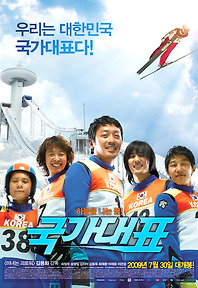
Korea Tip 111: Take Off (국가대표) - Review

국가 대표 (Korean for "National Team") goes by the English name "Take Off."  Both are reasonable titles, since it is about Korea's first Ski Jump National Team.
The basic storyline is that Korea is making a bid to host the winter Olympics.  However, on their previous bid, one of the disqualifying factors was Koreans' lack of interest in winter sports.  This time around, they try to remedy that problem in part by building a national ski jump team.  However, the sport is so dangerous and so new that they can only gather various misfits and screw-ups.  The basic story of the movie is how this group of young men (and their over-the-hill coach) learn the art of ski jumping and - in the process - come into their manhood.
Although I'm not a big fan of the movie overall, I did appreciate a few parts.
First, hosting the winter Olympics is a longstanding unfulfilled dream for Korea.  PyoungChan still ramps up their Olympic hopes every few years, only to be dashed again and again.  This movie touches on how far Korea will go to host that major event.
Second, the father-son relationship of one of the team members gives a good look into the tension Korea has between traditional success and alternative personal expressions (like sports and arts).  For many parents there is only one path to success: academics and making money and business.  However, Koreans also have a deep national pride and a corresponding desire for international fame and recognition.  These two conflicting desires naturally lead to conflict at home for many would-be athletes or artists.
Third, despite all the cheesy-ness and downsides, the team basically succeeds.  They become successful ski jumpers, earn a place in the national pride, and get a second chance at manhood.

However, two glaring plot weaknesses basically ruined the movie for me.  Both of these are total spoilers, so be forewarned.
First, the lead character joined the national ski team to claim his moment of fame and find his birth mother (who gave him up for adoption at around age 6).  His plan is to earn enough money ski jumping to buy her an apartment.  The first part of his plan succeeds; he finds his mother.  However, shockingly, he walks away from her because he is not able to provide an apartment for her.  Maybe this is a cultural thing.  I know Koreans really like melodramatic story lines.  But this seemed completely pointless and gave me a sour taste for the whole movie.  (On the other hand, perhaps this is also a bit of cultural insight into Korean culture regarding the deep importance of providing for the material needs of the family.)
Second, the national team's substitute ski jumper is one team member's mentally challenged little brother.  They rationalize this ridiculous proposition by saying that he'll never have to jump.  However, when one team member (the older brother) is injured, they talk the little brother into jumping for the sake of national pride.  This gave me a sick feeling inside.  I want to give the movie a little grace as they created an unrealistic scenario to develop the plot, but this was blatant reckless endangerment, and I couldn't get past it.

So, unfortunately, we didn't really enjoy the movie.  On the other hand, I would say it could still be worth a watch for the cultural content.  The Josh rating: JJ.
(Sorry W.)

Tuesday, June 7, 2011

Korea Tip 110: Doctors in Cheonan

Finding a good doctor can be intimidating.  Add to that the stress of trying to communicate in English while living in a foreign country, and some people just choose to tough it out at home.
Also, some hakwon bosses have shady deals with doctors.  Amazingly the doctors always prescribe a coctail of medicine and say that you're still OK to work.  Never mind that you've got it coming out both ends.  But finding an independent point of view can be difficult if you don't know where to start.
Here are some tips for the Cheonanites out there.

No need to be a cowboy (or cowgirl as the case may be).  Make your way to SsangYong Medical to speak to Dr. Ko.  She is kind and speaks English very well.  A word to the wise.  Unless you request something different, in typical Korean fashion, she will prescribe you three days of a rainbowed cocktail of pills in little packets.  However, if you ask, she will: (a) give you a prescription for a week or two (or longer for standard medications, like my allergy stuff), and (b) explain each pill she is prescribing - even to the point of showing you a picture of it on her computer.  SsangYong Medical is near the SsangYong McDonalds (between Korea Nazarene University and Lotte Mart).  From the McDonalds, walk toward Lotte Mart.  Take the stairs after Paris Baguette to the second floor.

Also, if you have a more intense issue and need a specialist, SsangYong Medical is still the place to start.  Just go in and explain your issues to Dr. Ko.  She will write up a referral and help you make your appointment with the specialist.  This is hugely helpful in getting past the secretary's desk - especially because many of the specialists tend to be in large amoeba-like university hospitals.

Put those pliers away, and go see a dentist.  Nero Dentistry (just above SsangYong Medical) is a fully bilingual dentist office.  The head dentist studied in the USA.  The place is kind, clean, and totally legit.  When I took my daughter in for a check up, he looked us both over, and since we didn't need any work, he sent us home for free.  They'll also send you a reminder text for your follow-up appointment.

For women's needs, the easiest place to find is Ehwa Hospital - also in SsangYong Dong.  It's between SsangYong Subway Station and E-Mart.  They have a few OBGYN's who speak English well.  Doing a cold-call might be intimidating, so you might want to have a Korean call first and help you figure out exactly when and where to go.

One more tip, most Korean doctors offices (with the exception of very busy specialists) don't work on an appointment basis.  Everything is just walk in.  Just bring a book, show up, and be prepared to wait anywhere from 5 to 30 minutes.

Happy Healing.

Sunday, May 15, 2011

Korea Tip 109: Local Blogs, Sites, and Facebook Groups

(Yu KwanSoon - Korean Patriot from Cheonan)
You might be surprised what kind of information is out there on the net.  Usually, there is somebody somewhere writing about almost everything.  Even in Korea.  Even in English in Korea.  Here are a few of my favorite local sources of info for Cheonan.
  • Cheonan World - The management blog/portal is passed down like a local inheritance among the semi-long term foreigners of Cheonan.  It is a good way to find out the local scoop on entertainment, pool night, group meet-ups, regular events - like open mic night, and a brief overview of helpful info for expats living in Cheonan.  It has a few extremely helpful tools like a bus map and an English annotated KimBap Nara menu.
  • Cheonan - Wikipedia - This site seems to be growing every week, always adding new little bits of history and local info.  This is a must read for people who want to get a quick overview of the city.
  • Facebook Groups - I am a member of 12 different facebook groups that relate to Cheonan or life in Korea.  One of the most active groups is run by my friend Jackie.  Eating Out in Cheonan invites people to meet up for a meal at a different restaurant every week or so.  It's a great way to see new places and meet new people. 
  • Jackie's Squidoo - Jackie also posts a huge variety of articles about life in Korea, restaurants, ESL teaching, and whatever other random stuff she happens to be interested in at the moment.  If we want info on a new restaurant in Cheonan, we go to Jackie first.
If anybody out there has other local recommendations, please pass them on.