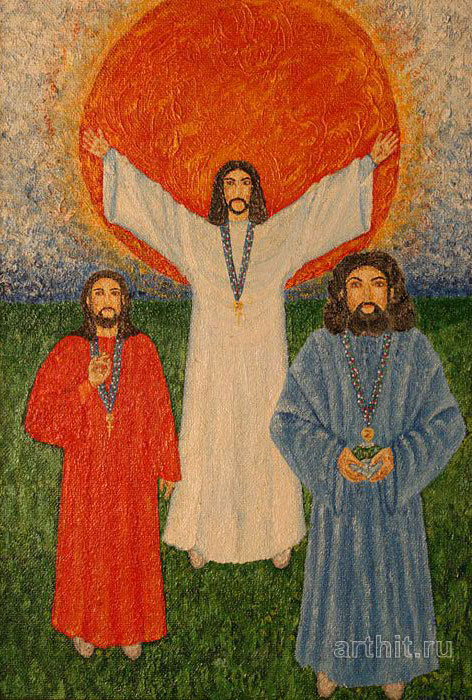
We humans have a love-hate relationship with eschatology. Eschatology is the study of the end. What will happen at the end of the world? What comes next?
On one hand, we seem to be irrevocably drawn to the apocalyptic, end-of-the-world stuff, especially in movies. apocalypticmovies.com lists 61 apocalyptic movies since the year 2000. In his article, “It’s the End of the World, and We Love It,” Mark Moring says, “We are divinely wired to wonder what comes next.”1
Every now and then, this deep hunger for knowing the future leads people to make some outrageous claims. Just a few months ago, an 89 year old American radio guy named Harold Camping hosted a huge campaign - with public billboards, radio slots, news footage, and mobile bus advertisements - saying Jesus was coming back at exactly 6 p.m. on May 21, 2011. Obviously, that didn’t happen.
That kind of error-based fear-building has given many people a distaste for eschatology. Many of us would rather just put our heads down and live today, one day at a time. Some folks just want to forget the future.
But eschatology is still really important. It’s the closing chapter of our human story. In fact, nearly all of the New Testament - and really the whole Bible - is forward looking. From the Biblical perspective, the future is holding our hand and pulling us into its reality.
The problem with understanding the future is that it isn’t here yet. As much as the Bible is forward-leaning, as much as Christianity views us as being pulled into the future, there aren’t many details.
Christians are deeply committed to the future, though. We have a few absolute beliefs about the future. ...
To continue reading this post, click here.
.
Friday, July 8, 2011
Wednesday, July 6, 2011
Korea Tip 113: Naver's Dictionary
Don't waste your money on an electronic dictionary - much less the neolithic paper versions. Naver (Korea's #1 search engine) has a top notch English/Korean dictionary. You can initiate your search in either Korean or English, and it will provide you with (1) a definition of the word or phrase and (2) examples of actual uses of that word or phrase on the net.
For example, today I looked up: 혹시 (hokshi), and I got the following results:
This is far more comprehensive than any other dictionary I've seen, and this is only about half of the results. I use this at least a few times a week when I'm trying to understand exactly what my Korean text book is saying.
For example, today I looked up: 혹시 (hokshi), and I got the following results:
- 1. (만일)
- 혹시 이쪽에 오게 되면 꼭 연락해라
- 혹시 저 없을 때 전화 오면 받아 주세요
- 2. (행여나, 어쩌면)
- 혹시 내일 떠나게 될지도 모르겠습니다
- 혹시나 했던 일이 현실로 나타났다
- 혹시 그녀가 아픈 건 아닌지 모르겠다
- 3. (확실한 건 아니지만) by any chance, (just) in case
- 혹시 우리 만난 적 있나요?
- 혹시 모르니까 우산을 가져가라
- 혹시라도 제가 못 가게 되면 혼자 가세요
- 큰 병은 아니겠지만 혹시 모르니까 병원에 가 봐야겠다
- 혹시 그가 집에 있나 하고 전화를 걸어 보았다
This is far more comprehensive than any other dictionary I've seen, and this is only about half of the results. I use this at least a few times a week when I'm trying to understand exactly what my Korean text book is saying.
Tuesday, July 5, 2011
Walking Through Jello
Through Jello
I sit up and reach for the clock
Through Jello
I find my way to the coffee pot
Through Jello
I eat my cereal and brush my teeth
Through Jello
I stumble down the hill
Through Jello
I stare at my computer screen
Through Jello
I try to make sense of today
Through Jello
I wander home again
Through Jello
I lay my head on my pillow
And snore
Through Jello
I sit up and reach for the clock
Through Jello
I find my way to the coffee pot
Through Jello
I eat my cereal and brush my teeth
Through Jello
I stumble down the hill
Through Jello
I stare at my computer screen
Through Jello
I try to make sense of today
Through Jello
I wander home again
Through Jello
I lay my head on my pillow
And snore
Through Jello
A Time to Kill - Book Review
A Time to Kill is John Grisham's first novel. It was rejected by 28 publishers before a small pub-house agreed to print a meager 5,000 copies. (Grisham's second book, The Firm, was the best selling book of 1991, and was on the best seller's list for 47 weeks.)
Grisham is a Southern boy, and most of his books are based in the deep South - especially Mississippi. A Time to Kill began this odyssey into rural, southern USA. It is replete with racial tension and insider looks at traditional stereotypes. Grisham writes as one who loves the South - and at the same time, as one who sees through its facade of overdrawn strengths and weaknesses, to the soul of the people.
A Time to Kill is built around a simple, heart-wrenching story. A young black girl is brutally raped by two white "rednecks." (Grisham freely uses inflammatory stereotyped words - which are also freely used by most folks in the South.) The girl's father guns down the two offenders as they are leaving their preliminary hearing at the courthouse. The rest of the book is about two points: (1) Was the father justified? (2) What are the racial implications and ramifications of this trial?
I wonder if Grisham's stereotypes are exaggerated, and I surely hope some of them are. But as a Southern boy myself, I know that many of his driving insights (into both the white and the black communities) are uncomfortably close to home.
This is my tenth Grisham book. He's one of my favorite fiction authors, hands down. Although the conclusion was a bit disappointing, I would say that A Time to Kill is one of Grisham's best. The Josh rating: JJJJ.
Grisham is a Southern boy, and most of his books are based in the deep South - especially Mississippi. A Time to Kill began this odyssey into rural, southern USA. It is replete with racial tension and insider looks at traditional stereotypes. Grisham writes as one who loves the South - and at the same time, as one who sees through its facade of overdrawn strengths and weaknesses, to the soul of the people.
A Time to Kill is built around a simple, heart-wrenching story. A young black girl is brutally raped by two white "rednecks." (Grisham freely uses inflammatory stereotyped words - which are also freely used by most folks in the South.) The girl's father guns down the two offenders as they are leaving their preliminary hearing at the courthouse. The rest of the book is about two points: (1) Was the father justified? (2) What are the racial implications and ramifications of this trial?
I wonder if Grisham's stereotypes are exaggerated, and I surely hope some of them are. But as a Southern boy myself, I know that many of his driving insights (into both the white and the black communities) are uncomfortably close to home.
This is my tenth Grisham book. He's one of my favorite fiction authors, hands down. Although the conclusion was a bit disappointing, I would say that A Time to Kill is one of Grisham's best. The Josh rating: JJJJ.
Wednesday, June 29, 2011
Denominations: What Happened & What Now?
There are almost 7,000 languages currently spoken on earth.
We started with one. Then came the tower of Babel - when God confused our languages and sent us running to the ends of the earth, scattered into the small groups of people who could understand each other and get along together.
There are some 33,800 different Christian denominations around the world.
We started with one. Then came a host of historical events, which sent us running to the ends of the earth, scattered into the small groups of people who could understand each other and get along together.
What happened? I feel like Rodney King, after the Los Angeles race riots, “People, I just want to say, can we all just get along? Can we all just get along?”
Apparently not. No, we can’t just all get along.
Today, we’re talking about denominations (교단) - all 33,800 of them, and we’re going to do this with a few different basic questions.
- What happened?
- Why?
- What now?
What Happened? The History.
1. The Early Breaks - The first major breaks within the Church - kind of like denominations - happened in the 5th century. Both splits were about one issue: How is Jesus both divine and human? In 431 the Assyrian Church of the East, centered in ancient Iraq, split away because they insisted on the separation and clear distinction of Jesus’ divine and human natures. 20 years later, the Oriental Orthodox Church, split away for the exact opposite reason.
Interestingly, in 1984, the Pope and the Syriac Patriarch issued a joint statement about these divisions: “The confusions and schisms that ... arose only because of differences in terminology and culture and in the various formulae ... express the same matter. Accordingly, we find today no real basis for the sad divisions and schisms that ... arose between us ...”
Samson and the Pirate Monks - Review
This is one of the most important books I've read in a long time. I read it in two days, which is extremely rare. I highly recommend it for all men who want to live faithfully, but struggle.
The first half of the book tells the story of the author, Nate Larkin's, downward spiral with sexual addiction. He starts out as a pastor's kid, with a dark secret, pornography. Despite countless prayers and promises, his attachment to pornography deepens all the way through college, seminary, and his first few years of marriage. After seminary (before he began pastoring), he was exposed to strip clubs, and that poured gasoline on his sex addiction.
He stumbled into a role as a lead pastor and stayed clean under the weight of this new authority ... for a few months. Then, it was back to the old problems again. Eventually, he picked up a prostitute, and that brought him into a decade or more of that. After a few years, he quit pastoring.
But the addiction continued ... even though they continued going to church ... even though he prayed for deliverance many times ... even though he went to Promise Keepers ... even though he got an accountability partner ... even though it cost him lots and lots of money ... even though his job suffered ... even though he even received prayers to have the "demons of sexual temptation" removed ... even though he tried hard to maintain daily disciplines of prayer and Bible study ... even though he went to counseling ... even though he cried and prayed and tried really hard and tried to really, really believe this time ... even though he did everything that most people in the church say you're supposed to do ... his addiction continued.
Finally, he bottomed out and went to a 12-step group called Sex Addicts Anonymous. Slowly, slowly, slowly, he got help and started to recover. There were two missing pieces in his life that SAA provided for him.
First was the awareness that he was powerless to overcome his addiction. He had to let God do it. Up until this time, despite all the religious lingo, he was really trying to just screw up his courage and determination and beat this thing. SAA helped him to rely on God everyday - sometimes every minute of every day, instead of just trying harder - which wasn't working anyway.
Second, SAA provided him with a community of support. He said that he learned how to trust Christ by trusting the body of Christ. The deep, honest community of a 12 step group was a means of grace for him that was not available in any other way. And it was just the grace that he needed.
Well on the road of recovery, Nate and some men at his church, who had also been in and around various 12-step groups, decided to bring that kind of deep community into the church setting. They formed the Samson Society, based on the Biblical character of Samson whose amazing strength was defeated by his isolation and sexual addiction. The Samson Society is a brotherhood of mutual aid. They meet once a week, and it is open to anyone who wants brotherhood and support - not just people with obvious addictions. They have some of the same kind of steps and rituals as 12 step groups. The basic premise is that we really, really, really need each other if we are going to live faithfully in God's grace. The weekly meeting and the relationships formed out of it provide us a means of accessing that grace deep within our hearts.
This is one of the best books for Christian men that I've seen in many years. Our world desperately needs Samson Societies. One of my friends is starting one here in Cheonan, currently scheduled to meet on Saturday mornings near Yawoori. Contact me if you're interested.
So obviously, the Josh rating on this book is the max: JJJJJ. Read it. Give it to people. Start a brotherhood of mutual aid.
The first half of the book tells the story of the author, Nate Larkin's, downward spiral with sexual addiction. He starts out as a pastor's kid, with a dark secret, pornography. Despite countless prayers and promises, his attachment to pornography deepens all the way through college, seminary, and his first few years of marriage. After seminary (before he began pastoring), he was exposed to strip clubs, and that poured gasoline on his sex addiction.
He stumbled into a role as a lead pastor and stayed clean under the weight of this new authority ... for a few months. Then, it was back to the old problems again. Eventually, he picked up a prostitute, and that brought him into a decade or more of that. After a few years, he quit pastoring.
But the addiction continued ... even though they continued going to church ... even though he prayed for deliverance many times ... even though he went to Promise Keepers ... even though he got an accountability partner ... even though it cost him lots and lots of money ... even though his job suffered ... even though he even received prayers to have the "demons of sexual temptation" removed ... even though he tried hard to maintain daily disciplines of prayer and Bible study ... even though he went to counseling ... even though he cried and prayed and tried really hard and tried to really, really believe this time ... even though he did everything that most people in the church say you're supposed to do ... his addiction continued.
Finally, he bottomed out and went to a 12-step group called Sex Addicts Anonymous. Slowly, slowly, slowly, he got help and started to recover. There were two missing pieces in his life that SAA provided for him.
First was the awareness that he was powerless to overcome his addiction. He had to let God do it. Up until this time, despite all the religious lingo, he was really trying to just screw up his courage and determination and beat this thing. SAA helped him to rely on God everyday - sometimes every minute of every day, instead of just trying harder - which wasn't working anyway.
Second, SAA provided him with a community of support. He said that he learned how to trust Christ by trusting the body of Christ. The deep, honest community of a 12 step group was a means of grace for him that was not available in any other way. And it was just the grace that he needed.
Well on the road of recovery, Nate and some men at his church, who had also been in and around various 12-step groups, decided to bring that kind of deep community into the church setting. They formed the Samson Society, based on the Biblical character of Samson whose amazing strength was defeated by his isolation and sexual addiction. The Samson Society is a brotherhood of mutual aid. They meet once a week, and it is open to anyone who wants brotherhood and support - not just people with obvious addictions. They have some of the same kind of steps and rituals as 12 step groups. The basic premise is that we really, really, really need each other if we are going to live faithfully in God's grace. The weekly meeting and the relationships formed out of it provide us a means of accessing that grace deep within our hearts.
This is one of the best books for Christian men that I've seen in many years. Our world desperately needs Samson Societies. One of my friends is starting one here in Cheonan, currently scheduled to meet on Saturday mornings near Yawoori. Contact me if you're interested.
So obviously, the Josh rating on this book is the max: JJJJJ. Read it. Give it to people. Start a brotherhood of mutual aid.
Korea Tip 112: Restaurants near Cheonan Bus Terminal
For starters, don't miss the upper level of the Shinsege building.
- I was delighted to see that the former food court area near the movie theater is being remodeled to include a Bennigans and a W-Burger.
- The old (and not so good) coffee shop next to the ticket booth has been replaced with a top-notch coffee chain called A Twosome Place, which also has nice gourmet sandwiches.
- Also, one floor up from the cinema is Hong Kong - a pretty decent Chinese place, with individual servings for less than 10,000 a plate.
- On our last trip to the movies, a serendipitous wrong turn led us to the top floor of the right hand side of the Shinsege Department Store (formerly The Galleria), and we discovered a very interesting Italian place and a Thai/Vietnamese place. We had already eaten, so we weren't able to try either though. (Let me know how the food is if you get in there.)
Near Tom N Toms, is a relatively new place called Welcoming the Moon. This is a good Italian place, and it's on the second floor with a great, open-window view of downtown.
In the maze of backstreets on the other side of the street, there are a few can't miss places.
- Dono Marco, 3-4 blocks behind Dunkin' Donuts, is owned by the chef. They make excellent Italian food, and the whole place only seats about 20 people, so it's a pretty intimate environment. Make sure to try the salmon fettuccine.
- Riposos is a basement pizza/pasta/bar not far from Dunkin Donuts. The food is great (especially the Riposo Pizza, with ham, tomatoes, and spinach), but the service is notoriously bad.
- A Bis has so-so food and a great atmosphere. It is in a European style house that looks like it was carried over on a ship straight from Switzerland. Go 1-2 blocks behind Dunkin' Donuts and turn left.
- Pios has the best carbonara in Cheonan. It is served in a huge bowl, and the noodles are literally swimming in sauce. I'm not sure if the name is exactly right. It has nothing in English, so my brain is blanking. Turn right at Baskin Robbins, and look to your right after 3-4 blocks. It has a white brick front and a little patio.
- The Fry Pan is a heart-attack on a plate, but you'll die happy. It is near the little park area. It has the best chicken fingers and french fries in town.
Tuesday, June 28, 2011
First and Last (Revelation 1:17-18)
[This is a children's sermon for Galilee Methodist Church Promise Land next Sunday. They are going to be partnering with us on Cheonan Migrant Shelter, so I said yes when they asked me to preach for their kids' program. They assigned this text.]
Revelation 1:17-18 ... Jesus “said, ‘Don’t be afraid. I am the First and the Last. I am the living one. I died, but look - I am alive forever and ever!’”
Do I look fat? Maybe not now, but when I was a kid, I was fat. Some of the mean kids in my school sang a song about me when they passed me in the hall. Have you ever heard the Batman song? They changed it for me: “Fatman, na-na-na-na-na, Fat-man!”
For some strange reason, I decided to be on the track team. One week I heard that our team didn’t have enough guys to run the 800 meter race. (That’s 2 times all the way around the big track at Cheonan Stadium.) I volunteered. My coach looked at me ... looked at my stomach ... and said, “800 meters? Have you even run that far before?”
I said, “Sure, sometimes I go jogging with my dad.” I didn’t know that jogging with my 50 year old father is completely different from racing around a track with a bunch of fast, skinny kids. ...
To continue reading this post, click here.
.
Do I look fat? Maybe not now, but when I was a kid, I was fat. Some of the mean kids in my school sang a song about me when they passed me in the hall. Have you ever heard the Batman song? They changed it for me: “Fatman, na-na-na-na-na, Fat-man!”
For some strange reason, I decided to be on the track team. One week I heard that our team didn’t have enough guys to run the 800 meter race. (That’s 2 times all the way around the big track at Cheonan Stadium.) I volunteered. My coach looked at me ... looked at my stomach ... and said, “800 meters? Have you even run that far before?”
I said, “Sure, sometimes I go jogging with my dad.” I didn’t know that jogging with my 50 year old father is completely different from racing around a track with a bunch of fast, skinny kids. ...
To continue reading this post, click here.
.
Monday, June 27, 2011
X-Men First Class - Review
Sarah and I took full advantage of our Friday night babysitter (somewhat of a rarity these days) and saw X-Men First Class at the Yaoori-14 Cinema here in Cheonan. We're not huge comic or fantasy fans, so we weren't excited like some of our aficionado friends. However, we weren't disappointed.
The basic story line is that this is a prequel to the X-Men series, explaining how Professor Xavier's school for mutant superheros developed. This movie also lays the foundation for some of the other basic themes of the X-Men series primarily - how will normal humans treat mutants and how will the mutants engage a society which engages them with mixed hostility and deference.
I appreciated a few basic things about this movie.
1. Xavier's relationship with the mutants is significant. He is helping each of them harness their own personal power and fulfill their potential. Sometimes he does this through encouragement, sometimes through technical development, and sometimes through deep empathy - helping them to tap into their own heart-level feelings.
2. This is the classic story of people who don't fit social norms, only this the cause of the maladaptation is exaggerated into actual physical (or mental) mutations of super-human powers. However, within this exaggerated story, we can see a depiction of very common social exclusion for very common reasons: appearance, finance, social awkwardness, mistakes, choices, preferences, diseases, etc. As I see it, one of the basic undercurrents of the X-Men series is that all people are genuine human beings and worthy of love and affection - despite our various differences.
At various times, the plot, directing, or dialog struggled. January Jones' acting was pitifully subdued; she seemed almost robotic sometimes. Some of the plot movements seemed forced and unnatural. And on occasion, the comic book dialog shone through - and not in a good way.
Overall, unless your a big comic fan, it's worth a rental, but it's only worth full-ticket price if you don't have other good options (like us). The Josh rating: JJJ.
The basic story line is that this is a prequel to the X-Men series, explaining how Professor Xavier's school for mutant superheros developed. This movie also lays the foundation for some of the other basic themes of the X-Men series primarily - how will normal humans treat mutants and how will the mutants engage a society which engages them with mixed hostility and deference.
I appreciated a few basic things about this movie.
1. Xavier's relationship with the mutants is significant. He is helping each of them harness their own personal power and fulfill their potential. Sometimes he does this through encouragement, sometimes through technical development, and sometimes through deep empathy - helping them to tap into their own heart-level feelings.
2. This is the classic story of people who don't fit social norms, only this the cause of the maladaptation is exaggerated into actual physical (or mental) mutations of super-human powers. However, within this exaggerated story, we can see a depiction of very common social exclusion for very common reasons: appearance, finance, social awkwardness, mistakes, choices, preferences, diseases, etc. As I see it, one of the basic undercurrents of the X-Men series is that all people are genuine human beings and worthy of love and affection - despite our various differences.
At various times, the plot, directing, or dialog struggled. January Jones' acting was pitifully subdued; she seemed almost robotic sometimes. Some of the plot movements seemed forced and unnatural. And on occasion, the comic book dialog shone through - and not in a good way.
Overall, unless your a big comic fan, it's worth a rental, but it's only worth full-ticket price if you don't have other good options (like us). The Josh rating: JJJ.
Thursday, June 23, 2011
Seung-An Im: Leading with Vision
[Michael R. Palmer and I wrote this article for Holiness Today.]
To continue reading the article, click here.
.
Just an hour south of Seoul and two hours south of the DMZ, Korea Nazarene University(KNU) is quietly changing the world. With almost 7,000 students, KNU is now the largest Nazarene university in the world. KNU’s president Seung-An (Abraham) Im has been named the Forbes Korea Global CEO for two years running. He regularly jokes about his small stature, but he has no shortage of vision.
Q: What was your childhood like?
A: I had a very difficult childhood. I was very poor, and at the age of seven I lost my mother. I often went without food or warm clothes.
In the sixth grade my friend invited me to a small Nazarene church. I attended it only two or three times, and then went to my sister's house for the winter vacation. When I returned, I learned that the Sunday School teacher had been asking where I was and if I was okay. This touched my heart, and I started attending church regularly.
Actually, I was really a trouble maker in the church youth group, but I began to pray that God would change me. ...To continue reading the article, click here.
.
Children of a Lesser God - Movie Review
Children of a Lesser God is a 1986 romantic drama, telling the story of James (a speech therapist at a deaf school) and Sarah (a former star student who is now the school's janitor). Marlee Matlin, who is actually deaf, won a well-deserved Oscar for her role in the film. She is both the youngest actress ever to win and the only deaf actress ever to win.
James is a passionate, effective, innovative, nomadic speech teacher. Some of the best scenes of the movie are when he is helping his students reach beyond their hearing deficits. He helps them engage pop music through "feeling" the music in their bodies. When one student curses at him, James corrects his pronunciation - which leads to repeated greetings with newly learned (but accurately pronounced) profanity.
Sarah's fiery attitude and good looks draw James's attention, and he soon discovers that she is basically hiding from the world by serving as a janitor at the safe deaf school. The hearing world represents mocking and danger and failure for her. She persistently refuses to read lips or to speak as an intentional effort to isolate herself to people who are safe. She rebuffs James' efforts to teach her to use her voice.
Eventually, as one might expect, the two fall in love. However, the path forward is complex as they each learn to accept each others' weaknesses and strengths. They must both give the other person space to change or not to change.
This is a beautiful and poignant film. The only major downside is the borderline (from behind) nudity, which does serve an artistic point, but nonetheless detracts from the film for me. (Also, be warned. For those who are sensitive to profanity, this film has a lot.)
The Josh rating: JJJJ.
James is a passionate, effective, innovative, nomadic speech teacher. Some of the best scenes of the movie are when he is helping his students reach beyond their hearing deficits. He helps them engage pop music through "feeling" the music in their bodies. When one student curses at him, James corrects his pronunciation - which leads to repeated greetings with newly learned (but accurately pronounced) profanity.
Sarah's fiery attitude and good looks draw James's attention, and he soon discovers that she is basically hiding from the world by serving as a janitor at the safe deaf school. The hearing world represents mocking and danger and failure for her. She persistently refuses to read lips or to speak as an intentional effort to isolate herself to people who are safe. She rebuffs James' efforts to teach her to use her voice.
Eventually, as one might expect, the two fall in love. However, the path forward is complex as they each learn to accept each others' weaknesses and strengths. They must both give the other person space to change or not to change.
This is a beautiful and poignant film. The only major downside is the borderline (from behind) nudity, which does serve an artistic point, but nonetheless detracts from the film for me. (Also, be warned. For those who are sensitive to profanity, this film has a lot.)
The Josh rating: JJJJ.
Wednesday, June 22, 2011
Nikki's Konglish with North Koreans
[My friend Nikki recently wrote this article about her life in Korea and her volunteer work with North Korean refugees. Check it out.]
As I was on a plane traveling to Korea for the first time, I remember studying some “learn Hangeul” print-outs that I had with me, desperately trying to get some of this new writing system to stick in my mind. I had a list of “Konglish” words to sound out for practice, which I suppose was meant to build confidence, but did little to calm my nerves when I tediously sounded out a word like “pi-ja” and was still unable to connect it to the English word “pizza.”
What match would I be for the language barrier if I couldn’t even understand Koreanized words from my native language? How would I overcome linguistic and cultural obstacles, and learn not only to adapt but also to thrive in this foreign land?
Thankfully, I encountered many friendly people to help me along the way. I have gradually learned more and more Korean. Sometimes I enjoy the convenience of English loan words if, for example, I want to take a “tek-shi” (taxi) to the “bus-seh tuh-mi-nuhl” (bus terminal). Sometimes I just get entertainment out of Korean pronunciation, like the lack of “r” in “ma-teh” (mart) or the “sh” in “shoo-puh” (super(market)).
Other times I feel frustrated with loan words like these. For instance, my students may not understand my pronunciation of “suh-tuh-di room” (study room), or might laugh at my attempt to spell a word like “saen-deh-wi-chi” (sandwich) in Hangeul.
Sometimes life in Korea can give me so much “suh-tuh-rae-suh” (stress), yet I am grateful that our languages do overlap in some instances. Otherwise, how would I ever navigate the “in-tuh-net” (Internet) on my Korean “com-pyu-tuh” (computer)?
With my blond hair and blue eyes, I never fool anyone into thinking that I am Korean, and this generally earns me the benefit of the doubt along with some extra help. I fit very well into Korea’s conception of a “way-gook-in” (that is, a foreigner). Yes, I am a foreigner, but I am not the only type of foreigner in this country. ...
Read the rest of this article, here.
.
As I was on a plane traveling to Korea for the first time, I remember studying some “learn Hangeul” print-outs that I had with me, desperately trying to get some of this new writing system to stick in my mind. I had a list of “Konglish” words to sound out for practice, which I suppose was meant to build confidence, but did little to calm my nerves when I tediously sounded out a word like “pi-ja” and was still unable to connect it to the English word “pizza.”
What match would I be for the language barrier if I couldn’t even understand Koreanized words from my native language? How would I overcome linguistic and cultural obstacles, and learn not only to adapt but also to thrive in this foreign land?
Thankfully, I encountered many friendly people to help me along the way. I have gradually learned more and more Korean. Sometimes I enjoy the convenience of English loan words if, for example, I want to take a “tek-shi” (taxi) to the “bus-seh tuh-mi-nuhl” (bus terminal). Sometimes I just get entertainment out of Korean pronunciation, like the lack of “r” in “ma-teh” (mart) or the “sh” in “shoo-puh” (super(market)).
Other times I feel frustrated with loan words like these. For instance, my students may not understand my pronunciation of “suh-tuh-di room” (study room), or might laugh at my attempt to spell a word like “saen-deh-wi-chi” (sandwich) in Hangeul.
Sometimes life in Korea can give me so much “suh-tuh-rae-suh” (stress), yet I am grateful that our languages do overlap in some instances. Otherwise, how would I ever navigate the “in-tuh-net” (Internet) on my Korean “com-pyu-tuh” (computer)?
With my blond hair and blue eyes, I never fool anyone into thinking that I am Korean, and this generally earns me the benefit of the doubt along with some extra help. I fit very well into Korea’s conception of a “way-gook-in” (that is, a foreigner). Yes, I am a foreigner, but I am not the only type of foreigner in this country. ...
Read the rest of this article, here.
.
Monday, June 20, 2011
Friday, June 17, 2011
Shaped by the Trinity
It’s time to think. This week we’re starting a six week series on tough theology topics. This is not easy business. We’ve chosen some of the most complex and most difficult theological issues of our era. Each week, we’ll give you a handout as a guide to further research. I encourage you to take this home and look up some of these articles and deepen your understanding. So buckle up. It’s time to think about some of the deepest stuff in Christianity.
Today is Trinity Sunday, so we starting our series with the heart of Christian theology - the Trinity. To help us get started on the right foot, I want us to read one of the most important Biblical texts on the Trinity:
Matthew 28:16-20.
16 Then the eleven disciples left for Galilee, going to the mountain where Jesus had told them to go. 17 When they saw him, they worshiped him—but some of them doubted!
18 Jesus came and told his disciples, “I have been given all authority in heaven and on earth. 19 Therefore, go and make disciples of all the nations, baptizing them in the name of the Father and the Son and the Holy Spirit. 20 Teach these new disciples to obey all the commands I have given you. And be sure of this: I am with you always, even to the end of the age.”
Thomas Oden says that all Christian theology is basically an extended commentary on our baptisms. We are baptized in the name of the Father, the Son, and the Holy Spirit, and then we spend the rest of our lives trying to understand and to live what that means.1
To be honest, I have kind of a love-hate relationship with the theological concept of the Trinity. Don’t get me wrong. I love the Trinity - God. And on one hand, I love thinking about all of this deep stuff. I love thinking about the inner workings of the Trinity, how the Father loves the Son and the Son loves the Spirit, and how there are diversity and hospitality in the heart of God. But, on the other hand, sometimes, I have a hard time with the doctrine of the Trinity. I wish we had something easier. I wish it was easier to explain God and to understand God. As someone, whose job includes a lot of explaining God, something easier than the Trinity would be ... easier.
For example, I remember studying a 900 year old symbol of the Trinity. This symbol expresses two fundamental truths about the Trinity. First, the Father, the Son, and the Holy Spirit are distinct, separate, not the same persons. Second, the Father, the Son, and the Holy Spirit are the same God, one, united, the same essence. Now, on one hand, I say, “Oh, OK, that makes makes sense.” But on the other hand, I kind of feel more confused the longer I look at this. How does this all work? Is ... Is not ... Is ... Is not. I feel like I should be picking petals from a flower. He love’s me. He’s God. He’s not the Spirit. He’s God. ... Aaahhhh. ....
To continue reading this post, click here.
.
Wednesday, June 15, 2011
Summer Goals
As a pastoral staff, we set goals for each quarter. Then, we use these goals to review our progress at the end of the quarter. Each quarter in our quarterly review, we spend a lot of time revising the goals to make sure they are SMART (significant, measurable, attainable, realistic, timely).
This quarter, I asked each staff member to highlight one ministry skill they especially want to develop this summer. Each of us also highlights one goal as the single most important goal for the quarter.
Also, in addition to the goals each staff member sets, I also give them a few of my own goals for them. This summer, I'm asking every pastor to take a spiritual retreat of at least 24 hours. To be fair, I also give the staff the chance to review my progress and to suggest some goals for me.
Here are my goals for the summer.
This summer, I want to focus on regrouping and recouping. I have been stressed and very busy for about 9 months. I want to take extra time this summer to think, to reorganize, and to pray about the future of our church. Toward this end, I'm limiting my goals to the bare basics.
Improvement Focus Goals:
Other Goals:
This quarter, I asked each staff member to highlight one ministry skill they especially want to develop this summer. Each of us also highlights one goal as the single most important goal for the quarter.
Also, in addition to the goals each staff member sets, I also give them a few of my own goals for them. This summer, I'm asking every pastor to take a spiritual retreat of at least 24 hours. To be fair, I also give the staff the chance to review my progress and to suggest some goals for me.
Here are my goals for the summer.
This summer, I want to focus on regrouping and recouping. I have been stressed and very busy for about 9 months. I want to take extra time this summer to think, to reorganize, and to pray about the future of our church. Toward this end, I'm limiting my goals to the bare basics.
Improvement Focus Goals:
- Finish at least one long term task each week. (I've been avoiding lots of important but not urgent things.)
- Resist new projects and new ideas that take a lot of time. (In order to recoup and regroup, this is my single most important goal for the summer. If I fail here, I won't be able to do the recouping and regrouping.)
- Spend extra time in prayer and reflection (especially Monday Think/Pray days).
Other Goals:
- Volunteer in children’s church once.
- Go to a teen social activity.
- Take one long retreat 3-4 days in July. (Plan it by June 17.)
- Meet with 2-3 Korean leaders outside our church to discuss an important cultural issue.
- Priority Long-term goals (See #1 above.)
- Clean and reorganize office.
- Read a book about multiple staff congregations, size change in congregations, and/or staff evaluations.
- Help Cheonan Migrant Shelter find more funders/partners.
- Work with Christian Education and Worship Planning teams to plan strengths quest - for at least AC.
- Read about Nazarene organic church network.
Goals from Staff Pastors:
- Call each staff member once a week to see how they are doing.
- Give extra care to x, x, x, x, x (people in our church, but I won't publish their names).
- Talk with leaders about possibly adding a children’s group for small children.
Tuesday, June 14, 2011
Korea Tip 111: Take Off (국가대표) - Review
The basic storyline is that Korea is making a bid to host the winter Olympics. However, on their previous bid, one of the disqualifying factors was Koreans' lack of interest in winter sports. This time around, they try to remedy that problem in part by building a national ski jump team. However, the sport is so dangerous and so new that they can only gather various misfits and screw-ups. The basic story of the movie is how this group of young men (and their over-the-hill coach) learn the art of ski jumping and - in the process - come into their manhood.
Although I'm not a big fan of the movie overall, I did appreciate a few parts.
First, hosting the winter Olympics is a longstanding unfulfilled dream for Korea. PyoungChan still ramps up their Olympic hopes every few years, only to be dashed again and again. This movie touches on how far Korea will go to host that major event.
Second, the father-son relationship of one of the team members gives a good look into the tension Korea has between traditional success and alternative personal expressions (like sports and arts). For many parents there is only one path to success: academics and making money and business. However, Koreans also have a deep national pride and a corresponding desire for international fame and recognition. These two conflicting desires naturally lead to conflict at home for many would-be athletes or artists.
Third, despite all the cheesy-ness and downsides, the team basically succeeds. They become successful ski jumpers, earn a place in the national pride, and get a second chance at manhood.
However, two glaring plot weaknesses basically ruined the movie for me. Both of these are total spoilers, so be forewarned.
First, the lead character joined the national ski team to claim his moment of fame and find his birth mother (who gave him up for adoption at around age 6). His plan is to earn enough money ski jumping to buy her an apartment. The first part of his plan succeeds; he finds his mother. However, shockingly, he walks away from her because he is not able to provide an apartment for her. Maybe this is a cultural thing. I know Koreans really like melodramatic story lines. But this seemed completely pointless and gave me a sour taste for the whole movie. (On the other hand, perhaps this is also a bit of cultural insight into Korean culture regarding the deep importance of providing for the material needs of the family.)
Second, the national team's substitute ski jumper is one team member's mentally challenged little brother. They rationalize this ridiculous proposition by saying that he'll never have to jump. However, when one team member (the older brother) is injured, they talk the little brother into jumping for the sake of national pride. This gave me a sick feeling inside. I want to give the movie a little grace as they created an unrealistic scenario to develop the plot, but this was blatant reckless endangerment, and I couldn't get past it.
So, unfortunately, we didn't really enjoy the movie. On the other hand, I would say it could still be worth a watch for the cultural content. The Josh rating: JJ.
(Sorry W.)
Pentecost - Fire, Wind, Water
Today is Pentecost Sunday. In Korean it is SoungNyoung GangNim Jeol - the commemoration of the Holy Spiritʼs coming. Today, we are going to take some time and talk about some of the symbols of the Holy Spirit which were active on Pentecost Sunday. With each symbol, weʼll read some of the most important texts for that image of God.
First is fire. Fire is a symbol of the Holy Spirit. [We lit a fire in a barbecue pit. Unfortunately, the wind was against us, so I had to move the pit way off to the side to keep the smoke out of people's eyes. Ah, the plans of mice and men.]
Malachi 3
1 “Look! I am sending my messenger, and he will prepare the way before me. Then the Lord you are seeking will suddenly come to his Temple. The messenger of the covenant, whom you look for so eagerly, is surely coming,” says the Lord of Heaven’s Armies.
2 “But who will be able to endure it when he comes? Who will be able to stand and face him when he appears? For he will be like a blazing fire that refines metal ...
To continue reading this post, click here.
.
Ashes to Fire - Review
On Patrick's suggestion, we started up a new small group working through the Ashes to Fire devotional guide produced by Nazarene Publishing House. The basic concept is that the whole church moves on a collective spiritual journey from Ash Wednesday (through Lent and Easter) all the way to Pentecost. To compliment the devo guide, there are lots of other resources: a 14 week worship service guide, a DVD with lots of digital support tools, 16 original songs, and resources for children.
Our church got into Ashes to Fire a little late, so we just had one small group working through the curriculum. But we're probably going to try to do the whole thing as a church next year.
Here are some of the things I liked most.
Our church got into Ashes to Fire a little late, so we just had one small group working through the curriculum. But we're probably going to try to do the whole thing as a church next year.
Here are some of the things I liked most.
- Far and away, my favorite part was the daily devotional. Each day there were morning and evening prayer and Bible guides. When I was busy, I would just read the prayers and summary verses. But when I had time, I would read through all the Bible selections. I appreciated using a guide for the Bible reading, and I liked having it relate to the church season.
- Still related to the devotional, I enjoyed the prayers from John Wesley or the Book of Common Prayer. I often felt like they put words to my actual desires for that day.
- Each devotional also included a quote - often from a church father (or mother). It was great to live in historic community with those who have gone before us.
- I liked the small group discussions. In fact, our group has already chosen another book and plans to continue meeting. I'm hoping that next time around, we'll be able to use the momentum from Ashes to Fire to start several new small groups.
- I really liked some of the songs on the CD - especially the ones for the Lenten season.
- Once a week there is a 2-3 page devotional on the gospel text. Some of these were good. Others were pretty weak. For our somewhat skeptical book, the cheese-factor here lessened their resolve to participate in the daily prayer guides as well.
- The daily quotes from church history could stand some improvement, (a) More women, (b) include the approximate date of the quote (Most people have no clue when Gregory the Great lived.), (c) Make the quotes more connected with the readings (Sometimes, they seemed kind of random.), (d) Stay with the ancient writers for these quotes. (It adds to the flavor.)
- Provide the lyrics for the CD. I couldn't even find out who wrote or performed the various songs. (Also, sheet music would be very important for incorporating some of these into our worship services.)
- Improve the promo videos. We'll need something better to help us promote this within our church.
Labels:
Ashes to Fire,
book,
Devotional,
Lent,
Nazarene,
Pentecost,
review
Tuesday, June 7, 2011
Korea Tip 110: Doctors in Cheonan
Finding a good doctor can be intimidating. Add to that the stress of trying to communicate in English while living in a foreign country, and some people just choose to tough it out at home.
Also, some hakwon bosses have shady deals with doctors. Amazingly the doctors always prescribe a coctail of medicine and say that you're still OK to work. Never mind that you've got it coming out both ends. But finding an independent point of view can be difficult if you don't know where to start.
Here are some tips for the Cheonanites out there.
No need to be a cowboy (or cowgirl as the case may be). Make your way to SsangYong Medical to speak to Dr. Ko. She is kind and speaks English very well. A word to the wise. Unless you request something different, in typical Korean fashion, she will prescribe you three days of a rainbowed cocktail of pills in little packets. However, if you ask, she will: (a) give you a prescription for a week or two (or longer for standard medications, like my allergy stuff), and (b) explain each pill she is prescribing - even to the point of showing you a picture of it on her computer. SsangYong Medical is near the SsangYong McDonalds (between Korea Nazarene University and Lotte Mart). From the McDonalds, walk toward Lotte Mart. Take the stairs after Paris Baguette to the second floor.
Also, if you have a more intense issue and need a specialist, SsangYong Medical is still the place to start. Just go in and explain your issues to Dr. Ko. She will write up a referral and help you make your appointment with the specialist. This is hugely helpful in getting past the secretary's desk - especially because many of the specialists tend to be in large amoeba-like university hospitals.
Put those pliers away, and go see a dentist. Nero Dentistry (just above SsangYong Medical) is a fully bilingual dentist office. The head dentist studied in the USA. The place is kind, clean, and totally legit. When I took my daughter in for a check up, he looked us both over, and since we didn't need any work, he sent us home for free. They'll also send you a reminder text for your follow-up appointment.
For women's needs, the easiest place to find is Ehwa Hospital - also in SsangYong Dong. It's between SsangYong Subway Station and E-Mart. They have a few OBGYN's who speak English well. Doing a cold-call might be intimidating, so you might want to have a Korean call first and help you figure out exactly when and where to go.
One more tip, most Korean doctors offices (with the exception of very busy specialists) don't work on an appointment basis. Everything is just walk in. Just bring a book, show up, and be prepared to wait anywhere from 5 to 30 minutes.
Happy Healing.
Also, some hakwon bosses have shady deals with doctors. Amazingly the doctors always prescribe a coctail of medicine and say that you're still OK to work. Never mind that you've got it coming out both ends. But finding an independent point of view can be difficult if you don't know where to start.
Here are some tips for the Cheonanites out there.
No need to be a cowboy (or cowgirl as the case may be). Make your way to SsangYong Medical to speak to Dr. Ko. She is kind and speaks English very well. A word to the wise. Unless you request something different, in typical Korean fashion, she will prescribe you three days of a rainbowed cocktail of pills in little packets. However, if you ask, she will: (a) give you a prescription for a week or two (or longer for standard medications, like my allergy stuff), and (b) explain each pill she is prescribing - even to the point of showing you a picture of it on her computer. SsangYong Medical is near the SsangYong McDonalds (between Korea Nazarene University and Lotte Mart). From the McDonalds, walk toward Lotte Mart. Take the stairs after Paris Baguette to the second floor.
Also, if you have a more intense issue and need a specialist, SsangYong Medical is still the place to start. Just go in and explain your issues to Dr. Ko. She will write up a referral and help you make your appointment with the specialist. This is hugely helpful in getting past the secretary's desk - especially because many of the specialists tend to be in large amoeba-like university hospitals.
Put those pliers away, and go see a dentist. Nero Dentistry (just above SsangYong Medical) is a fully bilingual dentist office. The head dentist studied in the USA. The place is kind, clean, and totally legit. When I took my daughter in for a check up, he looked us both over, and since we didn't need any work, he sent us home for free. They'll also send you a reminder text for your follow-up appointment.
For women's needs, the easiest place to find is Ehwa Hospital - also in SsangYong Dong. It's between SsangYong Subway Station and E-Mart. They have a few OBGYN's who speak English well. Doing a cold-call might be intimidating, so you might want to have a Korean call first and help you figure out exactly when and where to go.
One more tip, most Korean doctors offices (with the exception of very busy specialists) don't work on an appointment basis. Everything is just walk in. Just bring a book, show up, and be prepared to wait anywhere from 5 to 30 minutes.
Happy Healing.
12 Angry Men - Review (Greatest Movies of All Time #87)
Over the weekend, Sarah and I watched 12 Angry Men, #87 on the American Film Institute's list of Greatest Movies of All Time. It did not disappoint.
12 Angry Men tells the story of a jury in a murder trial. Except for the a total of 3 minutes (at beginning and end), the entire movie takes place in the jury's deliberation room (and the attached bathroom).
At the opening of the movie, the judge - with great boredom in his voice - gives the jury their instructions. A. They must be unanimous. B. If they render a guilty verdict, by state law, the defendant will be given the death penalty.
Within the first few minutes, the group takes an opening vote. On the surface, it is an open-and-shut case, so the results are 11 for guilty and 1 for not guilty. Only one person, for reasons he can't exactly name himself, believes that they should carefully weigh all the evidence before giving a guilty verdict. His resistance to a quick decision leads the jury on an odyssey of discovery - both in terms of the evidence and in terms of their own group dynamics.
The rest of the movie is a case study in group process, consensus building, team dynamics, group synergy, and individual psychology. The group wrestles with the meaning of the American judicial system, how to weigh conflicting or insufficient evidence, prejudice, inner psychological pains, and how to overcome divided opinions.
If I were teaching a class on church leadership, I would have my students watch this movie and write a paper about what it teaches us about church board meetings. Some of the most beautiful lessons I saw are:
(a) Minority voices are extremely important, so we need to give dissenters the opportunity to speak and to be heard. One of the most important supporting characters makes the valuable contribution of demanding that the minority voice be heard.
(c) Sometimes the most passionate defenders of a position hold that passion for reasons independent of the facts (prejudice or personal pain).
I highly recommend this movie. It's a bit slow and heady, but it ekes into the full 5 Js. The Josh rating: JJJJJ.
(Thanks for the loaner Michael.)
Monday, June 6, 2011
Giving Up our Snakes - Numbers 21
This week, I'm preaching at the monthly pastors' meeting for the Nazarene pastors in Cheonan. Here's my sermon.
4 Then the people of Israel set out from Mount Hor, taking the road to the Red Sea[a] to go around the land of Edom. But the people grew impatient with the long journey, 5 and they began to speak against God and Moses. “Why have you brought us out of Egypt to die here in the wilderness?” they complained. “There is nothing to eat here and nothing to drink. And we hate this horrible manna!”
6 So the Lord sent poisonous snakes among the people, and many were bitten and died. 7 Then the people came to Moses and cried out, “We have sinned by speaking against the Lord and against you. Pray that the Lord will take away the snakes.” So Moses prayed for the people.
8 Then the Lord told him, “Make a replica of a poisonous snake and attach it to a pole. All who are bitten will live if they simply look at it!” 9 So Moses made a snake out of bronze and attached it to a pole. Then anyone who was bitten by a snake could look at the bronze snake and be healed!
4 Then the people of Israel set out from Mount Hor, taking the road to the Red Sea[a] to go around the land of Edom. But the people grew impatient with the long journey, 5 and they began to speak against God and Moses. “Why have you brought us out of Egypt to die here in the wilderness?” they complained. “There is nothing to eat here and nothing to drink. And we hate this horrible manna!”
6 So the Lord sent poisonous snakes among the people, and many were bitten and died. 7 Then the people came to Moses and cried out, “We have sinned by speaking against the Lord and against you. Pray that the Lord will take away the snakes.” So Moses prayed for the people.
8 Then the Lord told him, “Make a replica of a poisonous snake and attach it to a pole. All who are bitten will live if they simply look at it!” 9 So Moses made a snake out of bronze and attached it to a pole. Then anyone who was bitten by a snake could look at the bronze snake and be healed!
[I want to say this first part in Korean.]
I have lived in Korea for seven years, so I guess I’m about 7% Korean. I am sorry that I cannot preach in Korean yet. I am studying Korean, but I still have a long way to go. I hope that I will not need a translator in a few years. However, for today, I can only say about 7% in Korean.
Next, I want to thank you for welcoming me as one of your own. I know that our church is the first English speaking Nazarene church in Korea, and I know that it is sometimes difficult to include me in your discussions and groups. So I want to thank you – especially those who have gone out of their way to include me and to make sure I understand what is happening. In many ways, this monthly zone pastors meeting is one of the most important ways I am learning about the Korean church. So thank you for the opportunity to be involved here.
Now, I guess I better stop chatting and start preaching.
The snake in the desert is a story of powerful and creative ministry. It was both Spirit-led and practical. The snake in the desert led to spiritual revival and physical healing. ...
To continue reading this post, click here.
.
To continue reading this post, click here.
.
Friday, June 3, 2011
Blind Love - 1 Corinthians 13
Just before she died in 1964, Flannery O’Connor wrote a brilliant short story called, “Revelation.” O’Connor seemed to like symbolic names. The lead character Mrs. Turpin - bringing to mind Turpentine, that cleaning chemical which is poisonous and stinky, and the other key character is an “ugly girl” named Mary Grace, who doesn’t like Mrs. Turpin and keeps giving her mean looking stares. In an ironic way Mary Grace represents the disruptive grace of God.
The Doctor’s waiting room, which was very small, was almost full when the Turpins entered and Mrs. Turpin, who was very large, made it look even smaller by her presence. She stood looming at the head of the magazine table set in the center of it, a living demonstration that the room was inadequate and ridiculous. Her little bright black eyes took in all the patients as she sized up the seating situation. There was one vacant chair and a place on the sofa occupied by a blond child in a dirty blue romper who should have been told to move over and make room for the lady. He was five or six, but Mrs. Turpin saw at once that no one was going to tell him to move over. He was slumped down in the seat ... his nose ran unchecked. ... if that child belonged to me, he would have some manners and move over-there's plenty of room there for you and him too. ...
Next to her was a fat girl of eighteen or nineteen, scowling into a thick blue book which Mrs. Turpin saw was entitled Human Development. The girl raised her head and directed her scowl at Mrs. Turpin as if she did not like her looks. She appeared annoyed that anyone should speak while she tried to read. The poor girl's face was blue with acne and Mrs. Turpin thought how pitiful it was to have a face like that at that age. She gave the girl a friendly smile, but the girl only scowled the harder. Mrs. Turpin herself was fat, but she had always had good skin, and, though she was forty-seven years old, there was not a wrinkle in her face - except around her eyes from laughing too much.
Next to the ugly girl was the child, still in exactly the same position, and next to him was a thin leathery old woman in a cotton print dress. She and Claud had three sacks of chicken feed in their pump house that was in the same print. She had seen from the first that the child belonged with the old woman. She could tell by the way they sat- kind of vacant and white-trashy, as if they would sit there until Doomsday if nobody called and told them to get up. And at right angles but next to the well-dressed pleasant lady was a lank-faced woman who was certainly the child's mother. She had on a yellow sweatshirt and wine-colored slacks, both gritty-looking, and the rims of her lips were stained with snuff. Her dirty yellow hair was tied behind with a little piece of red paper ribbon. Worse than [black folk] any day, Mrs. Turpin thought.
The gospel hymn playing [on the radio] was "When I looked up and He looked down," and Mrs. Turpin, who knew it, supplied the last line mentally, "And wona these days I know I'll we-eara crown. ...
To continue reading, click here.
.
The Doctor’s waiting room, which was very small, was almost full when the Turpins entered and Mrs. Turpin, who was very large, made it look even smaller by her presence. She stood looming at the head of the magazine table set in the center of it, a living demonstration that the room was inadequate and ridiculous. Her little bright black eyes took in all the patients as she sized up the seating situation. There was one vacant chair and a place on the sofa occupied by a blond child in a dirty blue romper who should have been told to move over and make room for the lady. He was five or six, but Mrs. Turpin saw at once that no one was going to tell him to move over. He was slumped down in the seat ... his nose ran unchecked. ... if that child belonged to me, he would have some manners and move over-there's plenty of room there for you and him too. ...
Next to her was a fat girl of eighteen or nineteen, scowling into a thick blue book which Mrs. Turpin saw was entitled Human Development. The girl raised her head and directed her scowl at Mrs. Turpin as if she did not like her looks. She appeared annoyed that anyone should speak while she tried to read. The poor girl's face was blue with acne and Mrs. Turpin thought how pitiful it was to have a face like that at that age. She gave the girl a friendly smile, but the girl only scowled the harder. Mrs. Turpin herself was fat, but she had always had good skin, and, though she was forty-seven years old, there was not a wrinkle in her face - except around her eyes from laughing too much.
Next to the ugly girl was the child, still in exactly the same position, and next to him was a thin leathery old woman in a cotton print dress. She and Claud had three sacks of chicken feed in their pump house that was in the same print. She had seen from the first that the child belonged with the old woman. She could tell by the way they sat- kind of vacant and white-trashy, as if they would sit there until Doomsday if nobody called and told them to get up. And at right angles but next to the well-dressed pleasant lady was a lank-faced woman who was certainly the child's mother. She had on a yellow sweatshirt and wine-colored slacks, both gritty-looking, and the rims of her lips were stained with snuff. Her dirty yellow hair was tied behind with a little piece of red paper ribbon. Worse than [black folk] any day, Mrs. Turpin thought.
The gospel hymn playing [on the radio] was "When I looked up and He looked down," and Mrs. Turpin, who knew it, supplied the last line mentally, "And wona these days I know I'll we-eara crown. ...
To continue reading, click here.
.
Thursday, June 2, 2011
"Book 'em" - Will Willimon on Preaching
-- I don't usually do reposts, but this is one of the most exceptional essays on preaching I've ever read. Preaching is not easy. This is why. --
In Flannery O’Connor’s short story "Revelation," Ruby Turpin is sitting in the doctor’s waiting room, evaluating each person around her. Ruby judges herself to be superior, by more than a grade or two, to everyone there, especially to a poor, unkempt, teenaged wretch seated across from her who is reading a book. Ruby thinks it sad that the girl’s parents did not groom her more attractively. Perish the thought of having a child as scowling as this one.
As for the "ugly" child, Mary Grace, she listens for a while as Ruby chatters outloud about the superiority of poor blacks over "white trash." Then, without warning, Mary Grace fixes her steely eyes on Ruby and hurls her book across the room. The book hits Ruby in the head and she falls to the floor with Mary Grace on top of her hissing into her ear; "Go back to hell where you came from, you old wart hog!"
This, says O’Connor, is the violent, shocked beginning of Ruby’s redemption, the catalyst for her repentance and her heavenly vision. Revelation often begins when a large book hits you on the head.
Now, the Bible is a violent book. That’s good, because we are very violent people. Something about our system of government makes an average of 2,000 New Yorkers want to kill one another. This is the system that we graciously offer to the people of Iraq.
But in Luke 4, in Jesus’ sermon in Nazareth, the violence is different. Here the violence is due not to the aspirations of American democracy or lust for national security, but rather to Jesus. All the Gospels agree that from the moment Jesus sets foot in the pulpit, things get nasty.
A friend of mine returned from an audience with His Holiness the Dali Lama. "When his Holiness speaks," my friend said, "everyone in the room becomes quiet, serene and peaceful." Not so with Jesus. Things were fine in Nazareth until Jesus opened his mouth and all hell broke lose.
And this was only his first sermon! One might have thought that Jesus would have used a more effective rhetorical strategy, would have saved inflammatory speech until he had taken the time to build trust, to win people’s affection, to contextualize his message -- as we are urged to do in homiletics classes.
No, instead he threw the book at them, hit them right between the eyes with Isaiah, and jabbed them with First Kings, right to the jaw, left hook. Beaten, but not bowed, the congregation struggled to its feet, regrouped and attempted to throw the preacher off a cliff. And Jesus "went on his way." ...
To continue reading this essay, click here.
.
In Flannery O’Connor’s short story "Revelation," Ruby Turpin is sitting in the doctor’s waiting room, evaluating each person around her. Ruby judges herself to be superior, by more than a grade or two, to everyone there, especially to a poor, unkempt, teenaged wretch seated across from her who is reading a book. Ruby thinks it sad that the girl’s parents did not groom her more attractively. Perish the thought of having a child as scowling as this one.
As for the "ugly" child, Mary Grace, she listens for a while as Ruby chatters outloud about the superiority of poor blacks over "white trash." Then, without warning, Mary Grace fixes her steely eyes on Ruby and hurls her book across the room. The book hits Ruby in the head and she falls to the floor with Mary Grace on top of her hissing into her ear; "Go back to hell where you came from, you old wart hog!"
This, says O’Connor, is the violent, shocked beginning of Ruby’s redemption, the catalyst for her repentance and her heavenly vision. Revelation often begins when a large book hits you on the head.
Now, the Bible is a violent book. That’s good, because we are very violent people. Something about our system of government makes an average of 2,000 New Yorkers want to kill one another. This is the system that we graciously offer to the people of Iraq.
But in Luke 4, in Jesus’ sermon in Nazareth, the violence is different. Here the violence is due not to the aspirations of American democracy or lust for national security, but rather to Jesus. All the Gospels agree that from the moment Jesus sets foot in the pulpit, things get nasty.
A friend of mine returned from an audience with His Holiness the Dali Lama. "When his Holiness speaks," my friend said, "everyone in the room becomes quiet, serene and peaceful." Not so with Jesus. Things were fine in Nazareth until Jesus opened his mouth and all hell broke lose.
And this was only his first sermon! One might have thought that Jesus would have used a more effective rhetorical strategy, would have saved inflammatory speech until he had taken the time to build trust, to win people’s affection, to contextualize his message -- as we are urged to do in homiletics classes.
No, instead he threw the book at them, hit them right between the eyes with Isaiah, and jabbed them with First Kings, right to the jaw, left hook. Beaten, but not bowed, the congregation struggled to its feet, regrouped and attempted to throw the preacher off a cliff. And Jesus "went on his way." ...
To continue reading this essay, click here.
.
Sunday, May 29, 2011
The Island of Dr. Moreau - Review
Sarah and I just finished reading The Island of Dr. Moreau by H. G. Wells. Amazingly, it was first published in 1896. It is an extremely interesting and kind of dark science fiction novel.
Spoiler alert: I can't really say much about the book without giving away its main twist.
The main character, Prendick, becomes lost at sea. He is picked up by a boat going to an out of the way island run by Dr. Moreau. He quickly sees that Moreau's assistants are strange and awkward in their movements. Eventually, he discovers that they are half-human, half-beasts.
In Moreau's secret lab on this deserted island, he is reshaping animals into human forms. In the process, he is also able to reprogram their brains to develop some higher form thinking - such as speaking and some reasoning.
However, the major problem is that the Beast Folk's beastly flesh is more powerful than Moreau's reformatting. Left to their own, they continually revert to their beastliness. Moreau combats this by installing The Law - a set of commands to keep the Beast Folk on the human path (no eating meat, no walking on all fours, etc.). Without giving the whole story away, the end result is that the beastly flesh wins out in the end.
One one level, this is a simple science fiction novel. Even on this level, it is worth a read. Its teasing unfolding of the plot is captivating.
On another level, it is a critique of religion and religious morality. The idea is that we are beastly people and that religion's manifold rules are simply intended to keep our beastliness in check.
However, I'm not sure Wells is trying to say that we should let our animal nature run wild. Prendick is appalled by the Beast Folk, and the Beast Folk society finally self-destructs. Perhaps this is the future Wells sees for humanity. Or perhaps, Wells is trying to direct our attention beyond the priests and religious representations of God to the great unseen God himself.
Either way, this is a good read, and I recommend it. I'm starting to believe that anything that people are still reading after 100 years is probably pretty good. This book holds true to the rule. The Josh rating: JJJJ.
Spoiler alert: I can't really say much about the book without giving away its main twist.
The main character, Prendick, becomes lost at sea. He is picked up by a boat going to an out of the way island run by Dr. Moreau. He quickly sees that Moreau's assistants are strange and awkward in their movements. Eventually, he discovers that they are half-human, half-beasts.
In Moreau's secret lab on this deserted island, he is reshaping animals into human forms. In the process, he is also able to reprogram their brains to develop some higher form thinking - such as speaking and some reasoning.
However, the major problem is that the Beast Folk's beastly flesh is more powerful than Moreau's reformatting. Left to their own, they continually revert to their beastliness. Moreau combats this by installing The Law - a set of commands to keep the Beast Folk on the human path (no eating meat, no walking on all fours, etc.). Without giving the whole story away, the end result is that the beastly flesh wins out in the end.
One one level, this is a simple science fiction novel. Even on this level, it is worth a read. Its teasing unfolding of the plot is captivating.
On another level, it is a critique of religion and religious morality. The idea is that we are beastly people and that religion's manifold rules are simply intended to keep our beastliness in check.
However, I'm not sure Wells is trying to say that we should let our animal nature run wild. Prendick is appalled by the Beast Folk, and the Beast Folk society finally self-destructs. Perhaps this is the future Wells sees for humanity. Or perhaps, Wells is trying to direct our attention beyond the priests and religious representations of God to the great unseen God himself.
Either way, this is a good read, and I recommend it. I'm starting to believe that anything that people are still reading after 100 years is probably pretty good. This book holds true to the rule. The Josh rating: JJJJ.
Thursday, May 26, 2011
Culture Shock Therapy
These days, we are talking about what it means to be the church. So far, we’ve talked about hospitality, family, living the mission, and conflict. Today, we’re picking up an issue that is really important for our local church: Culture Shock.
I want to start with a simple example. Words are like bags or containers for meaning. The words themselves are packages in which we store meaning, and different cultures pack words with different meanings. Sometimes, we’re surprised at the meanings other cultures pack into their words.
Here’s one example of how this might work. Jereme and Adam both went shopping. They both brought home a bag that says E-Mart.
I want to start with a simple example. Words are like bags or containers for meaning. The words themselves are packages in which we store meaning, and different cultures pack words with different meanings. Sometimes, we’re surprised at the meanings other cultures pack into their words.
Here’s one example of how this might work. Jereme and Adam both went shopping. They both brought home a bag that says E-Mart.
- They both bought noodles. (Jereme shows Korean “glass” noodles. Adam shows spaghetti.) They might look a little different, but they’re pretty close.
- They both bought red sauce. (Adam shows tomato sauce. Jereme shows red pepper paste.) Those are going to taste VERY different.
- They both bought something fermented. (Jereme shows kimchi. Adam shows sour cream.) At this point, both people might be saying, “You’re going to eat that?! Sour cabbage? Rotten milk?” And both people are saying, “Oh yeah, that’s good stuff.”
- They both bought fruit. (Adam shows an apple. Jereme shows a 참외.) Sometimes, when you start unpacking cultural differences, you run into a total difference. One person says, “What is that? We don’t even have a name for that.” Actually, the only translation I could find for 참외 is “oriental melon.” Basically, the dictionary people were like, “Um ... it’s kind of like melons you have in other countries, but not really.”
Story of Change - Mark Groleau
Sometimes, a little time and a few good conversations make a big difference in someone's life. Here is the story of my friend Mark, who found his way back to Christ while in Korea, and just graduated from seminary.
It was the spring of 2006. I was living in Korea, teaching English as a Second Language. Recently, I had registered for a Teachers’ Diploma Program at a university in Brisbane, Australia; it was slated to begin in the fall of the same year. My wife, Naomi, had applied to the same school for an MBA program. Our five-year plan was set. She would go into business, and I would fulfill my dreams of becoming a high school teacher at a public school in Canada. But our plan was about to change.
I grew up in a suburb of Ottawa, my family’s house backing onto a pasture where horses grazed and strawberries grew wild in summer. Even on the hottest of days, I couldn’t wear shorts; even when my sister rode her bike with me on the dirt track near our house or we went swimming, she wasn’t allowed to wear pants. These were just two of the “standards” on which salvation depended. They were not rules set by my parents, but by our pastor. They were the rules I grew up with, because one Sunday morning just before my third birthday, my father had taken me along to check out a tiny new church that had started up near our house. His decision to become a member would shape the rest of my life.
By the age of twenty, I had graduated from the one-room-schoolhouse-style church school that each child of the church was mandated to attend, and I was an undergrad student in the University of Ottawa’s English Literature program. Weekdays were spent reading Chaucer, Shakespeare, and literary criticism in the library; weekends were spent preaching and leading music in the sanctuary. As my time between school and church became increasingly divided, so did my mind. I began to question the legalism and the doctrine that had become my way of life; when I asked the pastor and other leaders for answers that might justify some of the more dogmatic claims, I found that there were none. One fateful Sunday morning, much like the one that had determined the trajectory of my life eighteen years earlier, I met my father at the door in my pajamas. I told my family I would no longer be attending church.
Four years later would find me graduated from university, teaching in Korea, and attacking Christianity on every level I could conjure up. But there was a Canadian girl. And an American pastor. Both Christians who would not let me go ...
To keep reading Mark's story, click here.
You can check out some of his sermons at: http://markgroleau.com/.
It was the spring of 2006. I was living in Korea, teaching English as a Second Language. Recently, I had registered for a Teachers’ Diploma Program at a university in Brisbane, Australia; it was slated to begin in the fall of the same year. My wife, Naomi, had applied to the same school for an MBA program. Our five-year plan was set. She would go into business, and I would fulfill my dreams of becoming a high school teacher at a public school in Canada. But our plan was about to change.
I grew up in a suburb of Ottawa, my family’s house backing onto a pasture where horses grazed and strawberries grew wild in summer. Even on the hottest of days, I couldn’t wear shorts; even when my sister rode her bike with me on the dirt track near our house or we went swimming, she wasn’t allowed to wear pants. These were just two of the “standards” on which salvation depended. They were not rules set by my parents, but by our pastor. They were the rules I grew up with, because one Sunday morning just before my third birthday, my father had taken me along to check out a tiny new church that had started up near our house. His decision to become a member would shape the rest of my life.
By the age of twenty, I had graduated from the one-room-schoolhouse-style church school that each child of the church was mandated to attend, and I was an undergrad student in the University of Ottawa’s English Literature program. Weekdays were spent reading Chaucer, Shakespeare, and literary criticism in the library; weekends were spent preaching and leading music in the sanctuary. As my time between school and church became increasingly divided, so did my mind. I began to question the legalism and the doctrine that had become my way of life; when I asked the pastor and other leaders for answers that might justify some of the more dogmatic claims, I found that there were none. One fateful Sunday morning, much like the one that had determined the trajectory of my life eighteen years earlier, I met my father at the door in my pajamas. I told my family I would no longer be attending church.
Four years later would find me graduated from university, teaching in Korea, and attacking Christianity on every level I could conjure up. But there was a Canadian girl. And an American pastor. Both Christians who would not let me go ...
To keep reading Mark's story, click here.
You can check out some of his sermons at: http://markgroleau.com/.
Tuesday, May 24, 2011
Interview with Hermann and Nathan
Our church recently hosted two leaders from South Asia - Hermann Gschwandtner and Rev. Nathan. (For safety reasons, we don't post his full name on the net.) On May 16, we went up to Seoul to meet the Nazarene leaders for the Korean district and to discuss how Koreans can partner with the church in South Asia. Between some of the meetings, Korea Nazarene Broadcasting interviewed Nathan and Hermann. You can watch the interview here. (I'm the fly on the wall who never says anything!)
Sunday, May 15, 2011
Korea Tip 109: Local Blogs, Sites, and Facebook Groups
| (Yu KwanSoon - Korean Patriot from Cheonan) |
- Cheonan World - The management blog/portal is passed down like a local inheritance among the semi-long term foreigners of Cheonan. It is a good way to find out the local scoop on entertainment, pool night, group meet-ups, regular events - like open mic night, and a brief overview of helpful info for expats living in Cheonan. It has a few extremely helpful tools like a bus map and an English annotated KimBap Nara menu.
- Cheonan - Wikipedia - This site seems to be growing every week, always adding new little bits of history and local info. This is a must read for people who want to get a quick overview of the city.
- Facebook Groups - I am a member of 12 different facebook groups that relate to Cheonan or life in Korea. One of the most active groups is run by my friend Jackie. Eating Out in Cheonan invites people to meet up for a meal at a different restaurant every week or so. It's a great way to see new places and meet new people.
- Jackie's Squidoo - Jackie also posts a huge variety of articles about life in Korea, restaurants, ESL teaching, and whatever other random stuff she happens to be interested in at the moment. If we want info on a new restaurant in Cheonan, we go to Jackie first.
Thursday, May 12, 2011
Korea Tip 108: KOREA Magazine
One of my favorite ways to learn about Korean culture is KOREA Magazine. It is a free, monthly, English-language magazine produced by the Korean government.
Each month's issue contains some standard components:
You can download the pdf from the website or subscribe for free delivery of a hard copy. To subscribe, just go to www.korea.net. Look in the bottom left for the subscribe button. The whole site is English friendly
Each month's issue contains some standard components:
- The cover theme -sometimes pop culture, sometimes historical, sometimes economic.
- Pop culture updates.
- Sports features.
- Stories on Korean businesses and upcoming industries.
- Updates on governmental issues and international politics.
- Profile of a famous Korean author and/or artist - with samples of their work.
- One article by a foreigner living in Korea.
You can download the pdf from the website or subscribe for free delivery of a hard copy. To subscribe, just go to www.korea.net. Look in the bottom left for the subscribe button. The whole site is English friendly
Tuesday, May 10, 2011
Pride of the Yankees - Review
I owe this one to my friend, Bruce. Pride of the Yankees, considered one of the best sports movies in history, tells the poignant story of Lou Gehrig.
Gehrig was an all around athlete, but he was also a socially awkward Momma's boy. His mom strongly pushed him to pursue a career in engineering. Despite his outstanding success in sports, especially baseball, Gehrig reluctantly agrees to fulfill his mother's dreams instead of his own.
However, when his mom becomes ill and the family can't pay the hospital bills, Gehrig signs on with the Yankees. His mom resists Gehrig's initial success, saying she wishes she had died instead of Gehrig wasting his life in baseball. However, after he becomes one of the best baseball players of all time, even his mom comes around and acknowledges the value of Gehrig pursuing his dreams and doing what he does best.
Gehrig led the Yankees to several World Series, won a host of batting crowns, and set many records that stood for decades. His most famous achievement was playing in 2,130 consecutive games - despite illness or injury. That record was only broken in 1995.
Gehrig's sudden decline is a poignant picture of how disease can take down our strongest lions. In the height of his career, Gehrig, suddenly and unexplainably slumped. He lost his power, his speed, and his coordination. Finally, when he realized he could no longer help his team, he sat down. The doctors confirmed that he had a life-ending neural disease. His nerves were basically shutting down - slowly decreasing his control over his exceptional body.
Through it all Gehrig operated with a quiet humility and confidence, which warms my heart and inspires me to follow. He didn't make much of his success, and he didn't make much of his decline. He just did his job, used his outstanding gifts, and sat down when it was over. Also noteworthy is his beautiful relationship with Eleanor, his wifely anchor and friend.
This is a simple, but profound movie. The Josh rating: JJJJ.
Gehrig was an all around athlete, but he was also a socially awkward Momma's boy. His mom strongly pushed him to pursue a career in engineering. Despite his outstanding success in sports, especially baseball, Gehrig reluctantly agrees to fulfill his mother's dreams instead of his own.
However, when his mom becomes ill and the family can't pay the hospital bills, Gehrig signs on with the Yankees. His mom resists Gehrig's initial success, saying she wishes she had died instead of Gehrig wasting his life in baseball. However, after he becomes one of the best baseball players of all time, even his mom comes around and acknowledges the value of Gehrig pursuing his dreams and doing what he does best.
Gehrig led the Yankees to several World Series, won a host of batting crowns, and set many records that stood for decades. His most famous achievement was playing in 2,130 consecutive games - despite illness or injury. That record was only broken in 1995.
Gehrig's sudden decline is a poignant picture of how disease can take down our strongest lions. In the height of his career, Gehrig, suddenly and unexplainably slumped. He lost his power, his speed, and his coordination. Finally, when he realized he could no longer help his team, he sat down. The doctors confirmed that he had a life-ending neural disease. His nerves were basically shutting down - slowly decreasing his control over his exceptional body.
Through it all Gehrig operated with a quiet humility and confidence, which warms my heart and inspires me to follow. He didn't make much of his success, and he didn't make much of his decline. He just did his job, used his outstanding gifts, and sat down when it was over. Also noteworthy is his beautiful relationship with Eleanor, his wifely anchor and friend.
This is a simple, but profound movie. The Josh rating: JJJJ.
Friday, May 6, 2011
The Family of God
Part 1:
Today we are celebrating several holidays: Children’s Day, Parents’ Day, Teachers’ Day, and Family Day - and while you’re at it, you can throw in Mothers’ Day and Fathers’ Day. We had some debate about how we should deal with these secular holidays in our Christian worship service. However, as we began to think about our series on the Church, we remembered the Christian teaching that God is our Father and that we are God’s family together.
Listen to how Paul explains this in Ephesians 2.
19 So now you Gentiles are no longer strangers and foreigners. You are citizens along with all of God’s holy people. You are members of God’s family. 20 Together, we are his house, built on the foundation of the apostles and the prophets. And the cornerstone is Christ Jesus himself. 21 We are carefully joined together in him, becoming a holy temple for the Lord. 22 Through him you Gentiles are also being made part of this dwelling where God lives by his Spirit.
We are one family, one house. God has carefully joined us together in Christ, so that together we are a temple for God’s Spirit. When we are together and committed to Jesus, something amazing and mysterious happens. Somehow, our togetherness and our foundation in Jesus makes God’s Spirit real among us.
One of the beautiful things of God’s family is that we are all in God’s family - whether we are single, married, divorced, or widowed. No one is excluded. If you have put your faith in Christ, God has given you a new family. We are all related to each other - like it or not! ...
To continue reading this post, click here.
.

Tuesday, May 3, 2011
Korea Tip 107: Kakao Talk
If you have a smart phone, you can use one of the coolest new programs out there: Kakao Talk. This is a Korean program, but it is available in English and Japanese. Kakao now has some 10,000,000 users in 216 countries - so basically everywhere.
I'm not a techie, but this is a cool app. Here's what I like.
1. You can create a group chat, where everyone is chatting in the same window and can see everyone's comments. I use this with the pastoral staff to set meetings and to solve issues that involve multiple people.
2. It recommends friends to you. You don't have to go hunting and requesting friends. As soon as someone in your phone contact list becomes a Kakao user, the system invites you to add them as your Kakao friend. This is hugely convenient.
3. It's free - almost. You have to pay for data transmission if you're not in a wifi zone.
4. There's no character limit. Your messages can be as long as you want.
5. Virtually every smart phone user in Korea is on it. That greatly reduces texting fees.
You can also share photos, videos, files, and links, but I don't really do all that stuff. Like I said, I'm not a techie. I use it for simple communication - kind of a hand-held modification of email, texting, and chatrooms. You can download it for free at the istore or android market.
I'm not a techie, but this is a cool app. Here's what I like.
1. You can create a group chat, where everyone is chatting in the same window and can see everyone's comments. I use this with the pastoral staff to set meetings and to solve issues that involve multiple people.
2. It recommends friends to you. You don't have to go hunting and requesting friends. As soon as someone in your phone contact list becomes a Kakao user, the system invites you to add them as your Kakao friend. This is hugely convenient.
3. It's free - almost. You have to pay for data transmission if you're not in a wifi zone.
4. There's no character limit. Your messages can be as long as you want.
5. Virtually every smart phone user in Korea is on it. That greatly reduces texting fees.
You can also share photos, videos, files, and links, but I don't really do all that stuff. Like I said, I'm not a techie. I use it for simple communication - kind of a hand-held modification of email, texting, and chatrooms. You can download it for free at the istore or android market.
Subscribe to:
Posts (Atom)