The Treasure of the Sierra Madre is the best Humphrey Bogart film I've seen. His character is a down-and-out American in a Mexican city. After getting some cash, he takes up gold prospecting - together with a friend and an experienced prospector.
The story itself has lots of twists and turns. It leaves you guessing right up to the very end.
However, the essence of the story is his transformation after they find gold. He moves from a trusting, stand-up guy to ... well I won't ruin the story. Gold changes people - a maxim often repeated by the old prospector (who seems to be the type-model for the old man prospector in Toy Story). They old guy himself claims to have made and lost many a fortune hunting for gold. Once you strike it rich, you just can't stop, he says.
In the end, this movie is a story about the foolishness of chasing wealth. A side plot basically reveals the point of the movie. Another gold prospector tries to force his way into their prospecting team. He is killed during an attack by bandits, and they discover that this guy has a wife and kids, who are longing for him to come home and to give up his pursuit of gold. Family, home, and loving relationships are the real treasure - not gold.
The Josh rating: JJJJ.
Sunday, July 10, 2011


Friday, July 8, 2011
Eschatology: Rapture or Restoration?

On one hand, we seem to be irrevocably drawn to the apocalyptic, end-of-the-world stuff, especially in movies. apocalypticmovies.com lists 61 apocalyptic movies since the year 2000. In his article, “It’s the End of the World, and We Love It,” Mark Moring says, “We are divinely wired to wonder what comes next.”1
Every now and then, this deep hunger for knowing the future leads people to make some outrageous claims. Just a few months ago, an 89 year old American radio guy named Harold Camping hosted a huge campaign - with public billboards, radio slots, news footage, and mobile bus advertisements - saying Jesus was coming back at exactly 6 p.m. on May 21, 2011. Obviously, that didn’t happen.
That kind of error-based fear-building has given many people a distaste for eschatology. Many of us would rather just put our heads down and live today, one day at a time. Some folks just want to forget the future.
But eschatology is still really important. It’s the closing chapter of our human story. In fact, nearly all of the New Testament - and really the whole Bible - is forward looking. From the Biblical perspective, the future is holding our hand and pulling us into its reality.
The problem with understanding the future is that it isn’t here yet. As much as the Bible is forward-leaning, as much as Christianity views us as being pulled into the future, there aren’t many details.
Christians are deeply committed to the future, though. We have a few absolute beliefs about the future. ...
To continue reading this post, click here.
.
Wednesday, July 6, 2011
Korea Tip 113: Naver's Dictionary

For example, today I looked up: 혹시 (hokshi), and I got the following results:
- 1. (만일)
- 혹시 이쪽에 오게 되면 꼭 연락해라
If you're ever in this area, be sure to give me a call.
- 혹시 저 없을 때 전화 오면 받아 주세요
Please answer the phone for me while[if] I'm out.
- 2. (행여나, 어쩌면)
- 혹시 내일 떠나게 될지도 모르겠습니다
I may have to leave tomorrow.
- 혹시나 했던 일이 현실로 나타났다
My fear has come true.
- 혹시나 했던 일이 현실로 나타났다
What I feared has come to pass.
- 혹시 그녀가 아픈 건 아닌지 모르겠다
I'm not sure, but she might be sick.
- 혹시 그녀가 아픈 건 아닌지 모르겠다
I'm not sure if she's sick (or not).
- 3. (확실한 건 아니지만) by any chance, (just) in case
- 혹시 우리 만난 적 있나요?
Have we met by any chance?
- 혹시 모르니까 우산을 가져가라
Take an umbrella just in case.
- 혹시라도 제가 못 가게 되면 혼자 가세요
Go alone if by any chance I cannot go.
- 큰 병은 아니겠지만 혹시 모르니까 병원에 가 봐야겠다
I'm sure it's nothing serious, but I should go see a doctor just in case.
- 혹시 그가 집에 있나 하고 전화를 걸어 보았다
I called him to see if he was home.

This is far more comprehensive than any other dictionary I've seen, and this is only about half of the results. I use this at least a few times a week when I'm trying to understand exactly what my Korean text book is saying.
Tuesday, July 5, 2011
Walking Through Jello

I sit up and reach for the clock
Through Jello
I find my way to the coffee pot
Through Jello
I eat my cereal and brush my teeth
Through Jello
I stumble down the hill
Through Jello
I stare at my computer screen
Through Jello
I try to make sense of today
Through Jello
I wander home again
Through Jello
I lay my head on my pillow
And snore
Through Jello
A Time to Kill - Book Review
A Time to Kill is John Grisham's first novel. It was rejected by 28 publishers before a small pub-house agreed to print a meager 5,000 copies. (Grisham's second book, The Firm, was the best selling book of 1991, and was on the best seller's list for 47 weeks.)
Grisham is a Southern boy, and most of his books are based in the deep South - especially Mississippi. A Time to Kill began this odyssey into rural, southern USA. It is replete with racial tension and insider looks at traditional stereotypes. Grisham writes as one who loves the South - and at the same time, as one who sees through its facade of overdrawn strengths and weaknesses, to the soul of the people.
A Time to Kill is built around a simple, heart-wrenching story. A young black girl is brutally raped by two white "rednecks." (Grisham freely uses inflammatory stereotyped words - which are also freely used by most folks in the South.) The girl's father guns down the two offenders as they are leaving their preliminary hearing at the courthouse. The rest of the book is about two points: (1) Was the father justified? (2) What are the racial implications and ramifications of this trial?
I wonder if Grisham's stereotypes are exaggerated, and I surely hope some of them are. But as a Southern boy myself, I know that many of his driving insights (into both the white and the black communities) are uncomfortably close to home.
This is my tenth Grisham book. He's one of my favorite fiction authors, hands down. Although the conclusion was a bit disappointing, I would say that A Time to Kill is one of Grisham's best. The Josh rating: JJJJ.
Wednesday, June 29, 2011
Denominations: What Happened & What Now?
There are almost 7,000 languages currently spoken on earth.
We started with one. Then came the tower of Babel - when God confused our languages and sent us running to the ends of the earth, scattered into the small groups of people who could understand each other and get along together.

There are some 33,800 different Christian denominations around the world.
We started with one. Then came a host of historical events, which sent us running to the ends of the earth, scattered into the small groups of people who could understand each other and get along together.
What happened? I feel like Rodney King, after the Los Angeles race riots, “People, I just want to say, can we all just get along? Can we all just get along?”
Apparently not. No, we can’t just all get along.
Today, we’re talking about denominations (교단) - all 33,800 of them, and we’re going to do this with a few different basic questions.
- What happened?
- Why?
- What now?
What Happened? The History.
1. The Early Breaks - The first major breaks within the Church - kind of like denominations - happened in the 5th century. Both splits were about one issue: How is Jesus both divine and human? In 431 the Assyrian Church of the East, centered in ancient Iraq, split away because they insisted on the separation and clear distinction of Jesus’ divine and human natures. 20 years later, the Oriental Orthodox Church, split away for the exact opposite reason.
Interestingly, in 1984, the Pope and the Syriac Patriarch issued a joint statement about these divisions: “The confusions and schisms that ... arose only because of differences in terminology and culture and in the various formulae ... express the same matter. Accordingly, we find today no real basis for the sad divisions and schisms that ... arose between us ...”
Samson and the Pirate Monks - Review
This is one of the most important books I've read in a long time. I read it in two days, which is extremely rare. I highly recommend it for all men who want to live faithfully, but struggle.
The first half of the book tells the story of the author, Nate Larkin's, downward spiral with sexual addiction. He starts out as a pastor's kid, with a dark secret, pornography. Despite countless prayers and promises, his attachment to pornography deepens all the way through college, seminary, and his first few years of marriage. After seminary (before he began pastoring), he was exposed to strip clubs, and that poured gasoline on his sex addiction.
He stumbled into a role as a lead pastor and stayed clean under the weight of this new authority ... for a few months. Then, it was back to the old problems again. Eventually, he picked up a prostitute, and that brought him into a decade or more of that. After a few years, he quit pastoring.
But the addiction continued ... even though they continued going to church ... even though he prayed for deliverance many times ... even though he went to Promise Keepers ... even though he got an accountability partner ... even though it cost him lots and lots of money ... even though his job suffered ... even though he even received prayers to have the "demons of sexual temptation" removed ... even though he tried hard to maintain daily disciplines of prayer and Bible study ... even though he went to counseling ... even though he cried and prayed and tried really hard and tried to really, really believe this time ... even though he did everything that most people in the church say you're supposed to do ... his addiction continued.
Finally, he bottomed out and went to a 12-step group called Sex Addicts Anonymous. Slowly, slowly, slowly, he got help and started to recover. There were two missing pieces in his life that SAA provided for him.
First was the awareness that he was powerless to overcome his addiction. He had to let God do it. Up until this time, despite all the religious lingo, he was really trying to just screw up his courage and determination and beat this thing. SAA helped him to rely on God everyday - sometimes every minute of every day, instead of just trying harder - which wasn't working anyway.
Second, SAA provided him with a community of support. He said that he learned how to trust Christ by trusting the body of Christ. The deep, honest community of a 12 step group was a means of grace for him that was not available in any other way. And it was just the grace that he needed.
Well on the road of recovery, Nate and some men at his church, who had also been in and around various 12-step groups, decided to bring that kind of deep community into the church setting. They formed the Samson Society, based on the Biblical character of Samson whose amazing strength was defeated by his isolation and sexual addiction. The Samson Society is a brotherhood of mutual aid. They meet once a week, and it is open to anyone who wants brotherhood and support - not just people with obvious addictions. They have some of the same kind of steps and rituals as 12 step groups. The basic premise is that we really, really, really need each other if we are going to live faithfully in God's grace. The weekly meeting and the relationships formed out of it provide us a means of accessing that grace deep within our hearts.
This is one of the best books for Christian men that I've seen in many years. Our world desperately needs Samson Societies. One of my friends is starting one here in Cheonan, currently scheduled to meet on Saturday mornings near Yawoori. Contact me if you're interested.
So obviously, the Josh rating on this book is the max: JJJJJ. Read it. Give it to people. Start a brotherhood of mutual aid.
Korea Tip 112: Restaurants near Cheonan Bus Terminal
 Sometimes, it's hard to find anything other than Korean food and chain restaurants like McDonalds and Outback. (Not there's anything wrong with Korean. Just sometimes it's nice to have a taste of home.) For folks living in the Cheonan area, here are a few recommendations for good eats near the bus terminal (formerly known as - and still often called - Yawoori).
For starters, don't miss the upper level of the Shinsege building.
- I was delighted to see that the former food court area near the movie theater is being remodeled to include a Bennigans and a W-Burger.
- The old (and not so good) coffee shop next to the ticket booth has been replaced with a top-notch coffee chain called A Twosome Place, which also has nice gourmet sandwiches.
- Also, one floor up from the cinema is Hong Kong - a pretty decent Chinese place, with individual servings for less than 10,000 a plate.
- On our last trip to the movies, a serendipitous wrong turn led us to the top floor of the right hand side of the Shinsege Department Store (formerly The Galleria), and we discovered a very interesting Italian place and a Thai/Vietnamese place. We had already eaten, so we weren't able to try either though. (Let me know how the food is if you get in there.)
Near Tom N Toms, is a relatively new place called Welcoming the Moon. This is a good Italian place, and it's on the second floor with a great, open-window view of downtown.
In the maze of backstreets on the other side of the street, there are a few can't miss places.
- Dono Marco, 3-4 blocks behind Dunkin' Donuts, is owned by the chef. They make excellent Italian food, and the whole place only seats about 20 people, so it's a pretty intimate environment. Make sure to try the salmon fettuccine.
- Riposos is a basement pizza/pasta/bar not far from Dunkin Donuts. The food is great (especially the Riposo Pizza, with ham, tomatoes, and spinach), but the service is notoriously bad.
- A Bis has so-so food and a great atmosphere. It is in a European style house that looks like it was carried over on a ship straight from Switzerland. Go 1-2 blocks behind Dunkin' Donuts and turn left.
- Pios has the best carbonara in Cheonan. It is served in a huge bowl, and the noodles are literally swimming in sauce. I'm not sure if the name is exactly right. It has nothing in English, so my brain is blanking. Turn right at Baskin Robbins, and look to your right after 3-4 blocks. It has a white brick front and a little patio.
- The Fry Pan is a heart-attack on a plate, but you'll die happy. It is near the little park area. It has the best chicken fingers and french fries in town.
Tuesday, June 28, 2011
First and Last (Revelation 1:17-18)
[This is a children's sermon for Galilee Methodist Church Promise Land next Sunday. They are going to be partnering with us on Cheonan Migrant Shelter, so I said yes when they asked me to preach for their kids' program. They assigned this text.]
 Revelation 1:17-18 ... Jesus “said, ‘Don’t be afraid. I am the First and the Last. I am the living one. I died, but look - I am alive forever and ever!’”
Do I look fat? Maybe not now, but when I was a kid, I was fat. Some of the mean kids in my school sang a song about me when they passed me in the hall. Have you ever heard the Batman song? They changed it for me: “Fatman, na-na-na-na-na, Fat-man!”
For some strange reason, I decided to be on the track team. One week I heard that our team didn’t have enough guys to run the 800 meter race. (That’s 2 times all the way around the big track at Cheonan Stadium.) I volunteered. My coach looked at me ... looked at my stomach ... and said, “800 meters? Have you even run that far before?”
I said, “Sure, sometimes I go jogging with my dad.” I didn’t know that jogging with my 50 year old father is completely different from racing around a track with a bunch of fast, skinny kids. ...
To continue reading this post, click here.
.
 Revelation 1:17-18 ... Jesus “said, ‘Don’t be afraid. I am the First and the Last. I am the living one. I died, but look - I am alive forever and ever!’”
Do I look fat? Maybe not now, but when I was a kid, I was fat. Some of the mean kids in my school sang a song about me when they passed me in the hall. Have you ever heard the Batman song? They changed it for me: “Fatman, na-na-na-na-na, Fat-man!”
For some strange reason, I decided to be on the track team. One week I heard that our team didn’t have enough guys to run the 800 meter race. (That’s 2 times all the way around the big track at Cheonan Stadium.) I volunteered. My coach looked at me ... looked at my stomach ... and said, “800 meters? Have you even run that far before?”
I said, “Sure, sometimes I go jogging with my dad.” I didn’t know that jogging with my 50 year old father is completely different from racing around a track with a bunch of fast, skinny kids. ...
To continue reading this post, click here.
.
Monday, June 27, 2011
X-Men First Class - Review
Sarah and I took full advantage of our Friday night babysitter (somewhat of a rarity these days) and saw X-Men First Class at the Yaoori-14 Cinema here in Cheonan. We're not huge comic or fantasy fans, so we weren't excited like some of our aficionado friends. However, we weren't disappointed.
The basic story line is that this is a prequel to the X-Men series, explaining how Professor Xavier's school for mutant superheros developed. This movie also lays the foundation for some of the other basic themes of the X-Men series primarily - how will normal humans treat mutants and how will the mutants engage a society which engages them with mixed hostility and deference.
I appreciated a few basic things about this movie.
1. Xavier's relationship with the mutants is significant. He is helping each of them harness their own personal power and fulfill their potential. Sometimes he does this through encouragement, sometimes through technical development, and sometimes through deep empathy - helping them to tap into their own heart-level feelings.
2. This is the classic story of people who don't fit social norms, only this the cause of the maladaptation is exaggerated into actual physical (or mental) mutations of super-human powers. However, within this exaggerated story, we can see a depiction of very common social exclusion for very common reasons: appearance, finance, social awkwardness, mistakes, choices, preferences, diseases, etc. As I see it, one of the basic undercurrents of the X-Men series is that all people are genuine human beings and worthy of love and affection - despite our various differences.
At various times, the plot, directing, or dialog struggled. January Jones' acting was pitifully subdued; she seemed almost robotic sometimes. Some of the plot movements seemed forced and unnatural. And on occasion, the comic book dialog shone through - and not in a good way.
Overall, unless your a big comic fan, it's worth a rental, but it's only worth full-ticket price if you don't have other good options (like us). The Josh rating: JJJ.
Thursday, June 23, 2011
Seung-An Im: Leading with Vision
[Michael R. Palmer and I wrote this article for Holiness Today.]

To continue reading the article, click here.
.

Just an hour south of Seoul and two hours south of the DMZ, Korea Nazarene University(KNU) is quietly changing the world. With almost 7,000 students, KNU is now the largest Nazarene university in the world. KNU’s president Seung-An (Abraham) Im has been named the Forbes Korea Global CEO for two years running. He regularly jokes about his small stature, but he has no shortage of vision.
Q: What was your childhood like?
A: I had a very difficult childhood. I was very poor, and at the age of seven I lost my mother. I often went without food or warm clothes.
In the sixth grade my friend invited me to a small Nazarene church. I attended it only two or three times, and then went to my sister's house for the winter vacation. When I returned, I learned that the Sunday School teacher had been asking where I was and if I was okay. This touched my heart, and I started attending church regularly.
Actually, I was really a trouble maker in the church youth group, but I began to pray that God would change me. ...To continue reading the article, click here.
.
Children of a Lesser God - Movie Review
Children of a Lesser God is a 1986 romantic drama, telling the story of James (a speech therapist at a deaf school) and Sarah (a former star student who is now the school's janitor). Marlee Matlin, who is actually deaf, won a well-deserved Oscar for her role in the film. She is both the youngest actress ever to win and the only deaf actress ever to win.
James is a passionate, effective, innovative, nomadic speech teacher. Some of the best scenes of the movie are when he is helping his students reach beyond their hearing deficits. He helps them engage pop music through "feeling" the music in their bodies. When one student curses at him, James corrects his pronunciation - which leads to repeated greetings with newly learned (but accurately pronounced) profanity.
Sarah's fiery attitude and good looks draw James's attention, and he soon discovers that she is basically hiding from the world by serving as a janitor at the safe deaf school. The hearing world represents mocking and danger and failure for her. She persistently refuses to read lips or to speak as an intentional effort to isolate herself to people who are safe. She rebuffs James' efforts to teach her to use her voice.
Eventually, as one might expect, the two fall in love. However, the path forward is complex as they each learn to accept each others' weaknesses and strengths. They must both give the other person space to change or not to change.
This is a beautiful and poignant film. The only major downside is the borderline (from behind) nudity, which does serve an artistic point, but nonetheless detracts from the film for me. (Also, be warned. For those who are sensitive to profanity, this film has a lot.)
The Josh rating: JJJJ.
Wednesday, June 22, 2011
Nikki's Konglish with North Koreans

As I was on a plane traveling to Korea for the first time, I remember studying some “learn Hangeul” print-outs that I had with me, desperately trying to get some of this new writing system to stick in my mind. I had a list of “Konglish” words to sound out for practice, which I suppose was meant to build confidence, but did little to calm my nerves when I tediously sounded out a word like “pi-ja” and was still unable to connect it to the English word “pizza.”
What match would I be for the language barrier if I couldn’t even understand Koreanized words from my native language? How would I overcome linguistic and cultural obstacles, and learn not only to adapt but also to thrive in this foreign land?
Thankfully, I encountered many friendly people to help me along the way. I have gradually learned more and more Korean. Sometimes I enjoy the convenience of English loan words if, for example, I want to take a “tek-shi” (taxi) to the “bus-seh tuh-mi-nuhl” (bus terminal). Sometimes I just get entertainment out of Korean pronunciation, like the lack of “r” in “ma-teh” (mart) or the “sh” in “shoo-puh” (super(market)).
Other times I feel frustrated with loan words like these. For instance, my students may not understand my pronunciation of “suh-tuh-di room” (study room), or might laugh at my attempt to spell a word like “saen-deh-wi-chi” (sandwich) in Hangeul.
Sometimes life in Korea can give me so much “suh-tuh-rae-suh” (stress), yet I am grateful that our languages do overlap in some instances. Otherwise, how would I ever navigate the “in-tuh-net” (Internet) on my Korean “com-pyu-tuh” (computer)?
With my blond hair and blue eyes, I never fool anyone into thinking that I am Korean, and this generally earns me the benefit of the doubt along with some extra help. I fit very well into Korea’s conception of a “way-gook-in” (that is, a foreigner). Yes, I am a foreigner, but I am not the only type of foreigner in this country. ...
Read the rest of this article, here.
.
Monday, June 20, 2011
Parched

Baked in the sun
Muddy banks exposed
Cracks forming
Like skin pulling away
From itself.
Low water islands
Invite long-legged birds
To forage in my wounds.
I am a parched lake
Baking in the sun,
But rain is in the forecast.
Friday, June 17, 2011
Shaped by the Trinity
It’s time to think. This week we’re starting a six week series on tough theology topics. This is not easy business. We’ve chosen some of the most complex and most difficult theological issues of our era. Each week, we’ll give you a handout as a guide to further research. I encourage you to take this home and look up some of these articles and deepen your understanding. So buckle up. It’s time to think about some of the deepest stuff in Christianity.
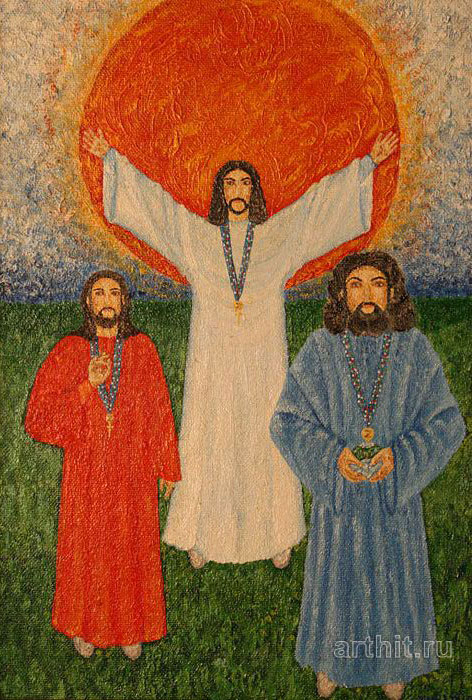
Today is Trinity Sunday, so we starting our series with the heart of Christian theology - the Trinity. To help us get started on the right foot, I want us to read one of the most important Biblical texts on the Trinity:
Matthew 28:16-20.
16 Then the eleven disciples left for Galilee, going to the mountain where Jesus had told them to go. 17 When they saw him, they worshiped him—but some of them doubted!
18 Jesus came and told his disciples, “I have been given all authority in heaven and on earth. 19 Therefore, go and make disciples of all the nations, baptizing them in the name of the Father and the Son and the Holy Spirit. 20 Teach these new disciples to obey all the commands I have given you. And be sure of this: I am with you always, even to the end of the age.”
Thomas Oden says that all Christian theology is basically an extended commentary on our baptisms. We are baptized in the name of the Father, the Son, and the Holy Spirit, and then we spend the rest of our lives trying to understand and to live what that means.1
To be honest, I have kind of a love-hate relationship with the theological concept of the Trinity. Don’t get me wrong. I love the Trinity - God. And on one hand, I love thinking about all of this deep stuff. I love thinking about the inner workings of the Trinity, how the Father loves the Son and the Son loves the Spirit, and how there are diversity and hospitality in the heart of God. But, on the other hand, sometimes, I have a hard time with the doctrine of the Trinity. I wish we had something easier. I wish it was easier to explain God and to understand God. As someone, whose job includes a lot of explaining God, something easier than the Trinity would be ... easier.

To continue reading this post, click here.
.
Wednesday, June 15, 2011
Summer Goals

This quarter, I asked each staff member to highlight one ministry skill they especially want to develop this summer. Each of us also highlights one goal as the single most important goal for the quarter.
Also, in addition to the goals each staff member sets, I also give them a few of my own goals for them. This summer, I'm asking every pastor to take a spiritual retreat of at least 24 hours. To be fair, I also give the staff the chance to review my progress and to suggest some goals for me.
Here are my goals for the summer.
This summer, I want to focus on regrouping and recouping. I have been stressed and very busy for about 9 months. I want to take extra time this summer to think, to reorganize, and to pray about the future of our church. Toward this end, I'm limiting my goals to the bare basics.
Improvement Focus Goals:
- Finish at least one long term task each week. (I've been avoiding lots of important but not urgent things.)
- Resist new projects and new ideas that take a lot of time. (In order to recoup and regroup, this is my single most important goal for the summer. If I fail here, I won't be able to do the recouping and regrouping.)
- Spend extra time in prayer and reflection (especially Monday Think/Pray days).
Other Goals:
- Volunteer in children’s church once.
- Go to a teen social activity.
- Take one long retreat 3-4 days in July. (Plan it by June 17.)
- Meet with 2-3 Korean leaders outside our church to discuss an important cultural issue.
- Priority Long-term goals (See #1 above.)
- Clean and reorganize office.
- Read a book about multiple staff congregations, size change in congregations, and/or staff evaluations.
- Help Cheonan Migrant Shelter find more funders/partners.
- Work with Christian Education and Worship Planning teams to plan strengths quest - for at least AC.
- Read about Nazarene organic church network.
Goals from Staff Pastors:
- Call each staff member once a week to see how they are doing.
- Give extra care to x, x, x, x, x (people in our church, but I won't publish their names).
- Talk with leaders about possibly adding a children’s group for small children.
Tuesday, June 14, 2011
Korea Tip 111: Take Off (국가대표) - Review
 국가 대표 (Korean for "National Team") goes by the English name "Take Off." Both are reasonable titles, since it is about Korea's first Ski Jump National Team.
The basic storyline is that Korea is making a bid to host the winter Olympics. However, on their previous bid, one of the disqualifying factors was Koreans' lack of interest in winter sports. This time around, they try to remedy that problem in part by building a national ski jump team. However, the sport is so dangerous and so new that they can only gather various misfits and screw-ups. The basic story of the movie is how this group of young men (and their over-the-hill coach) learn the art of ski jumping and - in the process - come into their manhood.
Although I'm not a big fan of the movie overall, I did appreciate a few parts.
First, hosting the winter Olympics is a longstanding unfulfilled dream for Korea. PyoungChan still ramps up their Olympic hopes every few years, only to be dashed again and again. This movie touches on how far Korea will go to host that major event.
Second, the father-son relationship of one of the team members gives a good look into the tension Korea has between traditional success and alternative personal expressions (like sports and arts). For many parents there is only one path to success: academics and making money and business. However, Koreans also have a deep national pride and a corresponding desire for international fame and recognition. These two conflicting desires naturally lead to conflict at home for many would-be athletes or artists.
Third, despite all the cheesy-ness and downsides, the team basically succeeds. They become successful ski jumpers, earn a place in the national pride, and get a second chance at manhood.
However, two glaring plot weaknesses basically ruined the movie for me. Both of these are total spoilers, so be forewarned.
First, the lead character joined the national ski team to claim his moment of fame and find his birth mother (who gave him up for adoption at around age 6). His plan is to earn enough money ski jumping to buy her an apartment. The first part of his plan succeeds; he finds his mother. However, shockingly, he walks away from her because he is not able to provide an apartment for her. Maybe this is a cultural thing. I know Koreans really like melodramatic story lines. But this seemed completely pointless and gave me a sour taste for the whole movie. (On the other hand, perhaps this is also a bit of cultural insight into Korean culture regarding the deep importance of providing for the material needs of the family.)
Second, the national team's substitute ski jumper is one team member's mentally challenged little brother. They rationalize this ridiculous proposition by saying that he'll never have to jump. However, when one team member (the older brother) is injured, they talk the little brother into jumping for the sake of national pride. This gave me a sick feeling inside. I want to give the movie a little grace as they created an unrealistic scenario to develop the plot, but this was blatant reckless endangerment, and I couldn't get past it.
So, unfortunately, we didn't really enjoy the movie. On the other hand, I would say it could still be worth a watch for the cultural content. The Josh rating: JJ.
(Sorry W.)
Pentecost - Fire, Wind, Water

Today is Pentecost Sunday. In Korean it is SoungNyoung GangNim Jeol - the commemoration of the Holy Spiritʼs coming. Today, we are going to take some time and talk about some of the symbols of the Holy Spirit which were active on Pentecost Sunday. With each symbol, weʼll read some of the most important texts for that image of God.
First is fire. Fire is a symbol of the Holy Spirit. [We lit a fire in a barbecue pit. Unfortunately, the wind was against us, so I had to move the pit way off to the side to keep the smoke out of people's eyes. Ah, the plans of mice and men.]
Malachi 3
1 “Look! I am sending my messenger, and he will prepare the way before me. Then the Lord you are seeking will suddenly come to his Temple. The messenger of the covenant, whom you look for so eagerly, is surely coming,” says the Lord of Heaven’s Armies.
2 “But who will be able to endure it when he comes? Who will be able to stand and face him when he appears? For he will be like a blazing fire that refines metal ...
To continue reading this post, click here.
.
Ashes to Fire - Review
On Patrick's suggestion, we started up a new small group working through the Ashes to Fire devotional guide produced by Nazarene Publishing House. The basic concept is that the whole church moves on a collective spiritual journey from Ash Wednesday (through Lent and Easter) all the way to Pentecost. To compliment the devo guide, there are lots of other resources: a 14 week worship service guide, a DVD with lots of digital support tools, 16 original songs, and resources for children.
Our church got into Ashes to Fire a little late, so we just had one small group working through the curriculum. But we're probably going to try to do the whole thing as a church next year.
Here are some of the things I liked most.
Our church got into Ashes to Fire a little late, so we just had one small group working through the curriculum. But we're probably going to try to do the whole thing as a church next year.
Here are some of the things I liked most.
- Far and away, my favorite part was the daily devotional. Each day there were morning and evening prayer and Bible guides. When I was busy, I would just read the prayers and summary verses. But when I had time, I would read through all the Bible selections. I appreciated using a guide for the Bible reading, and I liked having it relate to the church season.
- Still related to the devotional, I enjoyed the prayers from John Wesley or the Book of Common Prayer. I often felt like they put words to my actual desires for that day.
- Each devotional also included a quote - often from a church father (or mother). It was great to live in historic community with those who have gone before us.
- I liked the small group discussions. In fact, our group has already chosen another book and plans to continue meeting. I'm hoping that next time around, we'll be able to use the momentum from Ashes to Fire to start several new small groups.
- I really liked some of the songs on the CD - especially the ones for the Lenten season.
- Once a week there is a 2-3 page devotional on the gospel text. Some of these were good. Others were pretty weak. For our somewhat skeptical book, the cheese-factor here lessened their resolve to participate in the daily prayer guides as well.
- The daily quotes from church history could stand some improvement, (a) More women, (b) include the approximate date of the quote (Most people have no clue when Gregory the Great lived.), (c) Make the quotes more connected with the readings (Sometimes, they seemed kind of random.), (d) Stay with the ancient writers for these quotes. (It adds to the flavor.)
- Provide the lyrics for the CD. I couldn't even find out who wrote or performed the various songs. (Also, sheet music would be very important for incorporating some of these into our worship services.)
- Improve the promo videos. We'll need something better to help us promote this within our church.
Tuesday, June 7, 2011
Korea Tip 110: Doctors in Cheonan

Also, some hakwon bosses have shady deals with doctors. Amazingly the doctors always prescribe a coctail of medicine and say that you're still OK to work. Never mind that you've got it coming out both ends. But finding an independent point of view can be difficult if you don't know where to start.
Here are some tips for the Cheonanites out there.
No need to be a cowboy (or cowgirl as the case may be). Make your way to SsangYong Medical to speak to Dr. Ko. She is kind and speaks English very well. A word to the wise. Unless you request something different, in typical Korean fashion, she will prescribe you three days of a rainbowed cocktail of pills in little packets. However, if you ask, she will: (a) give you a prescription for a week or two (or longer for standard medications, like my allergy stuff), and (b) explain each pill she is prescribing - even to the point of showing you a picture of it on her computer. SsangYong Medical is near the SsangYong McDonalds (between Korea Nazarene University and Lotte Mart). From the McDonalds, walk toward Lotte Mart. Take the stairs after Paris Baguette to the second floor.
Also, if you have a more intense issue and need a specialist, SsangYong Medical is still the place to start. Just go in and explain your issues to Dr. Ko. She will write up a referral and help you make your appointment with the specialist. This is hugely helpful in getting past the secretary's desk - especially because many of the specialists tend to be in large amoeba-like university hospitals.
Put those pliers away, and go see a dentist. Nero Dentistry (just above SsangYong Medical) is a fully bilingual dentist office. The head dentist studied in the USA. The place is kind, clean, and totally legit. When I took my daughter in for a check up, he looked us both over, and since we didn't need any work, he sent us home for free. They'll also send you a reminder text for your follow-up appointment.
For women's needs, the easiest place to find is Ehwa Hospital - also in SsangYong Dong. It's between SsangYong Subway Station and E-Mart. They have a few OBGYN's who speak English well. Doing a cold-call might be intimidating, so you might want to have a Korean call first and help you figure out exactly when and where to go.
One more tip, most Korean doctors offices (with the exception of very busy specialists) don't work on an appointment basis. Everything is just walk in. Just bring a book, show up, and be prepared to wait anywhere from 5 to 30 minutes.
Happy Healing.
Subscribe to:
Posts (Atom)