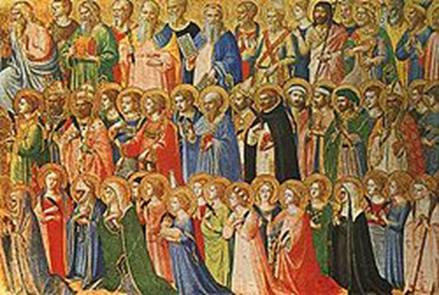
Today is All Saints Day - a day to remember people who have followed Jesus especially well. Nazarenes donʼt usually celebrate All Saints Day, but weʼre missing out. All Saints Day is an important part of Christian tradition, and it was actually John Wesleyʼs favorite day of the church year. All Saints Day is a great opportunity for us to remember the “great cloud of witnesses” who have gone before us (Hebrews 12:1).
Listen to how John the Revelator describes this great crowd in his vision of heaven in Revelation 7:9-17. 9 After this I saw a vast crowd, too great to count, from every nation and tribe and people and language, standing in front of the throne and before the Lamb. They were clothed in white robes and held palm branches in their hands. 10 And they were shouting with a mighty shout,“Salvation comes from our God who sits on the throne and from the Lamb!” 11 And all the angels were standing around the throne and around the elders and the four living beings. And they fell before the throne with their faces to the ground and worshiped God. 12 They sang, “Amen! Blessing and glory and wisdom and thanksgiving and honor and power and strength belong to our God forever and ever! Amen.” [3] 13 Then one of the twenty-four elders asked me, “Who are these who are clothed in white? Where did they come from?” 14 And I said to him, “Sir, you are the one who knows.” Then he said to me, “These are the ones who died in the great tribulation. They have washed their robes in the blood of the Lamb and made them white. 15 “That is why they stand in front of God’s throne and serve him day and night in his Temple. And he who sits on the throne will give them shelter. 16 They will never again be hungry or thirsty; they will never be scorched by the heat of the sun. 17 For the Lamb on the throne will be their Shepherd. He will lead them to springs of life-giving water. And God will wipe every tear from their eyes.”
There will come a time, when we will stand with the saints from every tribe and language and culture and time - all those who have ever trusted in the Jesus as the Lamb of God. Together we will sing praises to God. We will be one people, healed together by his love.
All Saints Day is a day to practice this corporate worship and unity now - here on earth. We stand today with the saints of Africa, Asia, Europe, Oceania, and the Americas. We stand today with the saints of the first humans, the first Israelites, the first Christians, the Middle Ages, the Reformation, the Industrial Age, our own time, and all times yet to come. Together, we are Godʼs people. Together, we worship him. Together, we learn what it means to follow him.
Today, as part of our study of our Nazarene Heritage, we are focusing on the two most important saints in our history: John Wesley and Phineas Bresee. As we talk about these two leaders and how God used them, my prayer is that we will catch some of their passion and let God use us in similar ways.
As part of an effort to reconnect with the founders of our tradition (in the Church of the Nazarene), I’ve started reading through some of the works of Phineas Bresee and John Wesley. Phineas Bresee started the first church to bear the name “Church of the Nazarene” in the late 1800‘s, and he was a key mover in the mergers of 1906 and 1908 which pulled together the various “holiness” groups around North America into one unified body, which also took the name Church of the Nazarene. (Actually the first name was “The Pentecostal Church of the Nazarene.”)
In the winter, we were preaching through the Sermon on the Mount, so I read Bresee’s Sermons from Matthew's Gospel, most of which is based in the Sermon on the Mount. I mixed reading it as my devotions and reading it as sermon study, when the texts overlapped. Here are a few things I learned by reading this book.
About half of Bresee’s sermons were not expository, and might not pass the muster with some modern fundamentalists. About half the time, he picked a small text (1-2 verses) and then went off on a topical tangent. It was all good stuff - don’t get me wrong - but it wasn’t an exegesis of the text.
Bresee reminded me again that it is possible to blend social justice and the traditional evangelical emphasis of personal transformation through Christ. I think I always knew this, but reading his sermons encouraged me to keep making personal transformation an important part of my preaching.
Bresee might not be so popular in many churches today. For someone who preached at the turn of the century, he was a surprising mixture of liberalism and conservatism. On one hand, he was a prohibitionist. On the other hand, he affirmed female preachers. On one hand, he was firmly committed to the primacy of personal transformation, which empowers even the most unlearned with Spiritual Power. On the other hand, he affirmed the need for the highest level of scholarship. On one hand, he was firmly committed to the Church as an institution. On the other hand, he was deeply critical of the common shape of the Church in his era and was deeply open to structural and stylistic changes.
Reading Bresee encouraged me to view sermon crafting as an art. He employs beautiful images and well-shaped phrases. He clearly invested great time and care into his sermons.
Although some of his words or points seem a bit out dated, I see much in Bresee that I want to emulate. I hope to find more of his works to read. The Josh rating, partly because of its own merit and partly because of its value to anyone in the Nazarene tradition: JJJJ.
The first thing for us to notice here is that Jesus called his disciples to follow him “to the other side of the lake.”This meant that they were leaving the Jewish territory and going into the Gentile territory.This is the first time in Matthew that Jesus has taken this radical step.
When the first guy says, “I’ll follow you wherever you go,” he probably means – even into Gentile territory.“Jesus, anywhere you go, I’ll go, even into the dark and dirty places of our world.”
Jesus responds to this guy and to the next guy with two difficult sayings.We could talk all day about what these mean, but the basic point is very simple: discipleship is not easy.Following Jesus is not easy.It involves sacrifice, and it challenges our basic perspectives on life.Jesus says, “If you want to follow me, follow me now.Don’t wait.Even if the road is difficult, even if it turns your life upside down, follow me.”
Not long after they started their journey across the lake or sea of Galilee, a storm came up.When Matthew says there was a “storm,” he says it was a seismos megas.This is the same word for “earthquake.”This was a mega-earthshaking-storm!The front of the boat is literally covered up by the waves.Now, remember, at least some of the disciples are professional fishermen.They have been through storms before, but this storm was freaking them out.
But there’s Jesus in the back of the boat, catching up on some sleep after a hard day of work.There’s an earthquake-like storm going on, the disciples are scared to death, and Jesus is snoozing on a pillow.
The disciples cry out: “Lord save us!We’re going to drown!” (Mt. 8:25).In Mark’s version of the same story, they say, “Teacher, don’t you care that we’re going to drown?” (Mark 4:38).
When I started thinking about this, I remembered that other people in the Bible felt like God was asleep when they needed him most.
nWhen the people of Israel had been taken into exile, they cried out: “Wake up, O Lord!Why do you sleep?Get up! … Why do you look the other way?Why do you ignore our suffering and oppression? … Get up!Help us!”(Psalm 44:23-36).
nWhen David was being attacked by an enemy, he cried out, “Arise, O LORD, in your anger; rise up against the rage of my enemies.Wake up, my God” (Psalm 7:6).
nIsaiah called out to God, “Wake up, wake up, O LORD! Clothe yourself with strength!Flex your mighty right arm!Rouse yourself as in the days of old” (Isaiah 51:9).
That made me wonder … when do we feel like God is asleep in our world?When do we feel like God has checked out of Hotel Earth?
nIn the movie Tears of the Sun, based during a crisis in Africa, a priest gives a blessing, “Go with God,” and Bruce Willis’s character shoots back, “God already left Africa a long time ago.”
nWhen I was in university, I met a Jewish scientist on a train.Yacov described himself as a secular Jew.When he saw a documentary on the Holocaust in elementary school, he became an atheist.He said to himself, “There is no such thing as God or the chosen people, or else this would not have happened.”
nIn the movie, Bruce Almighty, Jim Carrey’s character, raises his fist and shouts up to heaven, “The only one not doing his job around here is you!”
Don’t you feel like that sometimes?Where is God?Look at this mess our world is in.Where is God when children are dying of hunger?Where is God when people are killing each other because of religion? Where is God when we are destroying our air and water and plants for the sake of “progress”?Where is God when people are trapped in hopeless cycles of poverty?Where is God?Has God abandoned us?Is God asleep?
If video doesn't play, click here to watch it in its original context.
Maybe we need to ask a different question.Who is asleep in our world?God is not asleep. We are.According to Jesus, God is there with the suffering people, suffering with them.We are the ones who are sleeping. It’s like we are sleepwalking through life. We are living life, but we aren’t really awake to what’s happening around us.
I did a little research on sleepwalking this week.It seems that 18% of the world's population is prone to sleepwalking.[1]Sleepwalkers seem to be awake when they are up walking around, but they are actually still sleeping.Sleepwalkers do a wide range of things while they are sleeping: have a conversation, get dressed, go to the bathroom, clean the house, move furniture, cook, eat, drive a car, and even have sex.[2]
I know some of you are thinking, “How can I get my wife to sleep walk more?She’ll clean the house, cook breakfast, and have sex.This is great!It’s the perfect scenario for working moms, right?”
When I was in college, one of my roommates was a sleepwalker.One night I found him having a long conversation with a poster on the wall.
Sarah used to sleep walk when she was a girl.Once she dreamed that she was putting clothes in a laundry bin, and she woke up to find that she had thrown all of her sheets and blankets out her bedroom window.Another time, when Sarah was five or six years old, Sarah walked into her parents’ bedroom in the middle of the night.She walked up next to her parents’ bed, turned around, pulled her pants down, and sat down like she was using a toilet.Then, she got up and went back to bed.(No – in case you are wondering – she didn’t actually pee on the bed.)
Sleepwalkers do some crazy stuff.They are sort of half-functioning.Their minds are only half working.They are moving through life, but they don’t remember it, and they aren’t actually engaging with the real world.They are half-waking and half-sleeping.
Many of us go through life like this.We are only half-awake.We are sleepwalking through life.We go through the motions.We do OK at our jobs and with our families, but we are basically out of touch with the world around us.We are living, but only half-living.
We have faith, but we aren’t living it out.We’ve got this faith in Jesus, but it’s not shaping the way we live.We are sleepwalking through our world – having conversations with posters, saying things without meaning, and doing things that don’t make any sense.Our world is dying in the streets, and we are only concerned about what is happening in our living room.24,000 people die of hunger every day, and our churches are singing praise choruses and having debates about whether we should use paper plates or plastic plates for the fellowship dinner.
We need to wake up!We need to see the real world and start living in the real world.
Mad as Hell video:
(We will show a slightly edited version in church.)
Wake up church!It is time for some righteous anger – anything that will break us out of our status quo sleepwalking.I am so tired of church as usual.Imagine how our world could change if all of us around the world would wake up and start addressing the problems and opportunities of our generation.
It’s time for us to get angry: angry about wasting our time while the world is dying.It’s time for us to get hopeful: hopeful that we can actually do something about the world’s crises.It’s time for us to wake up!
Let’s wake up, church!Let’s be a church that wakes up!Let’s be a church where Jesus comes alive and starts changing the world!
That is why I’m still here.Over the past six months or so, I’ve been asking myself what is next for me.How long will I pastor this church?How long will we stay here?With so many poor nations in the world, why are we still here in the 11th richest nation in the world?So then, I started asking a different question.What is the best thing I can do for the world?If following Jesus means, actively working for the good of all people, like I said a few weeks ago, then how do I do that?For right now, I think the best thing I can do is to help this church wake up and engage our world, to help us open up to the life of Jesus in us, and to work with Jesus to address the crises of our world.
Discipleship is getting into that boat and facing the storms of human problems.We get into the boat, knowing that there will be storms, but also knowing that Jesus is with us and with them - and he is not asleep.My passion, for the next few years, is to help us live this out.Let’s be a church that wakes up!
What will it mean for our church to wake up?At the very least, it will mean that we will start to do things differently.We will try out new stuff.We will do stuff that most churches don’t do.We will get engaged in our world, and we let God change our world – one life, one community at a time.
What does it mean for you to wake up?First of all, we all need to ask ourselves a basic question: “Am I doing the right thing with my life?Am I working the kind of job God wants me to work?”Does God really want you to be teaching English or working in the business world, or does God want you to engage more directly in the pain and struggle of our world?
After that question, we need to ask a different question: “If this is the job that God wants me to have, how can I wake up while I do this job?”
If God wants you in business, how can you use your business influence to help people in developing nations pull out of poverty?How can you reduce environmental pollution and waste in your business?
If God wants you in science, how can you use those scientific skills to engage the problems that affect the poorest people in our world?Get a government grant and start helping people!
If God wants you to be a teacher or a student, how can you help your class and your school wake up to the world around you?Maybe you’ll ask them to become pen-pals or e-pals with students from a developing nation.Maybe you’ll teach lessons or write papers on the crises of our world and how we can help.Maybe your school will collect supplies for a school in a developing nation.
When Jesus calmed that storm, the disciples were amazed.They looked at Jesus and said, “Who is this man?Even the winds and the waves obey him?”
If we wake up and enter the storms of our world with the power of Jesus, (feeding the hungry, healing the sick, eliminating poverty, setting addicts free, educating the hopeless), people will look at us in awe, and they say, “Who are these people?Poverty and hunger and hatred disappear wherever they go.”
Here’s the deal:God is inviting us on a wild ride.If we get into this boat with Jesus, there will be a seismos megas for us – a big earth-shaking storm.Our world is going to get shaken up.Following Jesus into the storms of our world will change everything for us.
We are like the two guys standing on the side of the beach.We sing our praise: “Jesus’ I’ll follow you wherever you go.”
Jesus says, “This isn’t an easy trip.It will rock your world, but that’s a good thing.Your world needs a good shaking, so come on!Follow me!”
The Bible never tells us what happened to those two guys standing on the shore.We don’t know if they got into the boat or stayed on the shore.
What about you?
Are you going to stay on the shore where it’s safe and sleepy?
Or will you get in the boat with Jesus where life is wild but real?
“Do to others whatever you would like them to do to you” (Matthew 7:12).Without a doubt, this is the most famous thing Jesus ever said. This short saying earned the title “The Golden Rule” when Roman Emperor Alexander Severus had this rule written on his wall in gold.[1]
Let me give you a short quiz on the Golden Rule. I call this Elevator Ethics.
Question 1:You are on an elevator with several other people.Someone you don’t know gets on.He’s wearing one of those plastic nametags showing that he’s participating in a conference of some kind.He also has a long piece of toilet paper trailing from his shoe.The elevator door opens at his floor.What do you do?Do you tell him?Do you just let him walk out into the crowd of people?
Question 2: You are on an elevator.Earlier in the day, you had a wonderful but very spicy lunch.The spices are beginning to work through your system.You can feel your stomach rumbling.You try to hold it in, but suddenly you pass gas right there on the elevator.It’s one of those silent-but-deadly types.Everyone is making faces, and people begin to point to the slightly overweight, poorly dressed man standing next to you.Everyone thinks it’s him.What do you do?Do you speak out and take the blame, or do you walk away the as the secret farter?
Question 3:You are on an elevator, and a young woman gets on the elevator with a very cute T-shirt that has an offensive English phrase on it.This has actually happened to me.One of my theology students wore a shirt with a picture of a motorcycle and the words, “I wish my boyfriend was as dirty as my bike!”[2]No kidding!What do you do?Do you try to explain that the shirt is not so good?Or do you let her walk on in ignorant bliss?OK, we all know what Patricia would do, but what would you do?
How do we apply “The Golden Rule” in these situations?Is this what “The Golden Rule” is all about?
In the generation just before Jesus, there were two famous Jewish rabbis: Shammai and Hillel.Once, a Gentile man went to Shammai and said, “I will convert to Judaism, but I have one condition.You must teach me the entire Jewish law while I am standing on one leg.”Shammai was so angry that he beat the guy out of the area with a stick: “Heathen!Gentile!How dare you insult the Law of Yehovah!”
Later, the same guy went to Hillel and said the same thing: “I will convert to Judaism, but first you must teach me the entire Jewish law while I am standing on one leg.”Hillel said, “What is hateful to yourself, do to no other; that is the whole law, and the rest is commentary.Go and learn.”[3]
Jesus seems to agree with Hillel.As Jesus closes the Sermon on the Mount, he gives a one line summary his whole sermon: “Ask yourself what you want other people to do for you, then grab the initiative and do it for them.Add up God’s Law and Prophets and this is what you get” (Matthew 7:12).
That is very close to what Rabbi Hillel and many other ethical teachers have said.However, Jesus’ statement is different in several important ways.
First of all, Jesus’ statement is positive: “Do to others whatever you would like them to do for you,” not just “Don’t do what you don’t want done.”This might seem like a small difference at first, but it turns into something big.
A negative ethic – a philosophy of not doing harm – is very limited.It is focused on the do-not’s.It is enough not to steal; we are not required to help someone who has been robbed.It is enough not to commit adultery; we are not required to give assistance to prostitutes or to help people escape from addictions.It is enough not to hurt someone; we do not have to help those who are hurt by others.
A negative ethic is all about avoiding sin and avoiding evil.It isn’t about actively being good or doing good for anyone.We tend to live a negative ethic.We go our way and live our own life and try not to hurt people and try not to make the world any worse, but we do not go out of our way to make the world radically better.
Jesus says simply: “That is not enough.”Goodness involves real action.Goodness involves actively doing good things, not just passively avoiding wrong things. The way of Jesus is to actively work for the good of all people.
Jesus’ Golden Rule is different in another way.It is unlimited.The Greek actually says: “Everything whatever that you would like others to do to you, you yourselves do to them.”Everything whatever!In every last thing!Always and at all times!In every situation, in all your actions, in everything you do, from the big stuff to the little stuff, do it all as you would want someone else to act toward you.This is unlimited.
Jesus’ Golden Rule is also unlimited in scope.We normally interpret this rule to mean that we should be nice and kind to the people around us – Elevator Ethics.But Jesus doesn’t limit this to people near us.Jesus says, “Every last thing you want people to do to you, do the same things for them.”People are all over the place, all over the world, not just in our neighborhoods.This is getting more radical.The way of Jesus is to actively work for the good of all people.
Jesus says, “This IS the law and the prophets.” Everything written in the Law of Moses, every word from God spoken by Isaiah, Jeremiah, Ezekiel, and all the prophets, every command, every promise, every warning – they all come down to this: “In every last thing, work actively for the good of all people.”
Then, Jesus warns us about people who talk big and act big but don’t live up to this Golden Rule (Matthew 7:13-23).Jesus says that simple unselfishness counts for more than big miracles or great church programs.You can tell if people are good or bad by their actions.
Are they just living Elevator Ethics, being polite and maybe even generous on occasion, but basically looking out for themselves?Are they involved in church, do they know all the Bible answers, do they smile and say Amen, and then go out and live their lives as if no one else really matters?Those are the fakes.They are rejecting God’s way in their daily lives.They’re going into the fire.
Are they actively working for the good of all people?Are they thinking about how they live and how they interact with the world?Are they asking how they can help the people who most need their help?Are they taking action based on these questions?Those are the real people.They will be welcomed into the Kingdom of Heaven because they are already living God’s way in their daily lives.
Jesus concludes his sermon with a famous parable.There are two builders.The smart guy builds his house on the rock, and his house stays strong even when the storm comes.The stupid guy builds his house on the sand, and when the storm comes, his house falls down in a mighty crash.
What’s the difference between the smart guy and the stupid guy?Only one thing.The smart guy actually lived Jesus way, and the stupid guy listened to Jesus but kept living his own way.
When we keep this parable in the context of the overall Sermon on the Mount, we get a startling message.Remember, Jesus’ summary of all his teaching (and all of God’s teaching ever) is very simple: In every last thing,actively work for the good of all people, just like you would want them to work for your good.
So, the smart guy did this.He built his life on these words.He actively worked for the good of all people in every last thing he did.And he experienced God’s true life.
But the stupid guy didn’t do this.He was a good listener, but not a good doer.He listened to Jesus, and then went his own way, maybe being a nice guy, but generally ignoring the needs of others.In the end, his life came crashing down around him.
A paraphrase from The Message, helps us apply this to our lives: “But if you just use my words in Bible studies and don’t work them into your life, you are like a stupid carpenter who built his house on the sandy beach.”Going to a Bible study doesn’t do much good unless we actually live what Jesus says.
Rick Warren, author of The Purpose-Driven Life, says that in his church, at the beginning of every small group Bible study, the group checks to see if the people actually lived out what they studied last week. If most people didn’t put it into practice, they stop right there and talk some more about how to live out what the Bible is talking about.They don’t study another chapter until most people in the group can honestly say that they are putting into action what they studied the week before.[4]
How would that change your Bible study?How would that change our church?How would that change our world?
“Don’t just listen to God’s word.You must do what it says.Otherwise, you are only fooling yourselves.For if you listen to the word and don’t obey, it is like glancing at your face in a mirror.You see yourself, walk away, and forget what you look like.But if you look carefully into the perfect law that sets you free, and if you do what it says and don’t forget what you heard, then God will bless you for doing it” (James 1:22-25).
What is this “perfect law that sets you free”?Jesus says it very simply, “In everything, do to people whatever you want them to do to you.”In every last thing, work for the good of all people.
You and I might say: “But this is very hard.Everything is … well … everything!And that’s a lot.And all people … well … there are a lot of people.There are a lot of people in our world with a lot of needs, a whole lot of needs, starving people, poor people, sick people.There’s a lot of people.It’s one thing just to not hurt them, but to actively work for their good in everything I do?Well, that would take … my whole life!It would be … um … hard!”
Exactly!It will take your whole life.It will be hard.“Don’t look for shortcuts to God. … The way to life – to God! – is vigorous and requires total attention.” (Matthew 7:13-14, The Message).“You can enter God’s Kingdom only by the narrow gate.The highway to hell is broad, and its gate is wide for the many who choose that way.But the gateway to life is very narrow and the road is difficult, and only a few ever find it” (Matthew 7:13-14).
The way of Jesus is actively working for the good of all people in everything we do.This is hard!Let’s not pretend.It’s difficult.In fact, sometimes it will even feel like dying.That’s why Jesus talked about taking up your cross and giving up your life.This is the way of the Kingdom.This is the way of Jesus.With all of our life, we actively work for the good of others.We give our lives for those who most need our help.This is the way of Jesus.
This way leads us to the cross, to our own cross.But it is only possible because of the cross of Jesus, and even more, the resurrection of Jesus.Today is Easter, and today we celebrate that Jesus lived his own philosophy.He actively worked for the good of others wherever he went, and in the end he gave up his life for the good of all people.Jesus paid the highest price so that he could share with us the highest good – new life, God’s life, the Holy Spirit of God living and breathing in us, giving us the power to live in new ways, helping us to love our neighbors as ourselves, giving us the imagination and the determination to work for the good of all people.Through Jesus’ life, death, and resurrection, God is creating a new world in us and through us.
Easter is the day of global transformation.And this global change starts with the local action of one changed life.One person dies and experiences new life with Jesus.One person actually shapes his life around Jesus’ teaching: in every last thing, do what you want others to do for you.This local change starts what Shane Clairborne calls an Irresistible Revolution.
Our death is our life.Our unselfishness is the best thing we can do for others and ourselves.The Dalai Lama said, “If you want others to be happy, practice compassion. If you want to be happy, practice compassion.”[5]Jesus said, “If any of you wants to be my follower, you must turn from your selfish ways, take up your cross and follow me.If you try to hang on to your life, you will lose it.But if you give up your life for my sake, you will save it.And what do you benefit if you gain the whole world but lose your own soul?Is anything worth more than your soul?” (Matthew 16:24-26).
Easter is the day of resurrection.Easter is the day that we lay down our lives again and experience Jesus’ resurrection again.
The way of Jesus is to actively work for the good of all people.Elevator ethics is not enough.This is a life or death choice.What do you choose?
[1] Michael J. Wilkens, Matthew, NIV Application Commentary, (Grand Rapids, MI: Zondervan, 2004), 313.
[2] This is a “double entendre.”The word “dirty” has a second meaning relating to immoral sexuality.
[3] William Barclay, The Gospel of Matthew, (Louisville, KY: Westminster John Knox, 2001), 315.
[4] Rick Warren, The Purpose Driven Church – International Conference, Seoul, South Korea, 2006.


 , most of which is based in the Sermon on the Mount. I mixed reading it as my devotions and reading it as sermon study, when the texts overlapped. Here are a few things I learned by reading this book.
